


News & Updates


Political Power has gone local! Dr Nick Smith, mayor of Nelson and ex-National Party minister, is an early adopter when it comes to electric machines but, through his efforts with the council and his close involvement with the Ratepayer Assistance Scheme, he's also embracing one of Rewiring's core mantras: once you've electrified your own life, electrify someone else's life, too.
Whether it's the growing number of electric buses, new electric trains for the lower North Island and City Rail Link, or new electric ferries, we love seeing more electric transport options in our big cities. It's also good to see some of our smaller cities like Palmerston North, Timaru and Nelson going electric and, as is almost always the case, the drivers reckon it's better on electrons. At the Electrify Nelson expo, we spoke with one driver Lee about the city's electric buses. And he definitely wouldn't go back to diesel.
Labour's Jo Luxton, a list MP contesting the East Cape electorate, is next up on our Political Power series, and she's a fair way down the electric path.
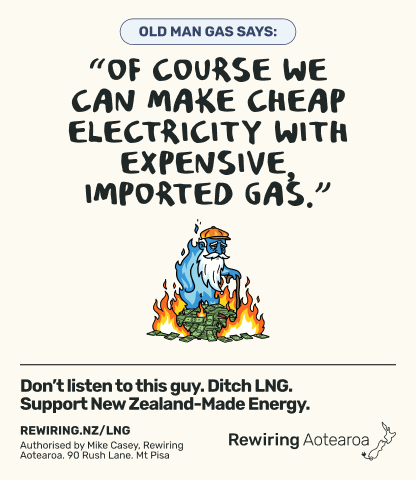
Old Man Gas will be featuring in a few newspapers and billboards this week discussing the proposed LNG import terminal. Not surprisingly, he has his justifications, but they don't stack up. It is a multi-billion dollar tax on Kiwis that many experts and sector players think is unnecessary.
.png)
"The sentiment around making the electricity market fairer and cheaper for customers is great, but there's still something missing." That's Rewiring Aotearoa CEO Mike Casey's summary of Act's energy policy announcement today.

ACT will open electricity networks to competition, give New Zealanders more freedom to generate and sell power, and make monopoly lines companies prove consumers are getting value before loading more costs onto their power bills, says ACT spokesperson for Energy and Resources Simon Court.
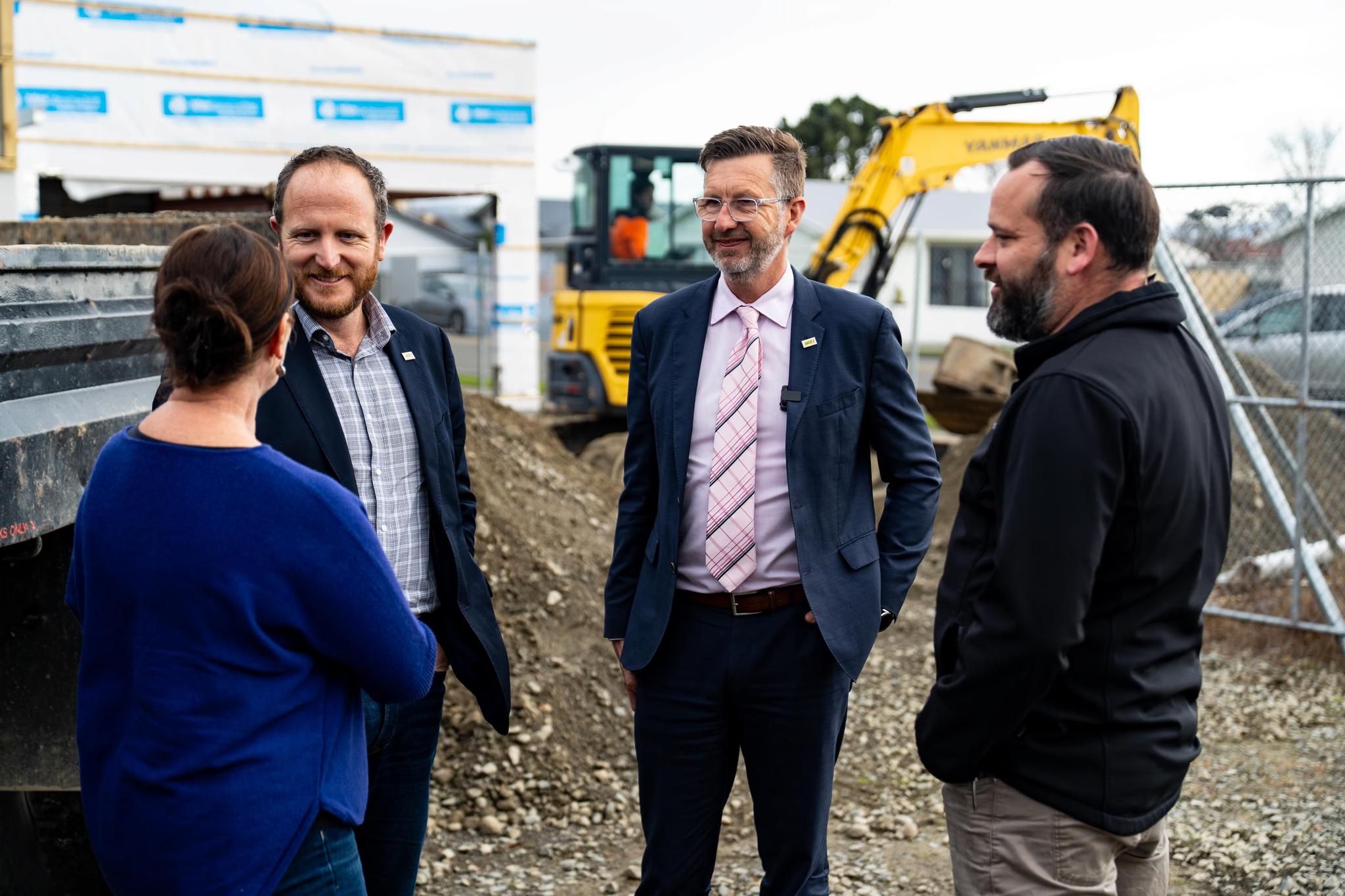
ACT is pledging to keep the gentailers whole and use market forces to curb the costs of lines management and increase solar repayment rates. Energy spokesperson Simon Court announced the party's electricity policy at Parliament on Friday afternoon.

The City Rail Link adds another electric string to the bow of Auckland, which is growing its public transport services and reducing operating costs while reducing emissions; you'd have to really hate saving money to buy a diesel van if you're a courier; Bob the Builder is back after a bit of a break to front a campaign about the need for workers to install solar, batteries and electric upgrades; another pilot in Australia aims to make it easy for Canberrans to go electric; and boating is going electric 'faster than you think'.

Te Pāti Māori has announced its energy policy, which it hopes will lower power costs for whānau and reduce New Zealand’s dependency on fossil fuels. The policy's centrepiece is an energy sovereignty fund, which will see Te Pāti Māori establish a $1 billion fund to “build Māori and community ownership of the energy system”.
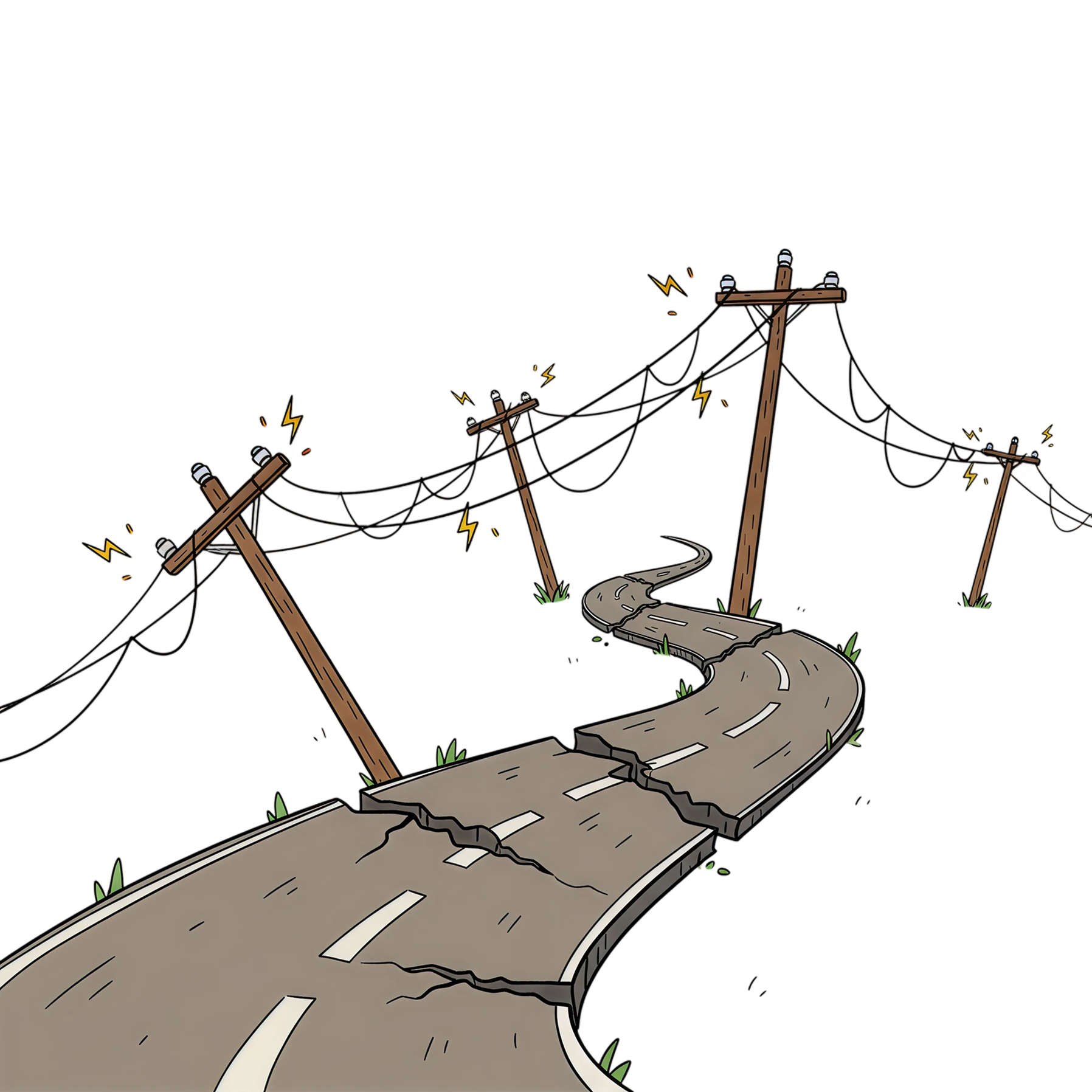
People installing solar power systems with batteries on their homes, hoping to avoid the disruption of a power cut, are being told to check with the installer that the battery can provide that protection.
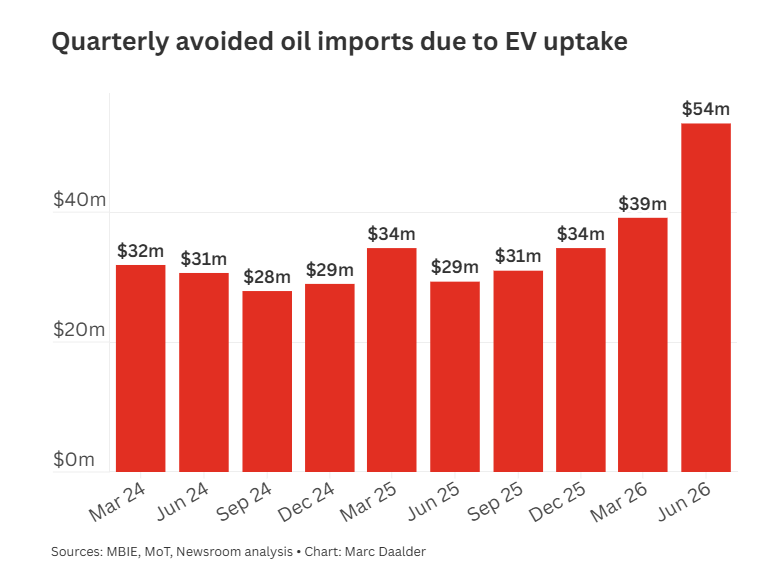
Whether you think subsidies are justified or not often depends on whether the goal is deemed worthy. One man’s subsidy is another man’s tax. And one man’s tax break, low-interest financing scheme or industrial policy intervention is another man’s subsidy. Government support can either keep the old world alive or give an uneconomic new option an unfair advantage. But there's a pretty good argument for subsidising EVs in New Zealand, as Marc Daalder explained in Newsroom.
Kiwis are catching on to the benefits of solar panels - and demand's spiking ... But the industry warns we need about six thousand more trained electricians - across the country - to do the work. Rewiring Aotearoa Chief Executive, Mike Casey told Heather du Plessis-Allan he hopes interest will continue over time. He says oil shortages because of the Iran war is keeping demand high - with energy prices climbing. He says solar is the one reprieve Kiwis get.
Roger Robson-Williams owns 20% of New Zealand's electric tractor fleet. That sounds impressive, until you learn there are only five of them. But, like his fellow electric tractor enthusiast Mike Casey, he's on a mission to change that by providing a bit of inspiration and information.

Your power bill is set to keep rising, in part because of how electricity distribution businesses (EDBs, also known as lines companies) are run and regulated. EDB spending is expected to be one of the biggest factors in increasing bills in New Zealand’s electricity system over the coming years, as it has been in the last few years. The Ministry of Business, Innovation & Employment (MBIE) is now asking what should change. This is a consequential energy consultation and we are encouraging you to submit to ensure the voice of the community is heard. If Government gets this wrong, your bills will be higher for decades to come. If Government gets this right, your bills could be lower. Submissions are due 5pm Friday 30 September 2026.
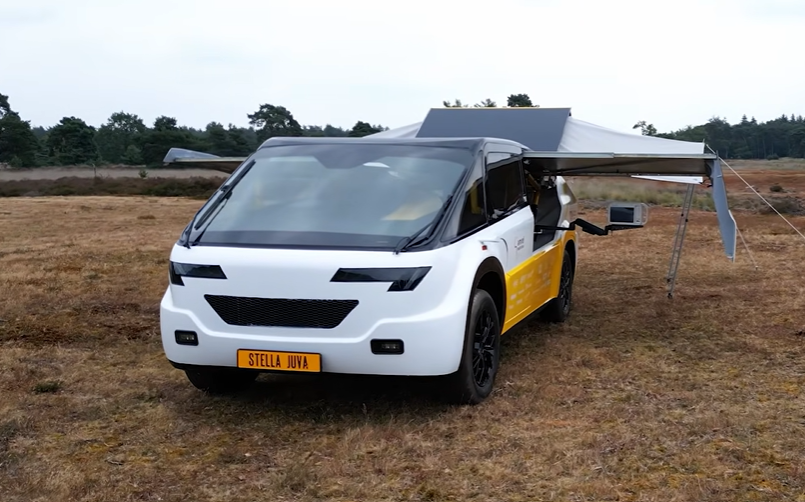
New Zealand has lots of renewable electricity, but still uses lots of expensive imported energy; commercial kitchens in the UK are are turning down the heat (and the toxins, and the costs, and hassle of cleaning gas hobs) by going electric; new research shows plenty of young'uns think petrol cars are akin to a landline; a solar-powered ambulance designed by Dutch students brings some 'medisun' to remote areas; 'Pic's Peanut Butter partners up with FTN Motion for a special electric motorbike; and a great website that helps us appreciate the abundance that's all around us (and the things that could be entirely normal soon).
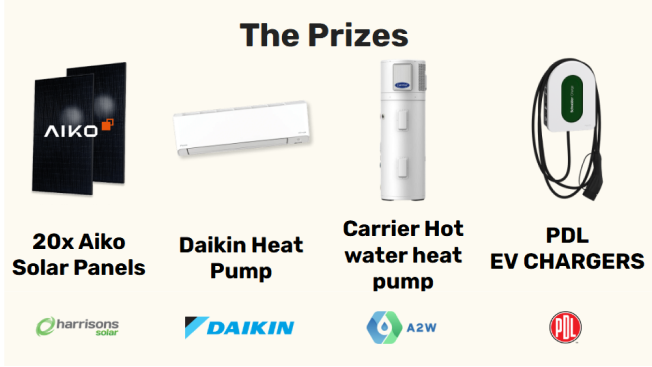
Congratulations to the winners of our tour prizes from Harrisons Solar, Daikin, Schneider/PDL and A2W.
.png)
Is a bigger solar system always better? That's the question that RNZ's Susan Edmunds posed and, as her story shows, the answer is 'probably'.
For our latest episode of Political Power, Labour's Nelson MP Rachel Boyack tells us about her own electric life and the increasingly electric life of the place she's representing.

Opportunity will establish a $1 billion Industry Energy Resilience Fund so New Zealand businesses can switch away from fossil fuels faster, cutting emissions while strengthening energy security and reducing costs.

Australia reaches a milestone in August, with more new electric cars sold than petrol cars; another new study shows EV batteries last longer than the myths have made out; Heart Aerospace sends the world's heaviest electric plane skywards; China's massive mining machine hits the dirt; and we've fully embraced heat pumps to warm the air, now they're coming for our water.
New Zealand spends about as much on petrol and diesel as it earns exporting concentrated milk. Mike Casey says that money leaves the country, and most of it does not have to. He runs a cherry orchard in Central Otago on 21 electric machines, and a $50,000 diesel bill became a $25,000 revenue stream before financing costs. What I Asked Mike👉 How much money does New Zealand lose every year buying fuel from offshore?👉 What did it actually cost to electrify 21 machines?👉 What is the real payback period, machine by machine?👉 What can you do if you lease your building and cannot touch the roof?👉 Who should not do this?
Rewiring Aotearoa supports the Energy Efficiency and Conservation Authority’s (EECA) levy funding proposal for 2026/27, as we see significant benefits for electricity consumers and New Zealand’s productivity from EECA’s workstreams. This is evidenced through EECA’s performance where it has met or exceeded targeted measures, which include cost and energy savings, efficiency investment and other metrics that demonstrate the value EECA’s programmes provide.
Read moreShareable linkDownloadRewiring generally supports the improvements proposed in the Bill, and seek that the scope of these improvements be expanded to include the legislative changes required to enable the Ratepayer Assistance RAS due to the significant infrastructure and cost of living improvements this innovative financing RAS unlocks.
Read moreShareable linkDownloadWe believe the Multiple Trading Relationships proposal will benefit consumers by providing customers with more choice over how they buy and receive fair payment for exported solar.
Read moreShareable linkDownloadRewiring Aotearoa is very supportive of the Electricity Authority’s introduction of requirements for distributors to provide payments for exports at peak based on the avoided long run marginal cost of peak demand. This will fairly support consumers to invest in batteries and encourage people to supply surplus energy to the network when it is needed, benefiting all customers through lower electricity costs that we all pay through our power bills. To unlock the full extent of these benefits it is important that the intended group of customers have access to these payments. This intended group is the small businesses who do not have the bargaining power to negotiate fair benefits. It excludes large customers who are already more likely to be rewarded for the benefits their injection (exports) provides. Unfortunately the preferred proposal the Electricity Authority (the Authority) has set out in this consultation will not achieve this, and will reduce benefits to customers and does not align with the Authority's statutory objectives.
Read moreShareable linkDownloadWe strongly support the Electricity Authority’s aim of removing unnecessary barriers to more efficient investment in distributed generation and maximise the benefits it brings for all New Zealanders. It is great to see the progress the EA is making in its Networks connection workstreams which will translate in real benefits for consumers. We agree with the Electricity Authority's description of benefits from distributed generation and support the proposals set out in this consultation although propose some additional measures and modifications.
Read moreShareable linkDownloadSolar and batteries - in homes and EVs - offer signicant resilience benefits during times of crisis and the Ratepayer Assistance Scheme can help unlock private investment.
Read moreShareable linkDownloadElectrification is the single biggest opportunity to improve fuel security in New Zealand and that's why we think we need a bold national energy independence plan, not just more incremental changes to our current fuel security plan.
Read moreShareable linkDownloadUnmanaged EV charging that occurs at network and system peaks could add unnecessary electricity infrastructure investment, increasing bills for all customers. Investment in our networks is scaled to meet peak demands and has the potential to significantly increase electricity bills over the coming decades. It is important we take action to shift demand, where it makes sense, to avoid peak demand increases. Rewiring Aotearoa is very supportive of the efforts the Ministry of Business Innovation and Employment is taking to consider options to deliver a more flexible electricity system that will lower system costs for all consumers. Uptake of smart EV chargers is one way to manage peak EV demand and support a lower system cost. However we do not think there is a strong enough case to mandate that all fixed EV charging units sold in New Zealand must be smart.
Read moreShareable linkDownloadRewiring Aotearoa supports the proposed changes to Multiple Trading Relationships (MTR) (allowing two traders – distributed generation and consumption), which will increase consumer choice and introduce more competition to retail tariffs. For example, it will disincentivise tariffs that offer competitive export tariffs, but also ramp up consumption tariffs. The Electricity Authority should also implement changes at this time that require retailers to allow large sites to share solar across multiple co-located installation control points (ICPs, i.e. ICP aggregation), and facilitate peer to peer trading for small scale renewable generators with local sites. Rewiring Aotearoa disagrees that delaying these steps via a staged approach is in consumers best interest. Consumers should not have to wait until demand increases to unlock the benefits of their solar and battery systems or access more competitive options from retailers. This should be supported now, to help consumers make investment and retail tariff decisions that reduce their overall energy bills.
Read moreShareable linkDownloadWe appreciate that broader resource management reform is underway that will ultimately provide a more consistent national framework. However, we cannot afford to wait for the perfect system while workable solutions are delayed. In the meantime, inconsistent and unnecessary consenting requirements for small-scale ground-mounted solar are slowing down projects that could deliver immediate benefits - lowering energy costs, strengthening resilience, and supporting the grid. While long-term reform is important, immediate adjustments will ensure small-scale solar isn’t held back by outdated or inconsistent rules.
Read moreShareable linkDownload"Investing in natural gas in homes doesn’t make economic sense anymore for New Zealanders ... Rewiring Aotearoa’s view is that the Government should support a managed transition away from natural gas for the homes and non-industrial businesses connected to reticulated natural gas distribution networks. This would help address inequity for households on low incomes and renters, and provide greater certainty over how quickly customers will disconnect, when networks would likely retire and cost recovery timelines."
Read moreShareable linkDownloadRewiring Aotearoa's submission highlights that successful digitalisation should allow customers to maximise benefits from their provision of demand flexibility and solar and battery exports, without third parties (aggregators or VPPs) routinely taking a cut of the value. Retail offerings that include time of use prices and fair export tariffs will be key enablers of successful digitalisation of the electricity system. Customers need a fair deal through their electricity prices and export tariffs. This means the customers need to have the option to choose from a range of retail tariffs that include time of use prices, fair export tariffs (that reflect the value in the wholesale market) and symmetrical export tariffs from distributors.
Read moreShareable linkDownloadRewiring Aotearoa is extremely supportive of the focus the Electricity Authority is putting into exploring opportunities and seeking views on a more ‘decentralised’ electricity system. It’s great to see the release of the Green Paper seeking views from New Zealanders on the role they can play in the future electricity system and how a more decentralised electricity system should evolve. As the Green Paper explains New Zealanders will benefit from a more decentralised, community-centric energy system through lower energy bills, greater energy resilience, fuel security and lower emissions. However there are some assumptions and emphasis in the Green Paper that we think needs to change
Read moreShareable linkDownloadRewiring Aotearoa is supportive of the Innovation and non-traditional solutions allowance (INTSA) and the development of Guidance for submissions. Read our full submission by downloading the document.
Read moreShareable linkDownloadWhile the potential implications of the Bill are wide-ranging, our submission has focused on the potential implications for the electrification of Aotearoa NZ if the Bill is enacted as proposed. This is pertinent to Rewiring’s work, because one of our core aims is to help reduce energy bills for customers - NZ’s households, farms, and businesses. Significant changes are needed to fix the status quo, and we are concerned that the Bill may inadvertently bake in the existing rules governing the sector.
Read moreShareable linkDownloadRewiring Aotearoa is supportive of the development of Publicly Available Specification for Residential solar photovoltaic (PV) and battery storage systems guidelines. These guidelines can provide a consolidated and trusted source of information to help households navigate the process of choosing and installing solar PV and batteries. There is some messaging and information in the PAS that we think needs to be changed or added to provide households with the best advice to support them to maximise benefits from solar PV and batteries. This includes removing the focus on pay back periods and informing households about cost savings from day one from solar PV and batteries financed over the life of the system. Households also need information about the potential risks of some existing lease to own sales models which provide little real benefit to households with the bulk of the savings captured in suppliers profits. Download the document to read our full submission.
Read moreShareable linkDownloadIn a cross-submission, Rewiring Aotearoa has responded to a range of concerns raised by other submitters in the Energy Competition Task Force's consulation.
Read moreShareable linkDownloadWe support the role that government procurement can play in benefitting every community across the motu. We agree that simplifying and streamlining the procurement process is important, and reducing rules is a logical starting point. However, this should not undermine key considerations and past efforts in ensuring government spending supports long-term positive outcomes. Government procurement can support us to go for growth by increasing productivity of energy, which is a fundamental economic input
Read moreShareable linkDownloadOverall, Rewiring Aotearoa welcomes the objectives of this package of proposals. from the Energy Competition Task Force. We view the package as a critical step in improving energy system outcomes for all consumers. We consider retailers paying consumers fairly as a critical step, and we are mostly satisfied with the Task Force’s approach to this (initiative 2C) and think it will create better outcomes for New Zealand consumers and the energy system as a whole. In contrast, the Task Force’s preferred option around how distributors are required to reward peak input from consumers (initiative 2A) will not in our view meet the Task Force’s (or the Electricity Authority’s) stated objectives.
Read moreShareable linkDownloadFocusing on the emissions reductions at home through electrification is a major opportunity (and challenge) for Aotearoa NZ. Homes, farms, and businesses must play a role in driving emissions reductions through electrification and the potential must be recognised and addressed to our 2035 international climate change target.
Read moreShareable linkDownloadRewiring Aotearoa believes we need to make better use of our existing infrastrucuture, see customers as an essential part of a 21st Century energy system and that electrification will lead to much greater energy security and resilience.
Read moreShareable linkDownloadRewiring Aotearoa's submission to the Electricity Authority on its Network Connections Project - Stage One is in and it is good to see the Authority practicing its statutory objective of protecting the interests of consumers.
Read moreShareable linkDownloadThe Ministry for Business, Innovation and Employment opened consultation on a discussion document about amendments to the Electricity Safety Regulations to expand the permitted voltage range for electricity supply. Rewiring Aotearoa's submission believes changes are needed to prepare for the rapid adoption of customer energy resources, and electricity distribution companies need to be compelled to allow export limits to be increased.
Read moreShareable linkDownloadThe Department for Prime Minister and Cabinet and the Ministry for the Environment proposed a topic for a Long Term Insights Briefing entitled 'Everyone plays a part: building New Zealand’s resilience in the context of global trends and our unique natural environment'. Rewiring Aotearoa's submission says energy security and resilience, critical infrastructure failing and commodity/energy price shocks are especially important for Aotearoa NZ’s resilience to future challenges, and farms can also play an important role.
Read moreShareable linkDownloadOur ERP2 submission outlines what we think needs to be done to improve the Government's plan to reach our climate targets, electrify the Aotearoa New Zealand economy and build a fairer future energy system for New Zealanders that saves people money and does not leave anyone behind.
Read moreShareable linkDownloadThere is a relevant saying: ‘Information wants to be free’. While the proposed Consumer and Data Product Bill takes a step in that direction, it does not offer the level of freedom that could be technically accomplished, nor the level of freedom that is likely to unlock the maximum level of innovation.
Read moreShareable linkDownloadRakiura / Stewart Island faces the highest electricity prices in New Zealand. Successive governments have funded report after report and numerous fly-in visits by Ministers have failed to change this situation for the local community. Rewiring Aotearoa believes the opportunity is to harness existing solar and battery technology to deliver significant cost-of-living savings and reduced emissions at scale via electrification on Stewart Island right now. With financed solar and batteries, electricity usage costs for residents could be halved without delay. Rewiring Aotearoa has been engaging with the local community, who have been sending us their power bills. On Saturday 27th April some of the Rewiring team visited Stewart Island (including Mike Rewi who has strong whakapapa to Stewart Island). What we are hearing from this community is many locals fear the proposals and the likely “preferred option” will be focused on replacing current diesel generators, not on reducing the cost of energy for consumers. Our proposal outlines Rewiring Aotearoa’s pitch for an alternative approach to develop a community-led energy solution for the Island.
Read moreShareable linkDownloadOverall, we encourage the Commission to think beyond competition merely as a driver for innovation, to consider the outcomes from innovation for the long term benefit for New Zealanders. Rewiring Aotearoa believes one such outcome from market innovation is supporting the electrification opportunity for Aotearoa New Zealand. The Commission has the opportunity to play an active role in driving this not just through the energy market, but also through the personal banking market. It is important that these functions are not seen in isolation, but as a system, to better realise the Commission's role in delivering on NZ’s emissions reduction plan, and 2050 Nationally Determined Contribution.
Read moreShareable linkDownload18 March 2024: New Zealand is one of the first places in the world where electric appliances and vehicles are now more affordable than their fossil fuel equivalents. A new report has shown that, on average, homes currently using gas appliances and petrol vehicles could save thousands every year if they went electric and got their electricity from a combination of rooftop solar, home battery and New Zealand’s already highly renewable grid.
Read moreShareable linkDownload
In this future, consumer infrastructure needs to compete on a level playing field with traditional infrastructure – if a $10,000 battery on a consumer’s premises can provide the same service as a $20,000 supply-side asset (a network or generation investment), the consumer’s asset should be selected for the service. However, today there is a systemic bias towards traditional infrastructure largely because it is seen as significantly more ‘dependable’. There are a variety of historical reasons for this. Our primary context to this submission is that many of the assumptions and rationale for this bias are quickly falling away, and DPP4 provides a significant opportunity for the Commerce Commission (the Commission) to reset the assumptions and correct some of this bias.
Read moreShareable linkDownload
The EA has the ability to take a leadership role in the energy transition on behalf of electricity consumers. Far more than the Commerce Commission’s oversight of EDBs investment plans, the EA’s network pricing workplan gives consumers agency in the development of the electricity system. When consumer agency is stifled, they will likely have significantly worse financial outcomes on their bills. Much of the necessary changes have been demonstrated already locally or overseas, and the remaining question is not if the changes are possible but if we as a nation will have the courage to implement them on the timeline required to drive better energy transition outcomes for consumers.
Read moreShareable linkDownloadNew Zealand is well-endowed with natural resources that we have harnessed to run our homes, farms and businesses. We are very reliant on hydro storage for electricity and when it doesn't rain we need to rely on other sources. So what's the best way to plug that gap as we wait for more renewables resources to come online?
Read moreSolar is the fastest growing source of electricity globally. And it’s the cheapest form of electricity available to New Zealand households. But not every home is suitable for panels. Not everyone owns the home they live in. And not everyone can access the capital for a rooftop solar system. That’s why there’s also been a surge of small-scale or plug-in solar in a number of countries. So why not here in New Zealand?
Read moreThe biggest barrier to unlocking the household savings that electric technology offers - as well as the many other public benefits - is the upfront cost. Long-term, low-interest energy loans are the ladder we need to get more people over that.
Read moreWe need gas in the short term to generate electricity and for certain industries to keep operating, but gas is expensive, it is likely to get more expensive, and it is running out faster than expected. So how do we use it now? How are shortages and price rises impacting homes and businesses? And what can we replace it with?
Read moreWe need great urban design that encourages electric public and active transport for safe neighbourhoods and healthy lifestyles, but we also need electric cars for rapid decarbonisation and to address all the vehicle travel we realistically aren’t going to shift or avoid. These two things can be complementary.
Read moreWhen it comes to our energy system, we could do the bare minimum and pay the price, or we could think ahead and reap the rewards. Here's what both of those options could look like in 2030.
Read moreYou will always have to pay for an energy subscription. Using renewable electricity in electric machines (and ideally running on the sun) is the cheapest energy subscription you can get. Here's how the numbers stack up.
Read morePlenty of people need cars (and plenty of people still want them), and other vehicles are literal engines of prosperity. We don't have to give them up to reach our climate goals. We just need them to be electric.
Read moreSolar on our rooftops, farms and businesses can displace the emissions generated by burning fossil fuels in our homes and especially our cars, provide the extra electricity we need to run our electric machines, help bring the cost of electricity down for everyone on the network, and improve our energy security by keeping water in our hydro lakes for when we need it most.
Read moreWe often hear from people who aren’t sure if switching to an electric alternative is the right move. One of the most common questions we get asked is ‘will switching to an electric machine actually reduce my carbon footprint if creating the new machine or materials produces emissions?’It’s a fair question, and we completely agree it’s important to think about the full life cycle of the products we buy and use. Electric alternatives, including vehicles, often produce more emissions than fossil fuel equivalents during manufacturing. But, over the lifetime of the machine, they create much less carbon pollution because they don't burn any fuel.
Read moreFossil fuels for homes, transport and industrial processes make up the vast majority of the country’s total energy consumption. Electrifying the machines that use these fossil fuels means we will use more electricity but much less energy overall.
Read moreAn electrified energy system is actually full of opportunities for redesign, reuse, recovery and recycling. There are opportunities for innovators and entrepreneurs to generate value across the lifespan of every energy asset, not least the return of its components to the manufacturing cycle. To explore this further, Rewiring Aotearoa has partnered with Circularity, local experts in circular design and strategy, to explain what the circular economy is, how to integrate circularity into the design of energy systems, and the role of policy strategy to make it happen.
Read moreThere are no free lunches in energy. But some lunches are far, far cheaper than others. Electrifying everything will massively reduce the overall material and energy requirements of the global energy system. This can be said with high confidence. To be sure, renewable energy systems take materials and energy to build. But this is dwarfed by the mind-boggling scale of extraction, consumption and wastefulness of fossil energy.
Read morePeople sometimes talk about ‘carbon tunnel vision’ – that is, the single-minded pursuit of emission reductions at the sake of everything else. But this is the wrong way to think about electrification. It isn’t only about emissions (even though preventing the world from dangerous overheating is quite the co-benefit). It isn’t only about the tech or the kit: the rooftop solar panels, the batteries, the electrified appliances and vehicles. These are just the means to an end. Electrification is about people and it is a fundamentally better way to power our lives and livelihoods.
Read more.png)
The IEA's World Energy Outlook and the age of electricity; zero bills homes are not a dream; impressive Scandi EV adoption but it's happening elsewhere too; Aussie study shows there's no substitute for charging experience; Drive Electric releases home charging report; and Air NZ's electric plane starts testing.
Read more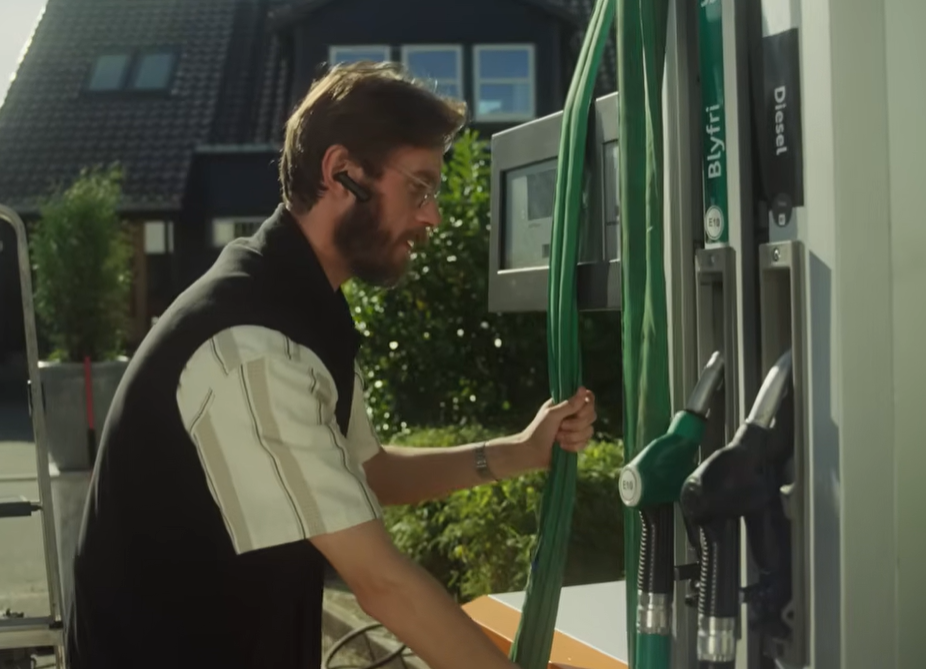
We're throwing a price parity party as BYD announces compelling deals for new electric cars (no need to add wings to save money); another impressive New Zealand marine business E-Stroke looks to retrofit recreational boats and shows the economics stack up; Australia gets creative with its excess solar and batteries that have been installed in a few months as part of the subsidy programme now rival our third biggest power station; New Plymouth District Council gets set to benefit from a big airport solar farm; how thousands of panels are being installed and cleaned with the help of robots; and Norwegian smart charging provider Zaptec tells the inspiring tale of a man on a home petrol pump mission.
Read more
In search of cleaner air, Vietnam prepares to usher in an electric motorbike era, while other developing nations go electric for the economics and the UK goes bananas for small EVs; ten years since the Paris Accord and there are many reasons to be optimistic; America's first all-electric hospital gets set to open; Pila Energy looks to get more storage into homes by focusing on appliances; Australia takes another step forward on V2G and some customers are making good money from renting out their cars; and an electric angle to the Louvre heist.
Read more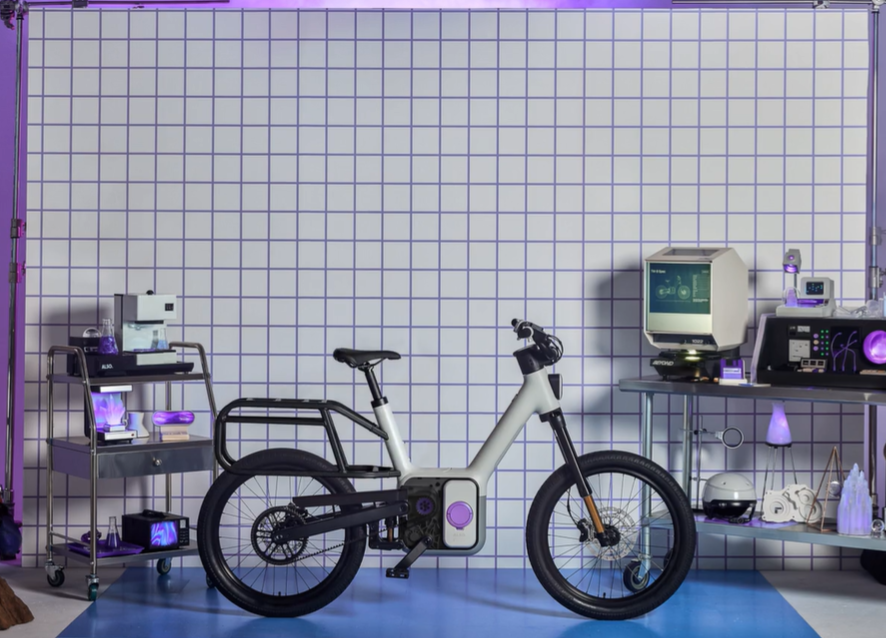
Electric homes and EVs show their worth once again by providing resilience during the recent storms; savvy landlords are installing solar and upgrading gas to electricity to help tenants - and themselves; Basis founder Danny Purcell shares some impressive numbers from his smart panel experimentation; Uber goes from green to electric as it pushes for a zero-emissions mobility platform; Air New Zealand's electric plane and airports investing in solar; and 'transcendent mobility' from Rivian's e-bike spinoff.
Read more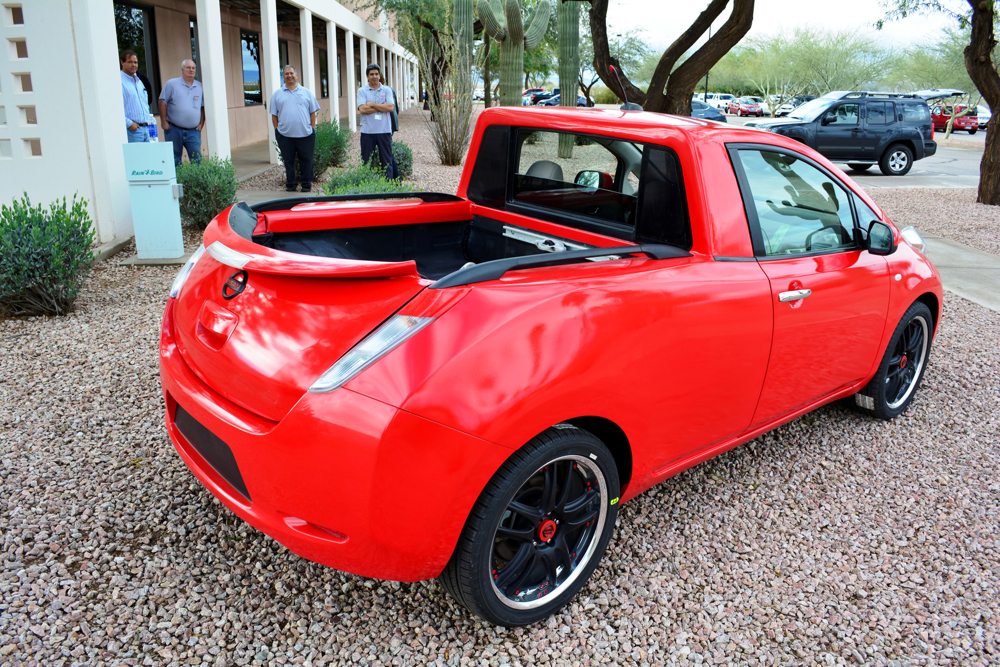
A look at why batteries are a booming business; EECA releases EV charging study; myths, legends and the Hasselhoff approach to EV adoption; a campaign to get more women driving EVs; and musical and spiritual solar.
Read more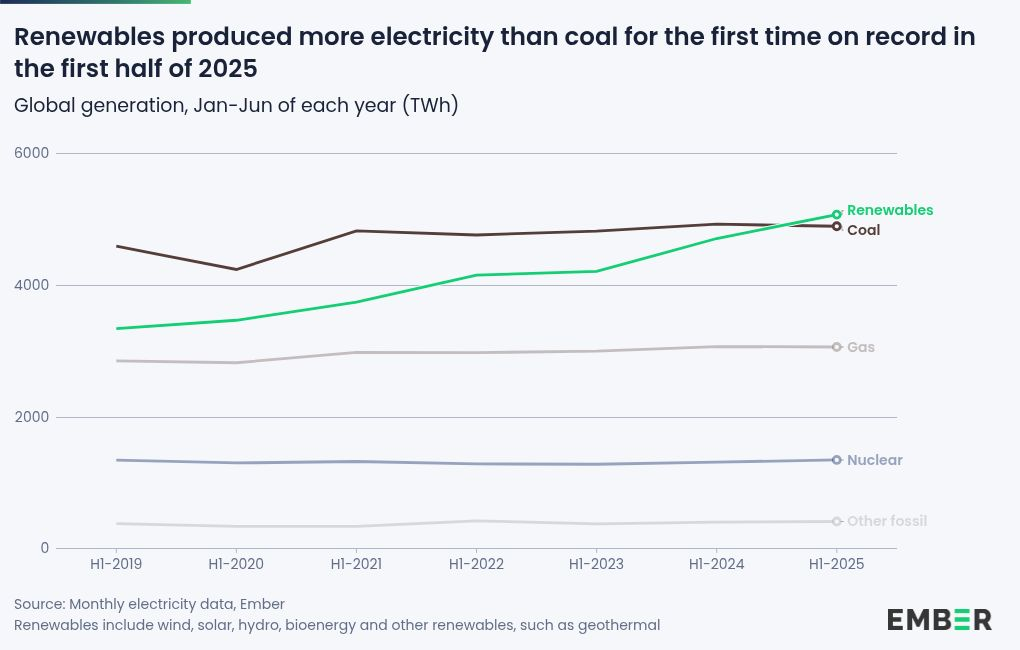
Renewables take over from coal for electricity generation and wind and solar match the world's growth in demand; old EV batteries are proving popular; an Australian study shows that solar panels can make you money, not just save you money; take a trip on a luxury electric solar-powered houseboat in Africa; and the amazing 'solar powered clothes dryer'.
Read more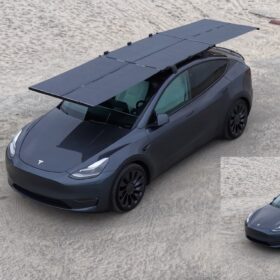
ChargeNet reaches double figures and looks ahead to much more electric transport; an Aussie town at the end of the line goes for pumped hydro, so how does it stack up here?; a new version of rooftop solar offers a little top up for EVs, while trials continue for wireless charging on the road; the EA's Power Innovation Pathway is open for business (and we need all the customer-focused innovation we can get); and a suggestion for those environmentally-focused email footers.
Read more
Big report lays out the massive opportunities for electric cars and trucks to provide power for homes or the grid and earn owners money; Lake Wakatipu could be getting some electric ferries; large trucks are increasingly going electric as hydrogen remains tiny; Hannah Ritchie clears the air with her new book; Transpower prepares for another 40,000 kettles on Saturday night; and some coal-based innovation on the West Coast.
Read more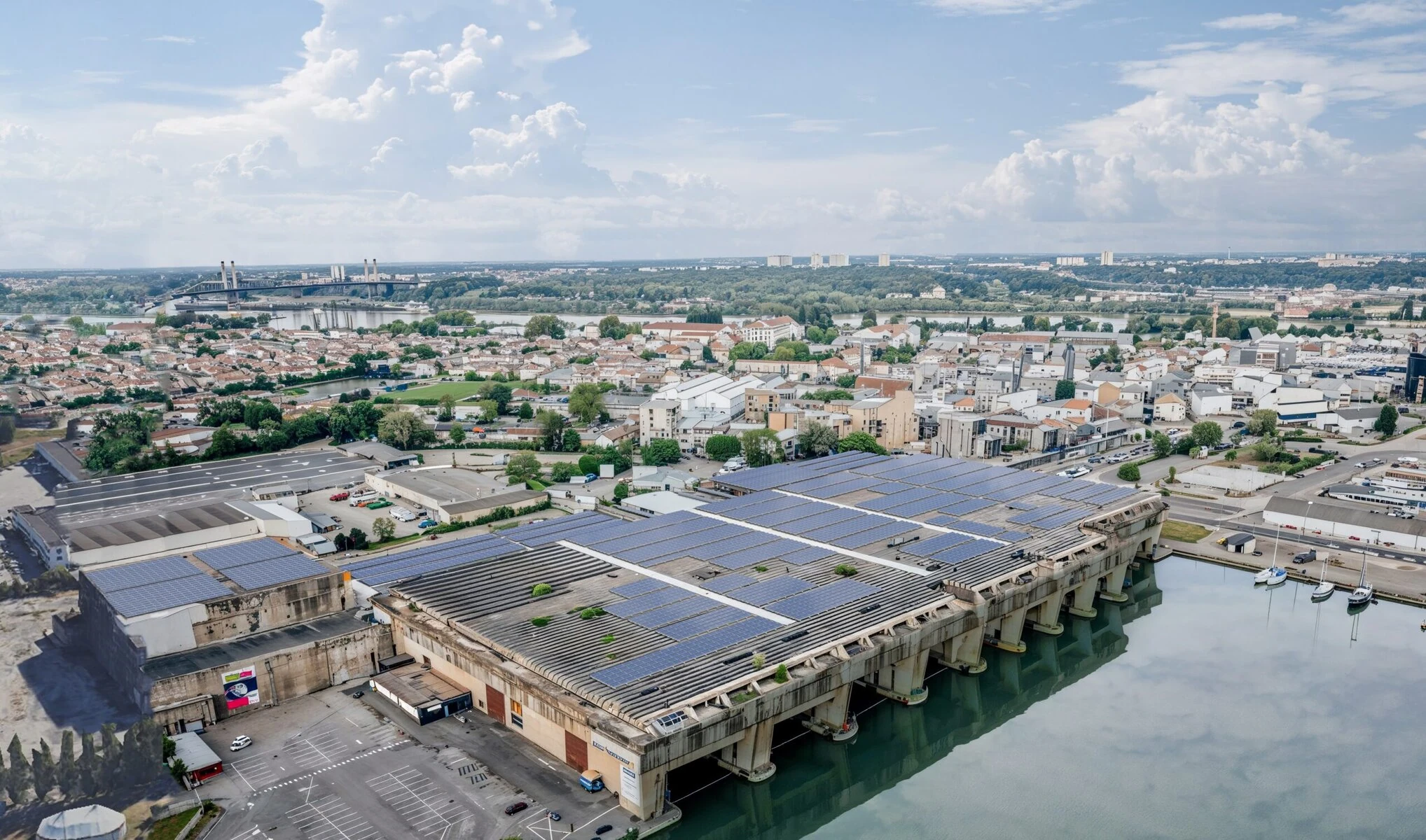
Bordeaux is embracing solar - and modern tech means heritage issues can generally be overcome; Mainfreight welcomes two new electric trucks to its fleet in the US, while Foodstuffs North Island celebrates an electric anniversary; why the radical left and the radical right can unite on solar; Edmund Becquerel's surprise discovery; and why better technologies sometimes take a while to catch on.
Read more
Yet more stunning stats on Australia's household battery boom after the subsidy was announced; the countries doing best on wind and solar on a per capita basis; a big report on China's energy transition looks like bad news for fossil fuels; the lower North Island is set to get the Southern Hemisphere's first battery electric trains, Samoa is set to get some electric solar catamarans, and Auckland is set to get zero-emissions deliveries from Ikea; the Shameless Plug podcast brings kitchen diplomacy to the table; and a song in the key of science from Elle Cordova.
Read moreWhether you're looking for an electric fruit picker, a farm workhorse, a high-end golf cart, a food and beverage hauler, a mobility scooter or a fold-up e-bike, Barry Hillyer could be the man you need to talk to. The E-motors showroom in Queenstown is home to an impressive collection of smaller electric machines and, while the big electric stuff like diggers and loaders creates plenty of attention, the small end of town is where the rubber is hitting the road in many other markets, where a lot of the innovation is happening and where the options are increasingly making economic sense.
Read more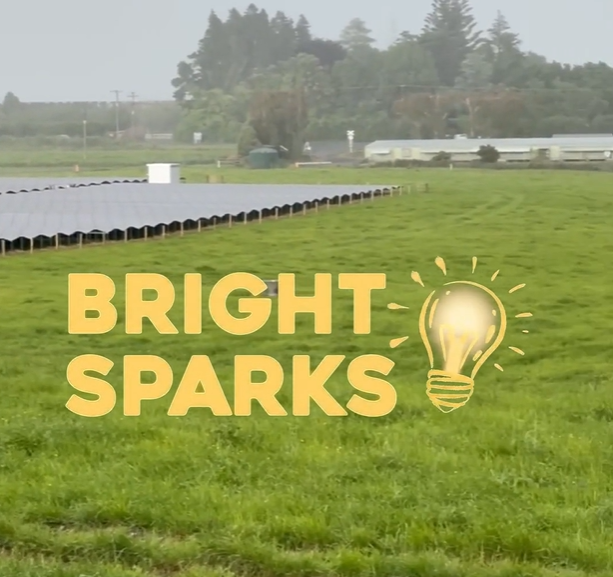
We've seen electric cherries and electric chickens. How about electric piggies? CJ and Tim Lepper run a pig farm in Taranaki and, like a growing number of clever rural folk, they realised that solar was a slam dunk for their business.
Read moreWhen it comes to electric farming, "the numbers are becoming undeniable," says Nicholson Poultry's Jeff Collings. With 60kW of solar, a Nissan Leaf as a 'farm quad', electric mowers, an electric ute that can run a water blaster, and even a chicken manure scraper made out of a wrecked Tesla that, as Rewiring's Matt Newman says, looks a bit like something out of Mad Max, "almost everything is electric". There aren't many others in New Zealand who have gone this far down the electric road. And, with his electric Stark Varg, the fastest off-road motorbike in the world, he's obviously having plenty of fun on that road, too.
Read more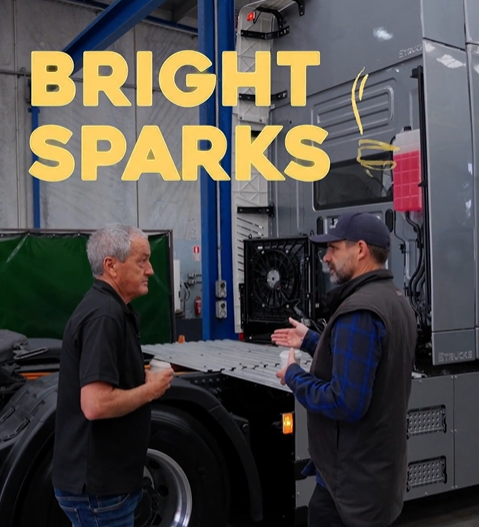
Talk about driving change!ETrucks' Ross Linton is at the forefront of New Zealand's nascent electric trucking scene and can claim responsibility for a number of firsts, from the country's first electric concrete truck to the country's first battery swap set up. Since he brought his first electric truck in to the country back in 2018, the technology has advanced massively and driving on electrons has become quite a bit cheaper than diesel and, not surprisingly, that's inspiring a great deal of interest among businesses.
Read more'I'm a bogan and I have no problem with the bastardisation of motor vehicles. You can stick whatever motor you like into whatever else you like.' Antz Davies, you are a true boganic Bright Spark and we salute you because it's the bogans that we need to be convincing! Davies is the main brain behind Watt Rods, a Lower Hutt company that converts old cars to electric. "Any and all vehicles, old or new, four wheels or two, big or small, on road or off, fully customised to your requirements."
Read more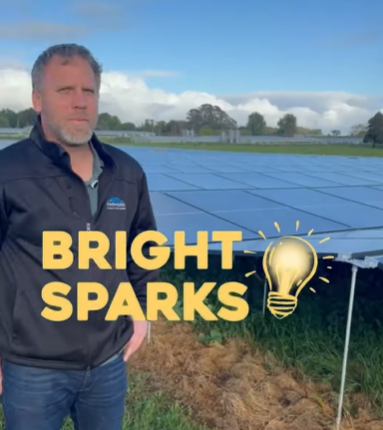
Solar is already cheap and an increasing number of farmers are discovering that, but Mattt Luscombe has found a way to make it even cheaper. The founder of FarmGen says architects like steel, but engineers like efficiency and taking steel out of the build and instead relying on ground anchors means the owners get more generation for less outlay.
Read more
We love a bit of renewable hydro power in New Zealand, but Ray Tomlinson from JT Group has brought a new meaning to that phrase with what he calls "probably the first battery electric operated commercial water blaster".
Read moreWhether big or small, it makes sense to go electric when you're building new and Parakiore, a $500 million project located on the site of an old brewery in Christchurch, is a great example of that.Parakiore will be the largest indoor sports facility and swimming complex in Australasia when it opens soon and, as Christchurch City Council's head of facilities and property Bruce Rendall says, choosing to use local electrons instead of burning molecules was about reducing emissions AND reducing the financial burden on ratepayers."We look at solutions that do both."
Read more
It's not just homes that are getting off the gas. A number of big new facilities are going all-electric, too, including the new Te Kaha / One NZ Stadium in Christchurch. As project director Kent Summerfield says, the covered 25,000 seat stadium (30,000 with the temporary seats) will run entirely on electrons, from the cooking to the heating to the ice baths to the machines required for maintenance and operation.
Read more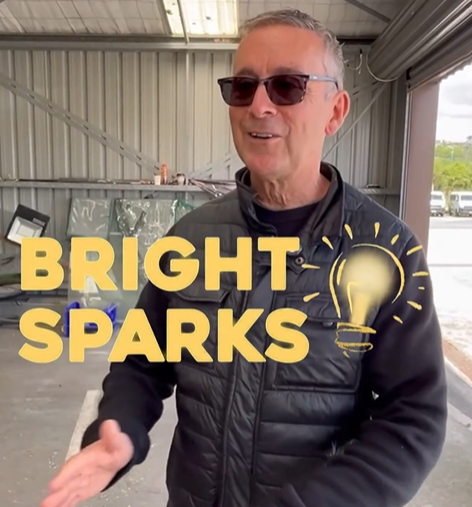
There’s plenty of energy emanating from the ground at Te Puia in Rotorua. And there’s plenty of creative energy emanating from those studying at the New Zealand Māori Arts and Crafts Institute. Now there’s also plenty of electric energy, because the business has upgraded its fossil fuel vehicles and added a big solar system so they can run on the sun.
Read moreSupport us
Your donations help our team keep the momentum of rapidly electrifying Aotearoa New Zealand within our key focus areas of community, government and industry.
.avif)
.avif)
.avif)

Our Newsletter
Stay informed about our work and discover various ways to contribute to enabling rapid electrification. Join our vibrant community of like-minded individuals.
Check out our privacy policy here
Contact us
hello@rewiring.nz

.avif)