


.svg)
Sun in a socket: plug-in solar
Solar is the fastest growing source of electricity globally. And it’s the cheapest form of electricity available to New Zealand households. But not every home is suitable for panels. Not everyone owns the home they live in. And not everyone can access the capital for a rooftop solar system. That’s why there’s also been a surge of small-scale or plug-in solar in a number of countries. So why not here in New Zealand?



.png)
Rewiring Aotearoa’s soon-to-be released report on the economics of going electric shows that rooftop solar costs the equivalent of 6c per unit of electricity, or 12c per unit with a 5.5% interest loan over 30 years.
Compare this with the average price of grid electricity today, including fixed daily charges, of 40c per unit.
For an average home with a 9kW rooftop solar system and a battery, that could add up to electricity bill savings of around $2,400 per year.
80% of homes with a system of this size would also generate around 40% more electricity than New Zealand does today and, when paired with batteries, build greater household and community resilience.
Access to finance, not cost, remains the primary barrier. Given that solar can not only recover the capital costs and any loan interest incurred, but also generate a return in the way of years of reduced energy bills, we need to focus on ensuring New Zealand households can tap into these savings. Currently between purchasing the gear upfront, or using mortgage lending and bank green loans, there aren’t enough ways for households to take advantage of rooftop-generated New Zealand-made energy, which is why we're advocating so strongly for Energy Impact Loans through the Ratepayer Assistance Scheme.
Then there are homes for which rooftop solar may not currently be viable.
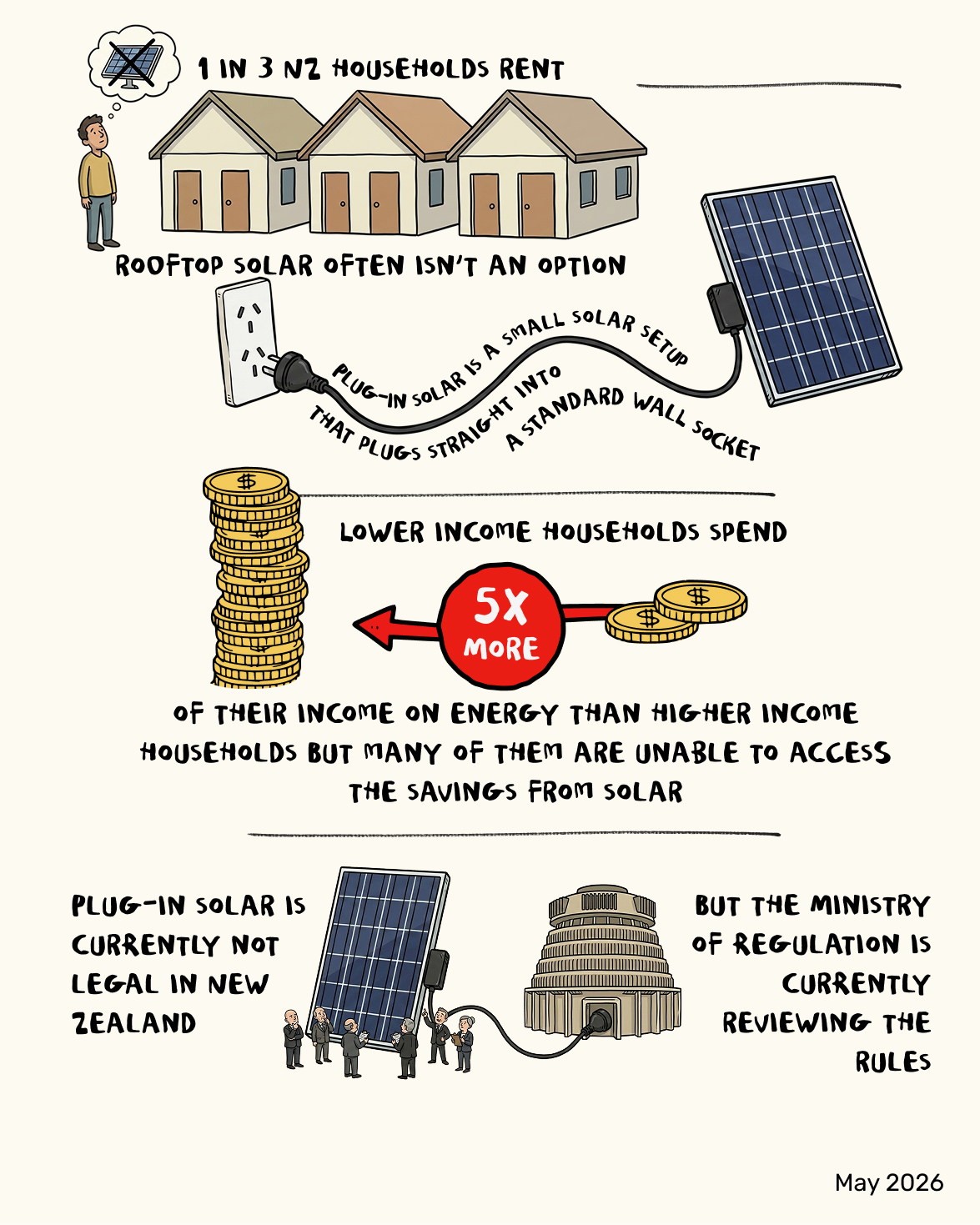
Approximately one third of New Zealand households are renting. Housing is increasingly more dense and joined dwellings such as apartments, townhouses and flats are increasingly taking up more share of New Zealand’s housing stock. Plus, rooftop solar may not appeal to debt-averse New Zealanders or low-income households, and some roofs may not be suitable.
Lower income households spend around five times more on energy as a proportion of their income than the highest income households. The result is that those who often have more to gain from lowering their energy bills are among the least able to access the technology that would deliver it.
That's where plug-in solar comes in.
TLDR? Check out our infographic
Jump to sections:
- What is plug-in solar
- How much energy can they generate?
- Who could benefit?
- What's happening overseas?
- Is it safe?
- What's the catch?
- Why isn't plug-in solar available in New Zealand?
What is plug-in solar?
Plug-in solar (also known as portable solar or balcony solar) are small photovoltaic systems, typically one or two panels paired with a microinverter, that connect to a home through a standard wall socket.
The microinverter is not separate but rather affixed to the back of the panels. This means the system arrives ready to use: there's no additional equipment to source, no separate installation and no electrician needed to wire components together. Everything that converts sunlight into usable electricity is built in. It is plug and play.
By plugging into your standard wall socket, the electricity your panels generate flows directly into your home's circuits where your appliances draw from it first, mixing with grid electricity to meet your total energy consumption needs.
Generally kits will come with mounting brackets that allow the panels to be installed on a balcony, terrace, roof or on the ground. You identify where’s most optimal for the household layout and energy generation, then mount them, run the cable to the nearest wall socket, and that's it.
In Germany, they’re most commonly found on balconies and called Balkonkraftwerk, best translated as “balcony power plant.” Savvy plug-in panel owners may choose to change their location or orientation, over their lifetime or even throughout the day, to maximise energy production. In addition to their size, it’s their flexibility and portability that sets them apart from fixed rooftop systems.
In mature markets like in Germany, you can purchase plug-in solar for around $600–$1,000 per kW (1000W). This compares to an average residential rooftop solar installation cost in New Zealand of around $2,000 per kW.
How much energy can they generate?
Though often sold in pairs, a single plug-in solar unit is typically 400–1000W. For reference, the average rooftop solar system in New Zealand is around 5kW, or 9kW in Australia. Overseas, the output of plug-in solar systems is generally capped (in Germany, inverter output is capped at 800W with panel capacity up to 2kW, whereas Utah has set a single 1,200W output limit). These limits keep the systems within safe wiring tolerances, and demonstrate how plug-in solar is best suited for offsetting household consumption, not generation at scale.
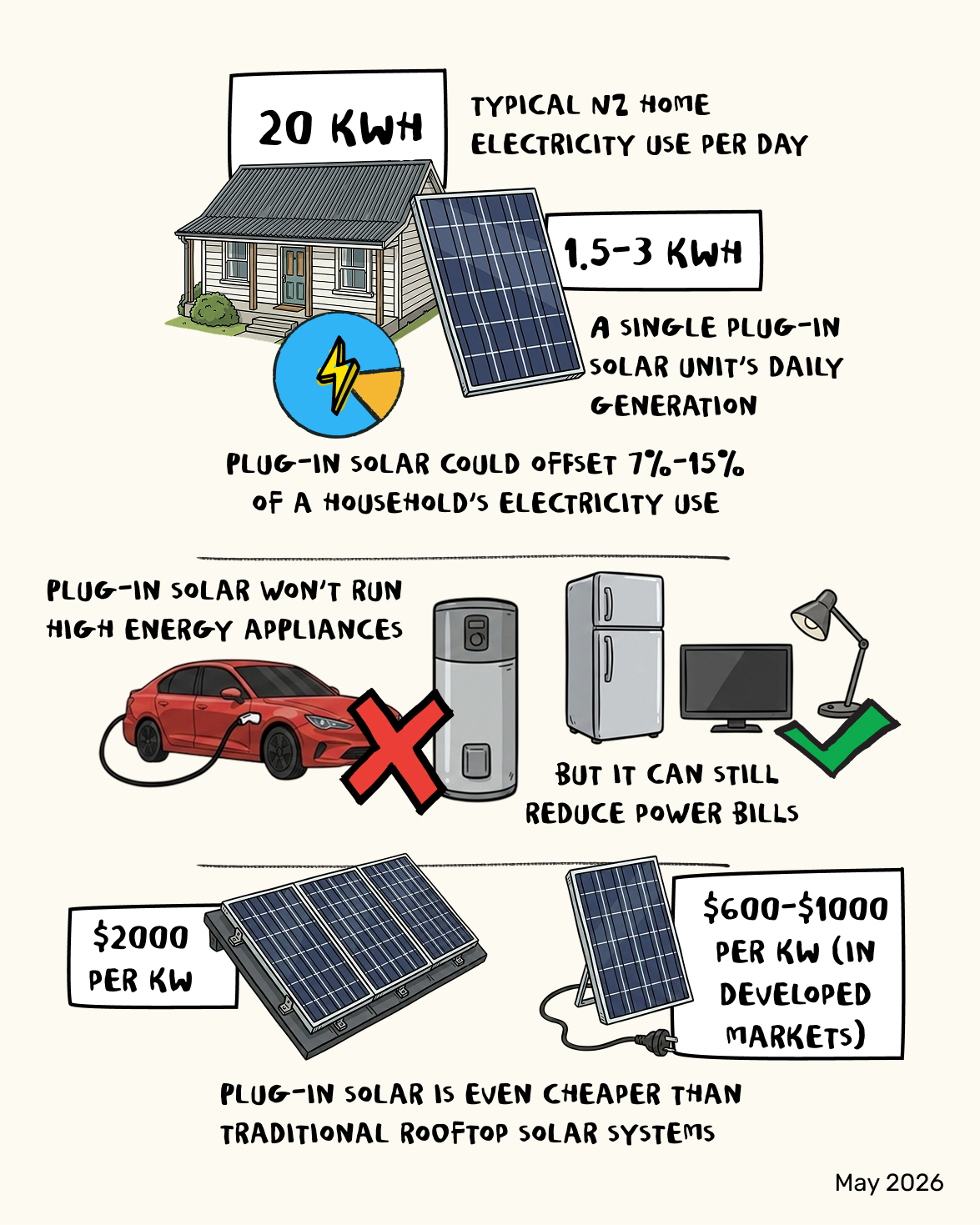
Given the average New Zealand household uses around 20 kWh of electricity every day, a single plug-in solar unit can be expected to generate approximately 1.5–3 kWh on a good day, offsetting around 7–15% of consumption, depending on location, orientation, and season. Even at a smaller size than a rooftop installation, they offer a meaningful and immediate reduction in energy costs.
For households that want to go further, plug-in solar can be paired with batteries, including portable batteries like those sold by Ecoflow or DJI in New Zealand. Like plug-in solar kits, portable batteries charge via the panels or a standard wall socket, giving households the option to store energy generated during the day for use when the sun isn’t shining or when electricity prices peak in the mornings and evenings.
They can also add an extra layer of resilience against outages. Unlike rooftop solar paired with home batteries, they’re unlikely to be a whole-home backup solution but are a meaningful step towards more resilience for a household with no other means of energy storage.
Who could benefit?
In short: many of the people with limited or no access to rooftop solar.
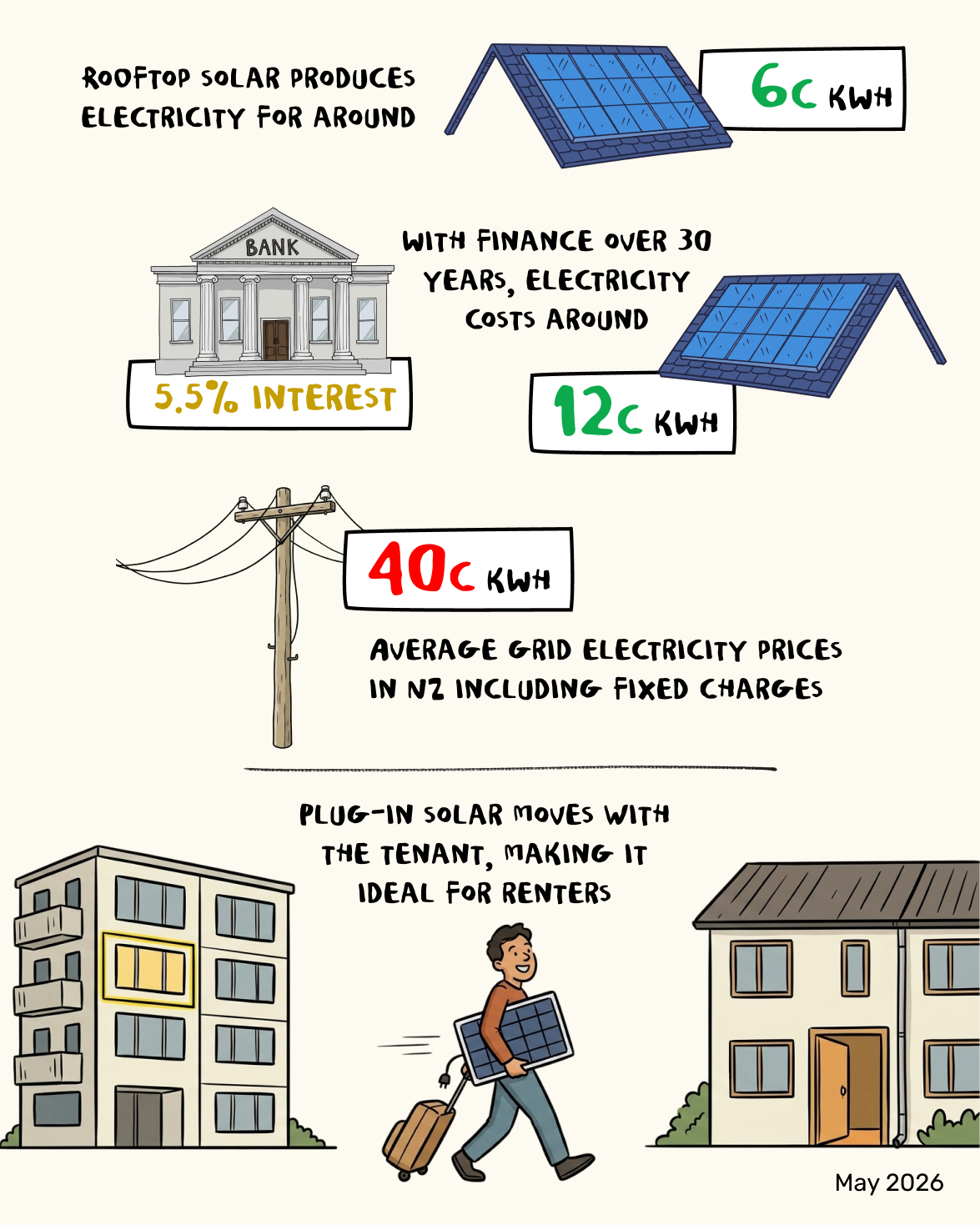
For the one-third of New Zealand households who rent, installing rooftop solar on their homes isn’t widely possible: not because their roof isn’t suitable, but because it isn’t theirs. Installing rooftop solar as a renter requires landlord consent and negotiating a mutually-beneficial arrangement to pay for it (there are some landlords embracing solar, however, and the Queenstown Electrification Accelerator's Solar for Renters scheme shows it can be a big win-win that can bring down bills for tenants and pay off the solar for the landlord).
Plug-in solar doesn’t require any of that: no modification to the property, no shared ownership model and no landlord permission needed. In Germany and the UK, landlords are legally prohibited from unreasonably refusing a tenant's request to install a qualifying device, with the burden of proof on the landlord to demonstrate specific grounds for refusal.
Portability is another key advantage that benefits renters, as well as anyone who moves frequently or is living in temporary or transitional accommodation. A plug-in system isn't fixed to the property, it belongs to the tenants and moves when they do.
Plug-in solar also overcomes practical barriers for other types of housing, such as apartments, flats, townhouses, and terraced homes. Shared rooftops, body corporate approval processes, and buildings without suitable roof access may mean rooftop solar is impractical, or difficult to get across the line, whereas plug-in solar doesn’t face the same challenges.
For low-income households, superannuitants on fixed incomes, or those who don't qualify for bank lending or green loan products, upfront cost barriers to rooftop solar exist even where the long-run economics are clearly favourable. Meanwhile plug-in solar is available at a fraction of the cost, offering immediate and meaningful bill savings to the household. For debt-averse households who'd simply prefer not to take on any obligation, plug-in solar may be a more appealing foot in the door to generating your own energy at home.
Homeowners aren't excluded from the picture either. For the small number of roofs that aren’t suitable for rooftop solar – whether it be due to their orientation, shading, roofing type or structural concerns – a plug-in unit placed outside may be a practical solution.
On top of benefitting the household, there are clear advantages to New Zealand’s energy system, too. Like rooftop solar, widespread plug-in solar adoption contributes to a distributed energy system and ultimately reduces demand on the grid, easing pressure on the network infrastructure that every electricity user pays for through their lines charges.
A lot of a little is a lot and, in Germany, “experts say plug-in solar devices could cover up to two per cent of electricity demand by 2045, when Germany aims to have achieved climate neutrality".
What's happening overseas?
Plug-in solar is already very popular overseas. In June of 2025, Germany surpassed one million registered installs of plug-in solar, having doubled the installs in the 12 months prior. Install numbers across Europe are estimated to be closer to 4-5 million.
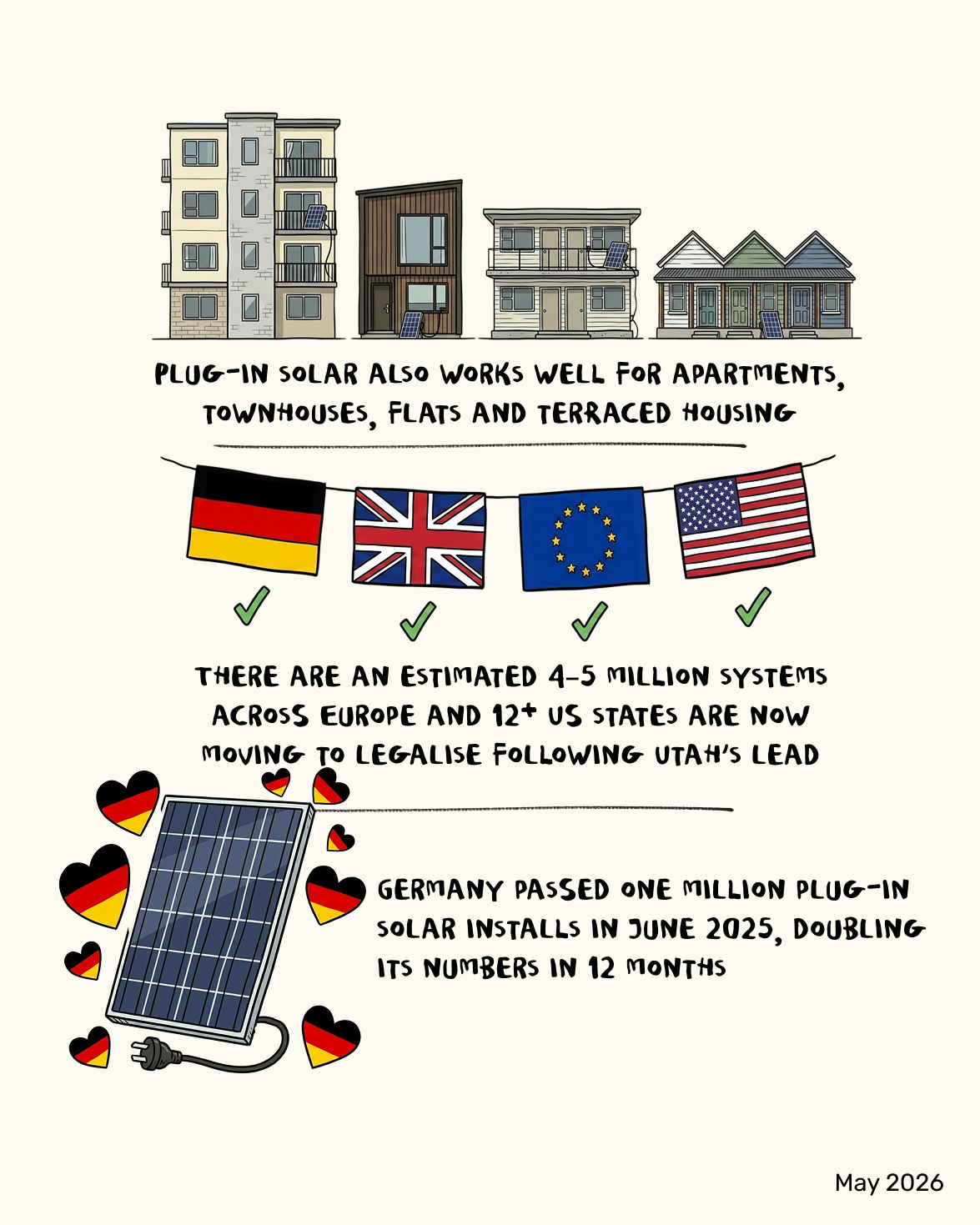
And now many American states are looking to be fast followers. Utah is leading the way, unanimously passing enabling legislation in 2025 which has led to bills in more than a dozen state legislatures to fully legalise plug-in solar, while Maine and Virginia look to be next. And very recently in March 2026, the United Kingdom government announced plans to update the grid code and wiring rules to enable plug-in solar by the end of the year.
Is it safe?
Yes. Modern product standards and certifications mean plug-in solar is safe. Every major jurisdiction that has examined this carefully has reached the same conclusion, and the evidence is in the frameworks they've built around it.
Today’s certified plug-in solar panels address safety risks as standard features. Anti-islanding — the automatic disconnection of the device if grid power is lost — is mandatory in every certified product, eliminating the back-feed risk entirely. Inverter output is power-limited to 800W in most jurisdictions, which keeps the current flowing through household wiring within its safe rated capacity. Certified connectors prevent accidental contact with live components.
Introducing sensible regulation in New Zealand would mean setting clear technical thresholds.
What’s the catch?
Plug-in solar is not a complete solution by design. Even offsetting between 7–15% of a household's daily electricity consumption, it falls short of what a full rooftop system can deliver. Plug-in solar also can't power high-draw appliances like charging an EV or heating a hot water heat pump. It doesn’t deliver a meaningful shift in how a household powers itself in the same way rooftop solar can, and it’s important we continue to work towards greater accessibility of rooftop systems for New Zealand households.
As with any solar system without battery storage, maximising the benefits (and the savings) comes from matching your electricity consumption to the times of day when the panels are producing. How much you get out of the system will also depend on placement, where the balcony or panel location should ideally be well-positioned to face the sun.
Plug-in solar is also likely to have a longer payback period than rooftop solar on a per-kW basis, depending on how well the system's output is matched to household consumption. And unlike rooftop solar, exported electricity from a plug-in system is unlikely to attract export revenue, meaning any generation that goes unused by the household is effectively uncompensated for.
Why isn’t plug-in solar available in New Zealand?
Currently, plug-in solar is not legal or available in New Zealand. Until the necessary regulatory changes are made, these devices cannot legally be sold, imported, or used. This has been a key area of Rewiring Aotearoa’s advocacy work for some time now, where we’ve mapped the necessary changes required across government agencies. These include:
- Creating a legal definition of what a plug-in solar device is, including the technical thresholds that determine what qualifies;
- Repealing a 2012 prohibition notice that bans any inverter connecting to the grid via a wall socket — written for cheap, unsafe devices that no longer exist on the market;
- Simplifying distributor approval;
- Establishing a product certification pathway;
- Exempting installation from electrician requirements;
- Amending tenancy law to give renters a presumptive right to install qualifying devices;
- Clarifying the technical detail, including how exported electricity is treated, whether existing meters can remain in place, and ensuring a renter's small unit can't inadvertently trigger compliance obligations on a landlord's rooftop system.
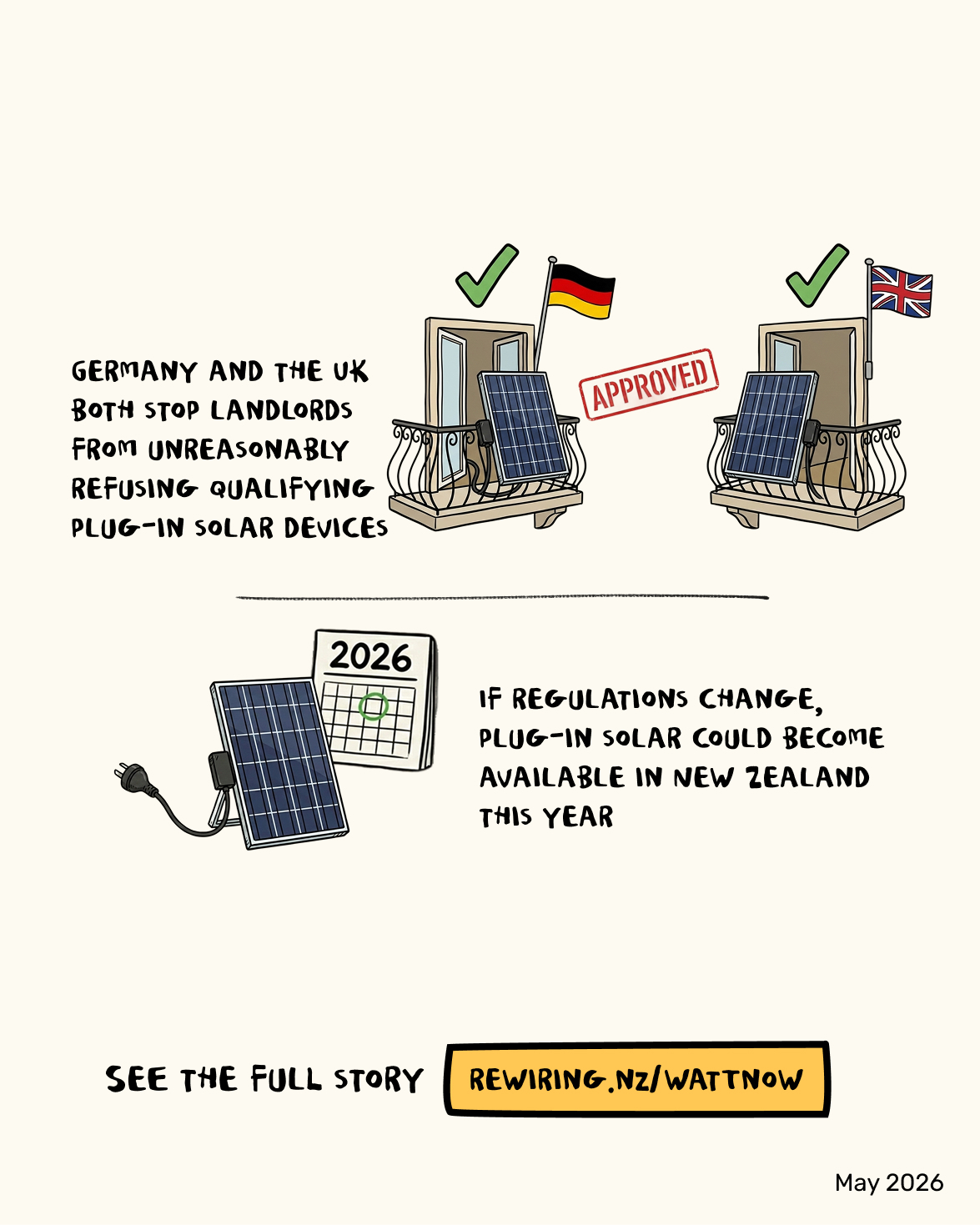
Just this month, the Ministry for Regulation announced a sector review into residential solar installation, with the aim of making New Zealand the simplest place in the developed world to install solar. It confirmed the review’s scope includes plug-in solar systems, applying to regulation that involves “plug‑in and other on‑site systems supplying electricity to homes and small businesses.” We’re glad to see the review will be looking at “how building rules, electricity safety requirements, connection processes and planning controls work together in practice” and examining “where low‑risk installations face unnecessary delays or cost.“
It’s our hope that this review leads to plug-in solar being available to New Zealanders this year, to cut energy bills for households and open up access to the cheapest form of electricity available to New Zealanders to even more households.
Full infographic

Related posts
More Watt Now? posts from Rewiring Aotearoa
.png)
Solving the dry year
Read More
Sun in a socket: plug-in solar
Read More
The case for energy loans
Read More

A bad case of gas
Read More

Scale and speed: why the climate needs electric vehicles
Read More

A future with two visions
Read More

Show me the money: the economics of going electric
Read More

Why electric vehicles matter
Read More

Why solar makes sense
Read More

Why going electric wins on emissions
Read More

Energy use in New Zealand
Read More

Closing The Loop
Read More

Electricity means efficiency
Read More
