


EV owners love what their cars can do. And they can do a lot these days. Whether it’s an old Nissan Leaf that cost a couple of grand and can take care of the daily duties, a new Polestar that can go the length of the North Island on one charge, a Zeekr that can plug in to a two-way charger and power a home, or a fleet of company EVs that can cut your costs and help you meet emissions targets, there are so many good stories to tell about electric vehicles and so many features of these new technologies that are worth promoting.
This Car Can... is a campaign celebrating the real stories of everyday New Zealanders who have already made the switch to electric vehicles in the hope it inspires more people to follow suit.
There’s a lot of talk about what electric vehicles can’t do and plenty of myths and misperceptions that might stop people from upgrading. But the people who actually own EVs? They’re overwhelmingly sold.
There are now almost 100,000 full EVs running on New Zealand-made energy and they make even more sense as fuel prices keep rising and the world becomes more unstable.
We want existing owners to share their electric enthusiasm with those who may be on the fence so that more New Zealanders get to experience the economic, energy security and environmental benefits of running on cheap local electrons rather than on expensive foreign fuels.
We've swapped one then both cars to electric. The electric vehicles are saving us about $1,800 per year since road user charges began. We find we're more inclined to go away on road trips, knowing the cost of travel is low.
We took advantage at the end of 2023, just before the government EV support ran out, to buy a new, very much discounted EV ute. And we have never looked back. Although it's a two-wheel drive, this ute's traction is excellent, even on our rather steep gravel driveway, probably due to the battery weight spread evenly under the whole vehicle. We have no issue whatsoever with towing a trailer (total weight one ton including say a pallet of potting mix) up our steep driveways. The driving is very comfortable and I've matured enough not feeling the need anymore at traffic lights to leave a Ford Ranger behind. We can deliver most seedlings to customers in Thames, Auckland and in Raglan (which involves a 260km drive in total) and it's much cheaper than when using our diesel truck.
Power charges are down to a third of what I'd been paying, and this includes charging my EV. As the EV has few moving parts maintenance costs are negligible, so there's an extra saving.
This is our third EV. Started with a BMW i3 in USA in 2015 - idealcity car. In NZ we bought an MgZS ev - gave us more range but was an early model so a little limited.
The Volvo is outstanding, fast to charge, sufficient range to get us to get us from Auckland to Wellington with a single stop (30 minutes). European comfort and driving smarts. We love it.
I noticed that one of my favourite features of my EV isn't in your list on the This Car Can section of the site. Using the app, I can turn on the A/C system and set the temperature in the car a couple of minutes before I head down to the garage or while I'm walking back to my parking place. Toasty warm or a cool haven whenever I want it. Amazing what can happen when your heating and cooling isn't dependent on a fire burning in the front of the vehicle!
5 kWh for a 20 litre batch, if you really wanted to know.
We’re just about to tick over 100,000km in our first EV (Kia EV6), plus another ~20,000km in our EV van. Real-world range for us has been around 380km and 270km respectively — which comfortably covers 90% of what we do.
The savings have been massive - we've saved roughly $50,000 so far. We save about $5,000 per year on each of our two cars.
Had four different lNissan Leafs, each with a bigger battery and had a small solar array and battery. Then we got the MG 4 which is exciting to drive and can travel further on one charge than our bladders can last and we put a decent solar array and battery system on the house. We can fill up for free for local trips from our solar panels and it whizzes us and our two e-bikes to a Northland holiday. Woo hoo!!! We LOVE it!
I have one EV and would definitely get another one. We’ve got one EV and one ICE. At the time, “best of both worlds” felt like a smart move… not entirely sure what problem I thought I was solving. Maybe the comfort of having a tank full of petrol “just in case” of… something? A year in, I can’t find a single real downside to the EV. 500km range, fast charging is quick enough that it’s never been an issue, way nicer to drive, range anxiety hasn’t happened once. Meanwhile the ICE car just sits there at the end of the driveway like it’s waiting for a purpose. We’ll almost definitely go fully EV next. Only hold-up is finding one that can handle a 9ft surfboard inside it - that’s the real bottleneck
We charge the EVs off solar during the day or overnight on off-peak rates, costing about $4 per full charge and saving us thousands every year. With charging costing so little, road user charges have actually become our biggest running expense.
Powering your caravan from your EV using V2L (Vehicle to Load).
Our car is our cost-effective resilience lifeline...
We live rurally in Hawke's Bay and were without power for just under five days following Cyclone Gabrielle. Sadly for us, we didn't have an EV or a battery attached to our solar at that time. This meant that we didn't have running water, couldn't flush the toilet or keep the fridge/freezer running.
As a result, we got used to boiling our drinking water, trying not to get food poisoning and became overly familiar with buckets of pure evil...
If the same event happened today, our EV could easily power all of those vital things for a week with no problem, even if the sun didn't shine.
During normal times, the EV also saves us a bunch of cash in fuel costs. We drive about 350km each week for work, and the home solar provides most of the energy at a fraction of the cost of grid supplied electricity.
We love our EV and there is no way we will ever be changing back to petrol.
The car is charged and ready to go every morning. For the few long trips we have taken, we have never had to stop longer than a typical lunch stop.
We feel proud for contributing to less fossil fuel use, and we love driving the EV - it is very quiet and peppy. Our next vehicle will definitely be an EV.
I’ve taken my Kia EV6 to the Wairoa Gorge Bike Park, Nelson loaded with four mountain bikes.
We ditched the gas guzzling vehicle for an EV in 2018. All in all about $50,000 after being electrified for 7 years. We're getting the largest savings from the EV.
1 EV, 1 ICE, the EV ends up being the only vehicle we use as a family, even on the big journeys across the country, fully loaded with bags, summer adventure gear and the longboards on the roof! I'm starting to feel very sorry for the ICE sat there gathering dust, and our next vehicle will definitely be EV. There's really no downside.
Well, the nonsense peddled by the oil lobby include that EVs can't tow. We are 5500km into a 10 week holiday from the Bay of Islands in the North, to Queenstown in the South, towing our caravan. Zero issues charging, with one sub-5 minute wait being the only inconvenience.
Since 2019 have driven EV, it's so much more comfortable, quiet, powerful, and convenient. No, the time it takes to charge is hardly relevant because most everyday use means plugging in and walking away. Or sub 10 seconds out of one's life, and no trips to the stinky fuel bowsers (didn't notice it pre EV).
Everything in our household runs on electricity now - including BBQ - most from rooftop solar with grid for the rest.
I cooked toasted sandwiches using V2L in the middle of Riverhead Forest for a mate who was running a Backyard Ultra. He said it was the best toasted sandwich he'd ever had that was cooked by a car.
Our only family car is a 2017 Nissan Leaf, a great round town car for all four of us. We supplement this with a road bike, an ebike, trains and buses. We've not got a fancy charger, just a three point plug near the carport. The only maintenance costs so far have been tyres and a yearly check. This is our second Leaf after an unfortunate incident involving a bus running a red light. Luckily we lived to tell the tale and bought another with the insurance money because we love it so much. We've been fully EV for seven years and can confirm you won't regret it!
This is our last big road trip in 'Squirrel' before we reluctantly upgraded to our new electric van last year.
glover.gen.nz/wordpress/otago-2022-a-winter-roadtrip
2500kms in August, battling wind, snow, freezing nights and a range of just 80 km.
My BYD Atto can go from Alexandra to Wellington in one day on two 30 min charges (over coffee and over lunch) whilst carrying three people and three bikes. Total fast charging cost $85!
Bought a Kia niro phev five years ago and loved it as 90% of its running was electric, yet we had the the reassurance of a petrol engine for when the charge was exhausted. After five years the range of EVs was enough for us to sell the hybrid and buy a fully electric Kia Niro. We would never go back to a petrol vehicle now. The EV is so quiet, so fast, so smooth, and of course so economical.
Last year my EV powered the home for 5 days. Clutha District lost cell towers and grid electricity. Having power at home meant the fridge and freezer worked, we had hot water, and hot food, we also had fibre surprisingly because all it needed was power. We used almost 50 kWh of electricity from the car battery.
Not a big deal you may rightly say, as most modern EVs do much more, but it does this on the electrical energy equivalent of just 5 litres of petrol ! (1 litre of petrol = approx 10 kWh of electrical energy). How far would a petrol/diesel car get on 5 litres of fuel?
We have paid a bit more than $114 in total for 'fuel electricity' at ChargeNet rapid charger stations since October 2017, after driving more than 41,000 km.
Apart from saving me a lot of money on petrol and maintenance costs. my car can pre-cool the cabin remotely so that I never have to get into a hot car on sunny days. My car also has "Dog Mode" where I can safely leave my dogs for a short time while I pop into the supermarket on my way home from a walk. The car sets a comfortable 19 - 21 degrees for the dogs to be in. With my app I can check on the dogs through the car's in-cabin camera to check they're ok (they're always just sleeping). I come back to happy dogs every time!
We share biscuits with all the kind people who stop to help us when they see the bonnet up.
I have a Signenstor with a two way 12.5kw DC charger. When I bought it was going one way (charging the EV). However as promised Sigenstor did a software update and after entering the few bits of information the two way charger now works. So now I have 8kwh fixed battery and 50.4 kwh (I stop EV battery usage at 20% remaining) extra by just plugging the EV in.
7 years ago with a 220km range EV we travelled about 4,500 km on a road trip around the South Island and there were fewer chargers then than now. A bit more careful planning was required. This year another South Island road trip in a 430km range car and it was great. No charging hassles or range anxiety and yes we can hook up a fridge or microwave/jug/electric frying pan if we want to from our car battery.
Our switch to EVs followed a 5-day rental holiday three years ago where we realised how good it was - smooth, quiet, effortless to drive, easy to charge and cheaper to own.
Honestly, driving an EV is just fun. Beyond the drive itself, I've really enjoyed watching the numbers. There is a real sense of satisfaction in seeing exactly how little energy we actually need to import from the grid.
I used my EV vehicle-to-load to run a cement mixer last year at a construction site and concreted 12 x 3M posts into the ground.
Across a 500km road-trip from Christchurch to Queenstown (6hrs of driving), we spend less than 30mins charging over 2 stops. Just enough time to quickly walk the dog, head to the bathroom ourselves and usually the vehicle is finished charging before the takeaway coffee is served! The car is almost always ready to get back on the road before we are!
After installing solar, we purchased an EV, which became our only car for our family of four. We love the savings made from solar and an EV, which means we have additional money to invest in other areas of our lives.
The EV is in all respects a better vehicle than the vehicle it replaced, and it had a similar new purchase cost. In the last 2 years we have only used a public charge station 12 times. The rest of the charging has been done at home utilising 3 hours of free power 9pm to midnight, plus solar surplus.
As for the EV, we love it and could never go back to petrol. We even took our car when travelling to the South Island earlier this year to avoid having to hire a fossil-fuel powered rental car down there.
We have travelled about 100,000km in the two vehicles, going from about 8L/100km to 13kWh/100km in the Ioniq and then 18kWh/100km in the Polestar, which saw about $20k of petrol replaced with about $4k of electricity.
Hauling a caravan 1600kms from Adelaide to Newcastle via The Grampians (~760m) and Canberra (~580m) was no problem, so the 1000km from Cape Reinga to Wellington via routes 32 and 41 to Türangi (max elevation ~800m) should be no trouble.
My Gen 1 Leaf has been from Glenorchy to Dargaville. Did Palmerston North to Auckland and return through Tauranga this week, all on the CHAdeMO public charging stations. No worries!
When the power is out at our house, we can switch our distribution board to auxiliary power (disconnected from the grid), and we can run all lights, power sockets, fridge, freezer, microwave, toaster, kettle, and water pump for our house by connecting a V2L lead from our Kia EV6. It provides 3.2kW of power, so as long as we don't turn everything on at once, we're good for a few days if needed.
By putting a timer on our hot water cylinder, we heat our water when the sun shines or at night when the price is low. The same applies to charging our EV.
Even in the winter, my monthly costs only reach up to about $130. This covers the energy for both my home and two electric vehicles.
EVs save you money

We love EVs because they’re kinder on your wallet. Cheaper energy, fewer moving parts, and lower lifetime costs.
Charging at home via the grid at off-peak rates costs about $1.50/L equivalent - and most people just use a standard three-pin plug. Rooftop solar pushes this even lower.
No oil changes, no exhaust system, no clutch or spark plugs. Hundreds of dollars saved every year.
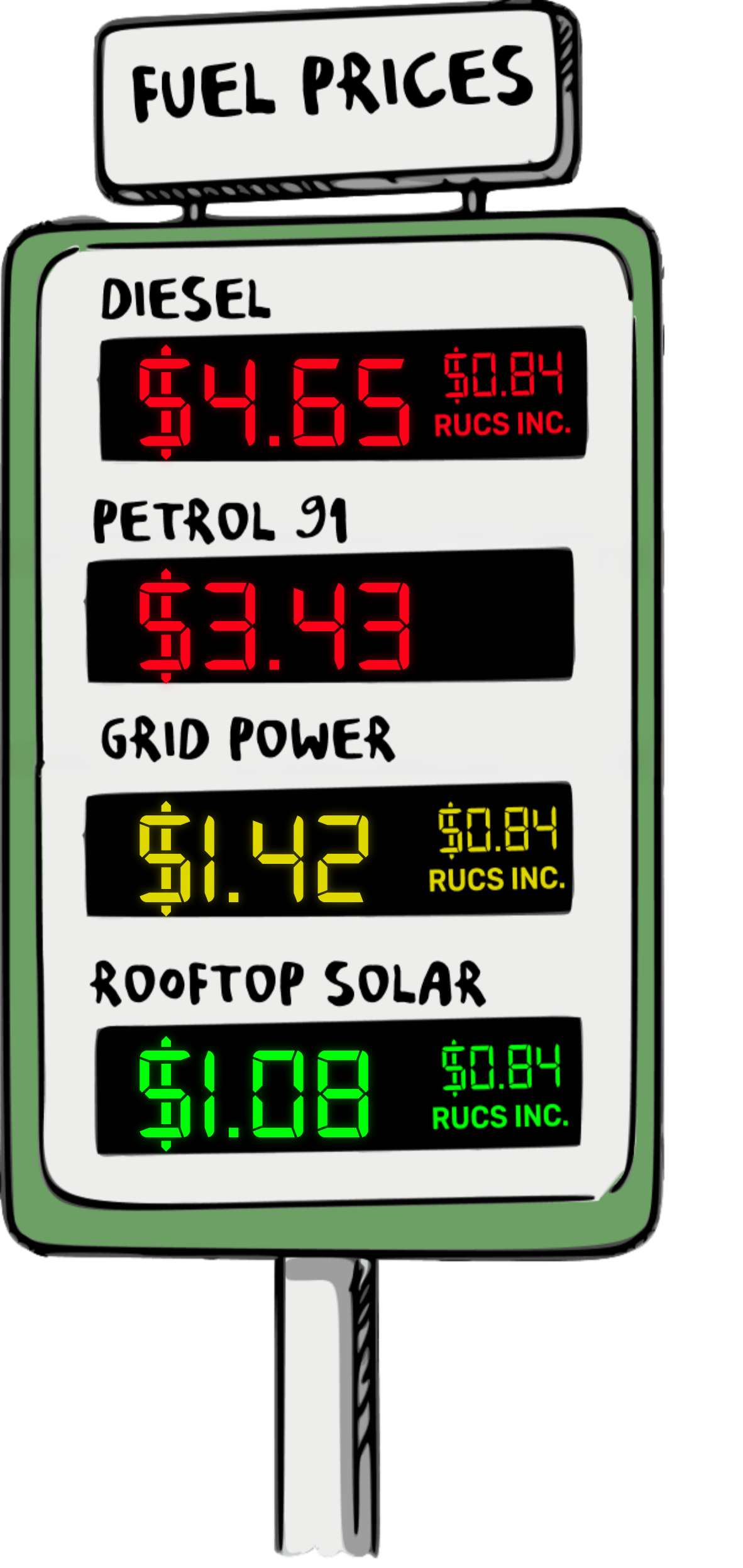
Run on the sun, not the pump.
Petrol and diesel prices sourced from Gaspy. See our methodology for equivalent fuel price calculations.
Running on New Zealand-made energy made economic sense before the fuel crisis kicked off and it makes even more sense now that fuel prices have gone through the roof. You could shop around and get slightly cheaper petrol or diesel, but history suggests the price will keep going up. As this live price tracker shows, the best bet is to go electric and, if you can, run on the sun.

Businesses across the motu are recognising that electrifying their fleet and running on New Zealand-made energy will save them money, reduce their emissions and increase their resilience. Here's how some of the early adopters did it and how they're benefitting as a result.





Share Your Company’s EV Story
Help inspire other NZ businesses by sharing your fleet electrification journey. Download the case study template, complete it, and send it back to us.
Or send your completed template directly to dawn@rewiring.nz
.png)
Businesses buy around 60% of the new cars in New Zealand, and we need as many of them as possible to be electric to seed the second-hand market, while larger vehicles like trucks, buses, diggers and loaders are increasingly running on electrons rather than imported molecules. Find out more about EVs here."
More reasons to love EVs
It’s not just about the money — EVs are better in almost every way.
Quieter and smoother
60% fewer emissions
‘Free fuel’
Much safer
Power on the go
Batteries built to last
Much less noise and vibration. Smooth, instant acceleration with no gear changes. No exhaust fumes improving air quality in our neighbourhoods.
Nearly 90% of NZ’s electricity is renewable. An EV here emits up to 90% less CO₂ per km. Even factoring in manufacturing, 60% fewer lifetime emissions.
Regenerative braking recovers energy while stopping or going downhill. One-pedal driving means your brakes barely wear out.
Despite the media attention on EV fires, petrol cars are around 20 times more likely to catch fire. No flammable fuel tank means a fundamentally safer vehicle.
Vehicle-to-Load lets you power kettles, fridges, power tools — great for camping and trade work. And with two-way charging you will soon be able to use your car to run your home or feed back into the grid.
Modern batteries have a 15–20 year lifespan and around 80% capacity after a decade. There are warranties of 8 years / 160,000km. And around 95% of battery materials can be recovered and reused.
Support us
Your donations help our team keep the momentum of rapidly electrifying Aotearoa New Zealand within our key focus areas of community, government and industry.
.avif)
.avif)
.avif)

Our Newsletter
Stay informed about our work and discover various ways to contribute to enabling rapid electrification. Join our vibrant community of like-minded individuals.
Check out our privacy policy here
Contact us
hello@rewiring.nz

.avif)