


Dangling carrots: the argument for electrification incentives in New Zealand
Subsidies, incentives and infrastructure investment aimed at speeding up electrification would help households address the cost of living in a permanent way, massively increase fuel security, protect local jobs, reduce emissions and improve the balance of trade by reducing imported fuel use. And the dividends would far exceed the costs. Here’s where the Government would get the best bang for buck.


Everywhere you look in subsidy land, there is hypocrisy. One man’s subsidy is another man’s tax break. And one man’s tax break, low-interest financing scheme or industrial policy intervention is another man’s subsidy.
Whether you think they’re justified or not often depends on whether the goal is deemed worthy, so an ‘involved State’ can either be keeping the old world alive or giving an uneconomic new option an unfair advantage. Both come at a significant cost to the taxpayer and both can significantly impact behaviour in the private market.
On the other hand, the Government sitting on its hands and not actively enabling or encouraging technology that can save the country billions of dollars also comes at a significant cost to the country.
In the past, the primary motivation for consumer subsidies for solar, batteries and EVs in New Zealand and around the world has been emissions reduction, as we’ve seen in Australia. Subsidies for businesses and manufacturers have largely been motivated by industrialisation, job creation/protection and economic growth, as we’ve seen in China.
But there are now some other strong arguments for electrification incentives, chief among them energy security, cost-of-living relief, and economic productivity - and, much like electric machines themselves, the underlying principle is that an upfront Government investment can ramp up existing consumer trends and result in a significant long-term benefit to the country.
There are also a range of "market failures" at play that can convince the most rational of Treasury economists that Government intervention is warranted.
If the economic, social or environmental gain that results from Government support is big enough - or if that support helps to avoid a burden like, for example, health costs - that incentive can theoretically be justified.
The role of subsidies and incentives isn’t always to make them stack up economically, but rather accelerate things, with choices about how high to crank up the dial. The incoming Government has the ability to help households address the cost of living in a permanent way, massively increase fuel security, back local businesses to switch fuels, reduce emissions and improve the balance of trade by reducing imported fuel use.
The ‘cost of living election’ on November 7 is going to be very tight. And while much of the policy has already been laid out and most parties support access to finance for electric upgrades at home, there’s a gaping hole where EV policy should be. New Zealanders are feeling the pain at the pump every day, and yet politicians aren’t offering many solutions to this.
A recent survey from Talbot Mills showed that 68% said long-term solutions to lower energy and transport bills would be critical or one of the main factors in their vote and well over half of voters wanted Government help to get individuals and businesses into EVs, so the opportunity to win votes is there for the taking.
While politicians are considering their final pitches to voters, we wanted to give our two cents on why voters should be on the look out for EV policies and why the incoming Government, regardless of its make-up, should crank up the electric dial and make New Zealand more prosperous.
TLDR? Check out our infographic
Jump to sections:
- Governments of all make-ups pick winners (or choose to support losers)
- What subsidies are still available?
- What would be the best investment in New Zealand?
- How would EV incentives help the country?
- What can Australia teach us?
- What’s the best way to do it here?
- What about plug-in hybrids?
- What about incentivising solar and batteries?
- Is reducing emissions still a good reason for subsidies?
- What about avoiding health costs?
- What incentives are the parties currently offering?
- Time to dangle some carrots
Governments of all make-ups pick winners (or choose to support losers)
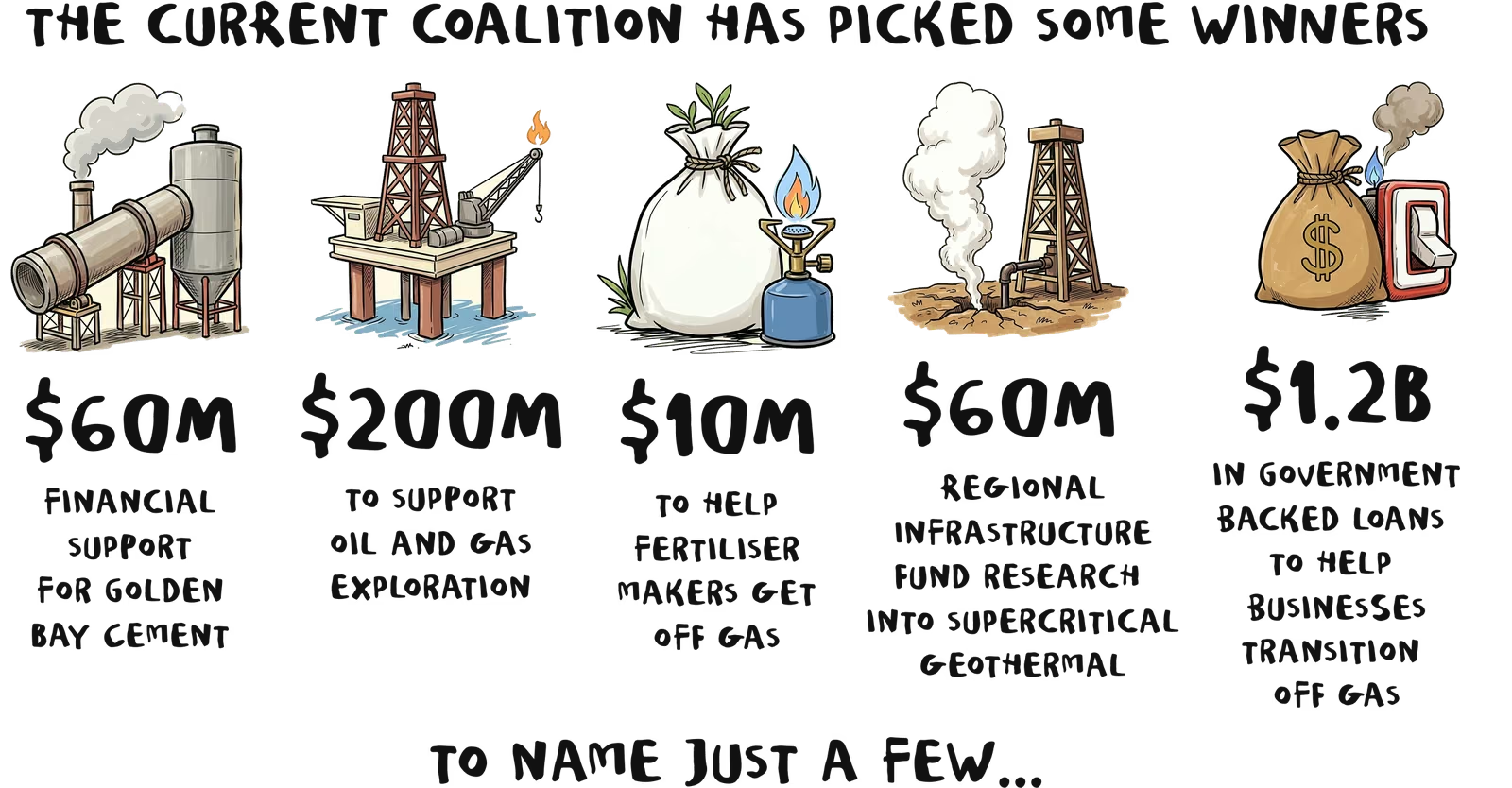
Past Governments in New Zealand have focused more on supporting businesses with subsidies. Recently, we’ve seen the Government offer $60 million in financial support to Golden Bay Cement, $200 million to support the oil and gas industry after the ban by the previous Government, $10 million to help fertiliser manufacturers get off gas, $60 million from the Regional Infrastructure Fund for research into supercritical geothermal, and $1.2 billion in Government-backed loans to help businesses transition off gas, to name just a few.
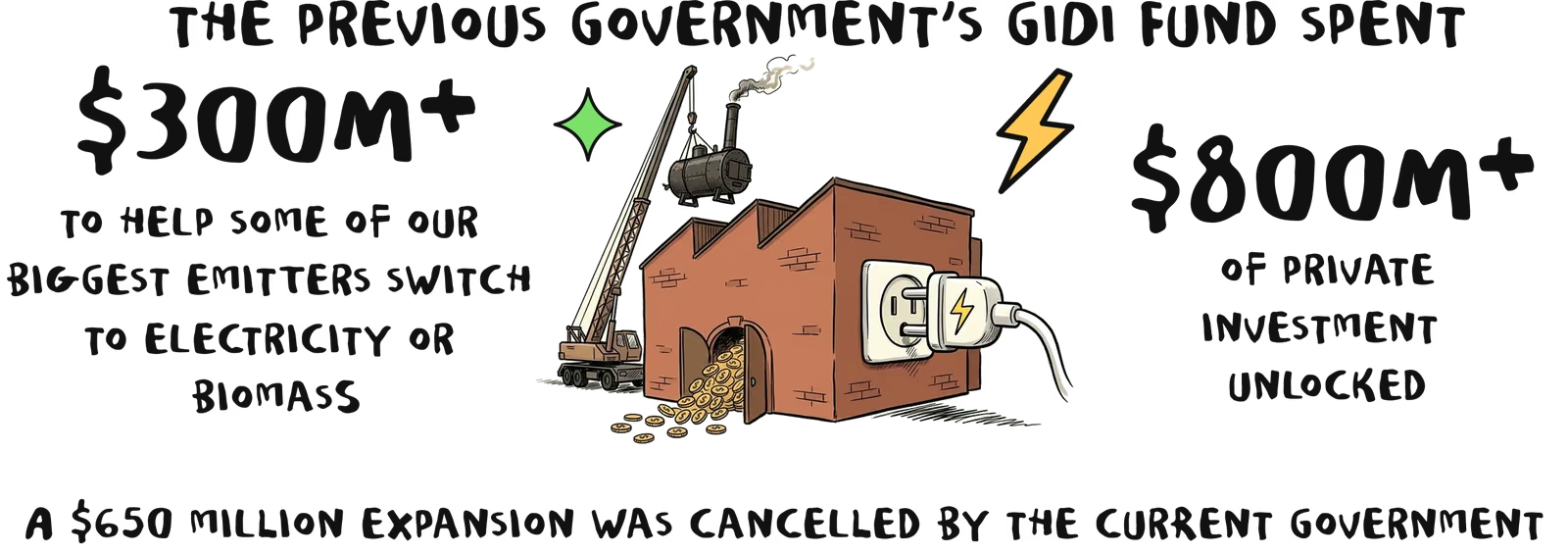
The GIDI Fund spent over $300 million to help some of our biggest emitters transition to electricity and it unlocked over $800 million of private investment. The fund paid around half the cost of Glenbrook Steel Mill’s $300 million upgrade to an electric arc furnace and Fonterra used $90 million from the fund to upgrade a number of its coal boilers to biomass or electricity. A $650 million expansion of the scheme was cancelled by the current Government.
Subsidies for households have been less common, but the Warmer Kiwi Homes scheme aims to improve health outcomes by offering discounts on insulation and heat pumps to low-income homes.
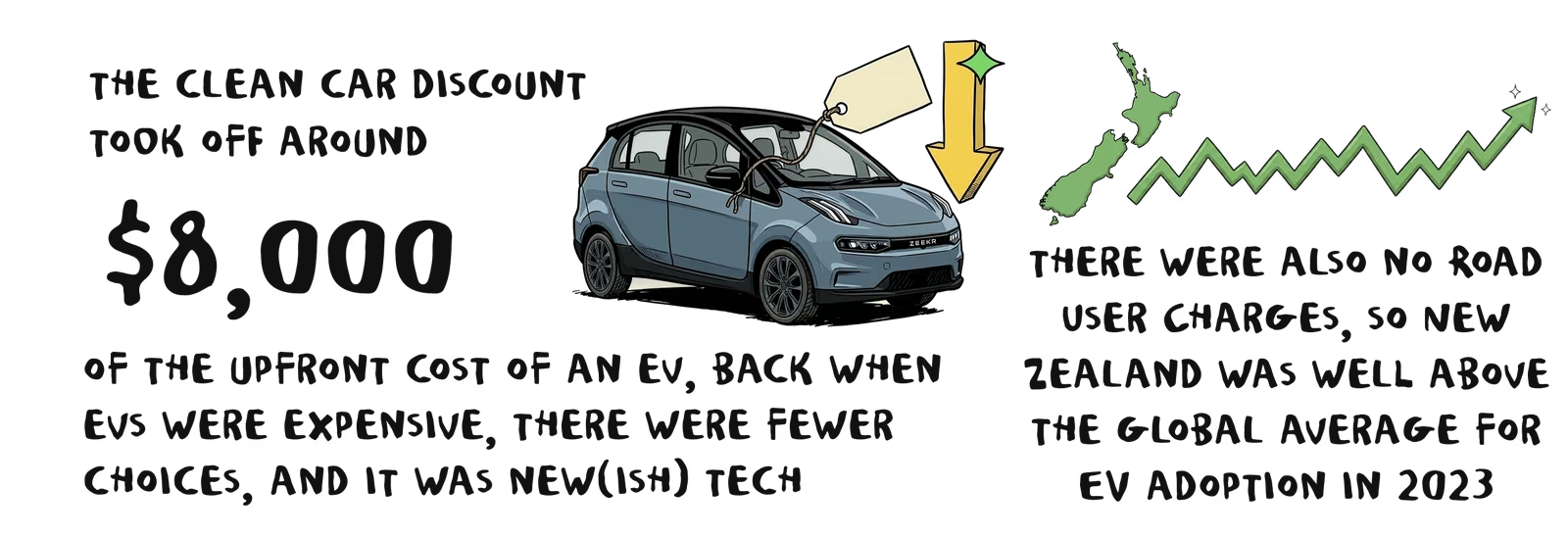
In an effort to incentivise EV uptake and reduce transport emissions, the Clean Car Discount took around $8,000 off the purchase price of a new EV, with second-hand vehicles and plug-in hybrids getting smaller discounts.
The Clean Car Discount policy embraced the classic carrot and stick approach. The incentive certainly did a good job of driving EV adoption and tapped into the very human impulse of FOMO, but the disincentive added a fee to anyone buying a high-emissions vehicle to help pay for it.
For many farmers and tradies (as well as the Opposition), it became known as the ‘Ute Tax’. The stick largely paid for the carrot, but there were no good pure electric options for ute drivers at the time, so it’s not hard to see why this policy created social division.
The current Coalition has repeatedly used the Clean Car Discount as an example of wasteful spending or middle class welfare and repeatedly claimed it ‘only helped millionaires in Remuera buy Teslas’ (even though the most popular car was a Nissan Leaf).
In addition, EVs didn’t have to pay Road User Charges and these policies meant New Zealand was well above the global average in terms of EV adoption in 2023. These incentives were removed by the current Government and uptake levels dropped rapidly. The vehicles purchased during this scheme are still here in New Zealand - and will continue to benefit their owners as petrol prices continue to climb.
What subsidies are still available?
The Low Emissions Heavy Vehicle Fund is still on offer and gives up to 25% off the upfront cost of “new zero and low-emissions heavy vehicles, and up to 25 per cent of the cost to convert existing higher-emitting heavy vehicles to be powered by low-emissions technology”.
While light EVs lost their discount and RUC dispensation, heavy electric vehicles (with a gross vehicle mass over 3.5 tonnes, including electric trucks and buses) are exempt until June 30, 2027.
Despite these incentives and the high cost of diesel this year, uptake has been slower than expected for trucks, although many councils have invested in electric buses and the fleet is growing rapidly. Lack of appropriate charging infrastructure for heavy vehicles is often cited as the main reason behind low uptake levels, something the Government could address with more targeted investment. This shows that Government policy is often a dance between supply, demand and infrastructure.
What would be the best investment in New Zealand?
As Drive Electric chair Kirsten Corson wrote in Newsroom recently: “In the year to July, New Zealand spent $12.1 billion importing petrol, diesel, and other fuels. That is $2.3 billion more than the year before, and Stats NZ says the jump came from the cost, not from us using more fuel. It works out at $33 million a day. About $2260 for every person in the country.”
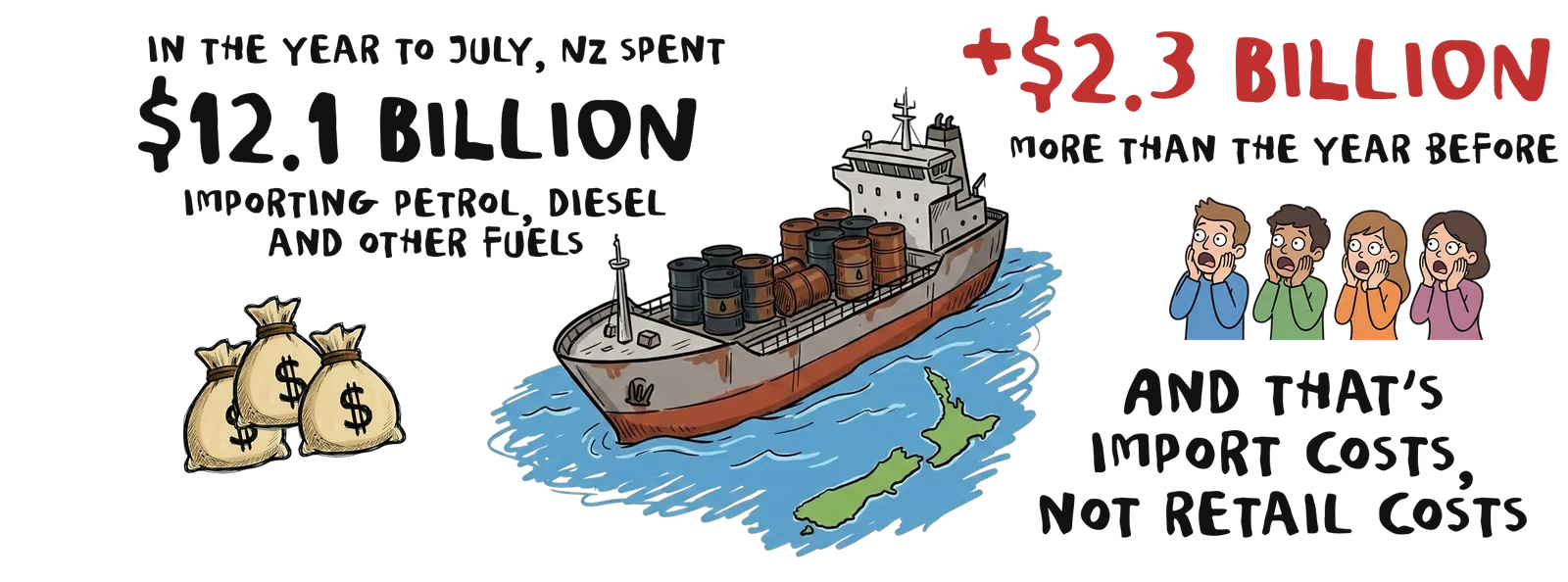
These imports then get marked up, taxes are added, and New Zealanders pay a much higher rate at the pump.
Where EVs make the most sense is in countries with plentiful and cheap renewable resources, small fossil fuel industries and no car manufacturing. And for that reason incentivising EVs would have the biggest bang for buck, although we suggest it be done in a different way to the Clean Car Discount.
More than half our total energy is imported and the high fuel prices in 2026 have had a major impact on the economy. While there is significant attention on rising electricity prices at the moment, around 60% of the average home’s energy bills are on fuel and Statistics NZ recently said that petrol “was the largest upward contributor to the annual inflation rate”. History suggests that fuel costs will continue to rise over time.
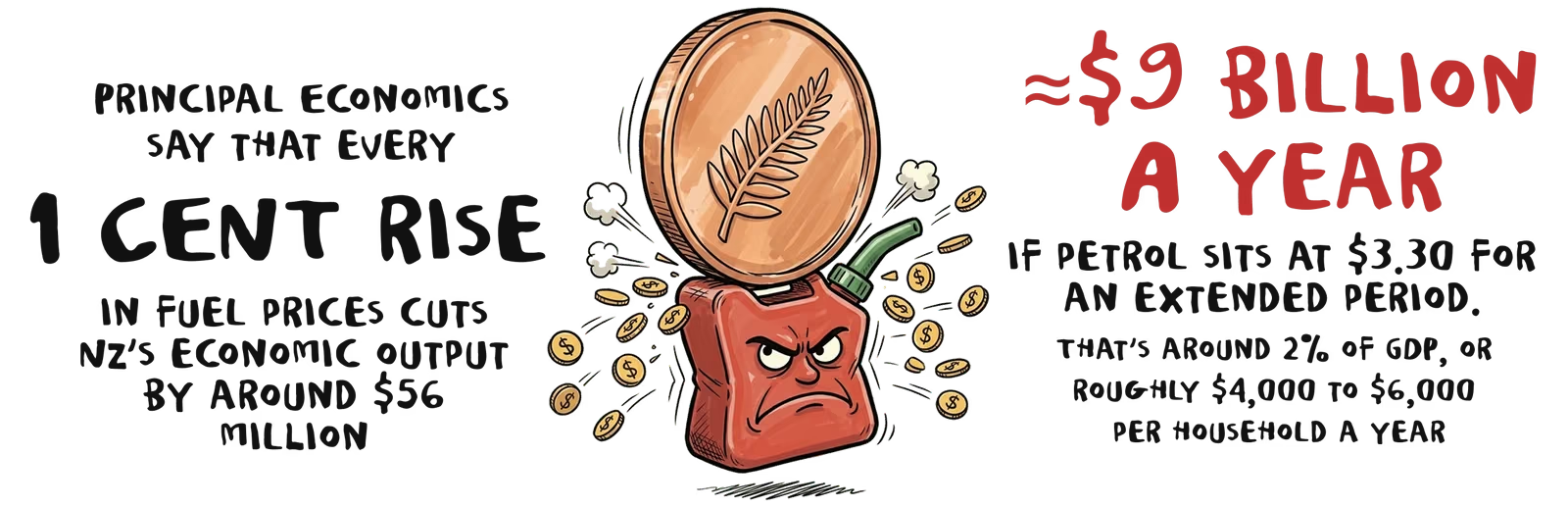
In March, just after the Middle East conflict kicked off, Principal Economics suggested that a 1 cent increase in fuel prices reduced New Zealand’s economic output by around $56 million. With prices at $3.30 for an extended period, it said it would cost approximately $9 billion per year.
“This is equivalent to around 2% of New Zealand’s GDP, or roughly $4,000 to $6,000 per household annually.”
How would EV incentives help the country?
As an idea of scale, our largest physical export product, concentrated milk, brings in about $10 billion every year. When you export something, you don't get all that money, because you also have the cost of producing what you export. When you import, it's the opposite, you pay all of it, and then often further markups before it reaches you. So the economic opportunity of switching from running our machines (industrial, vehicles, and otherwise) to New Zealand made electricity is likely near as big as one of our biggest industries.
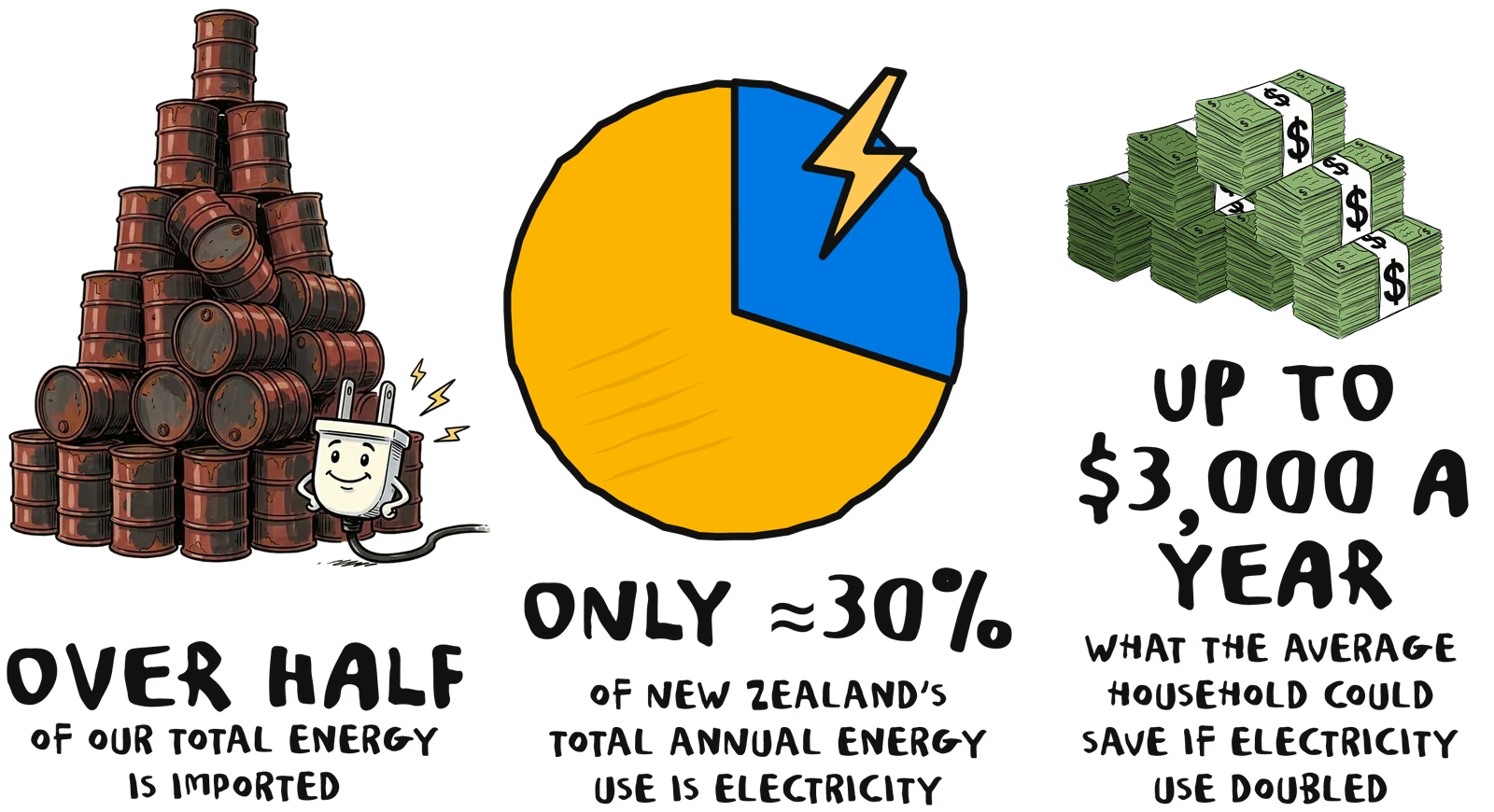
Genesis Energy chief executive Malcolm Johns also pointed out recently that electricity only makes up around 30% of New Zealand’s total annual energy use. If that were to double, the average household would be saving up to $3,000 a year.
According to energy consultancy Ember, New Zealand's EV adoption rates are on the up, but we’re a long way behind the leaders. And with our 160k EVs and plug-in hybrids, that’s estimated to avoid 867,000 barrels of oil every year and save US$86 million.
Given we have no refining capability, the savings are likely to be much higher (and given we pay some of the highest prices in the world for petrol and diesel at the pump, the savings for customers are likely to add up to a bigger number).
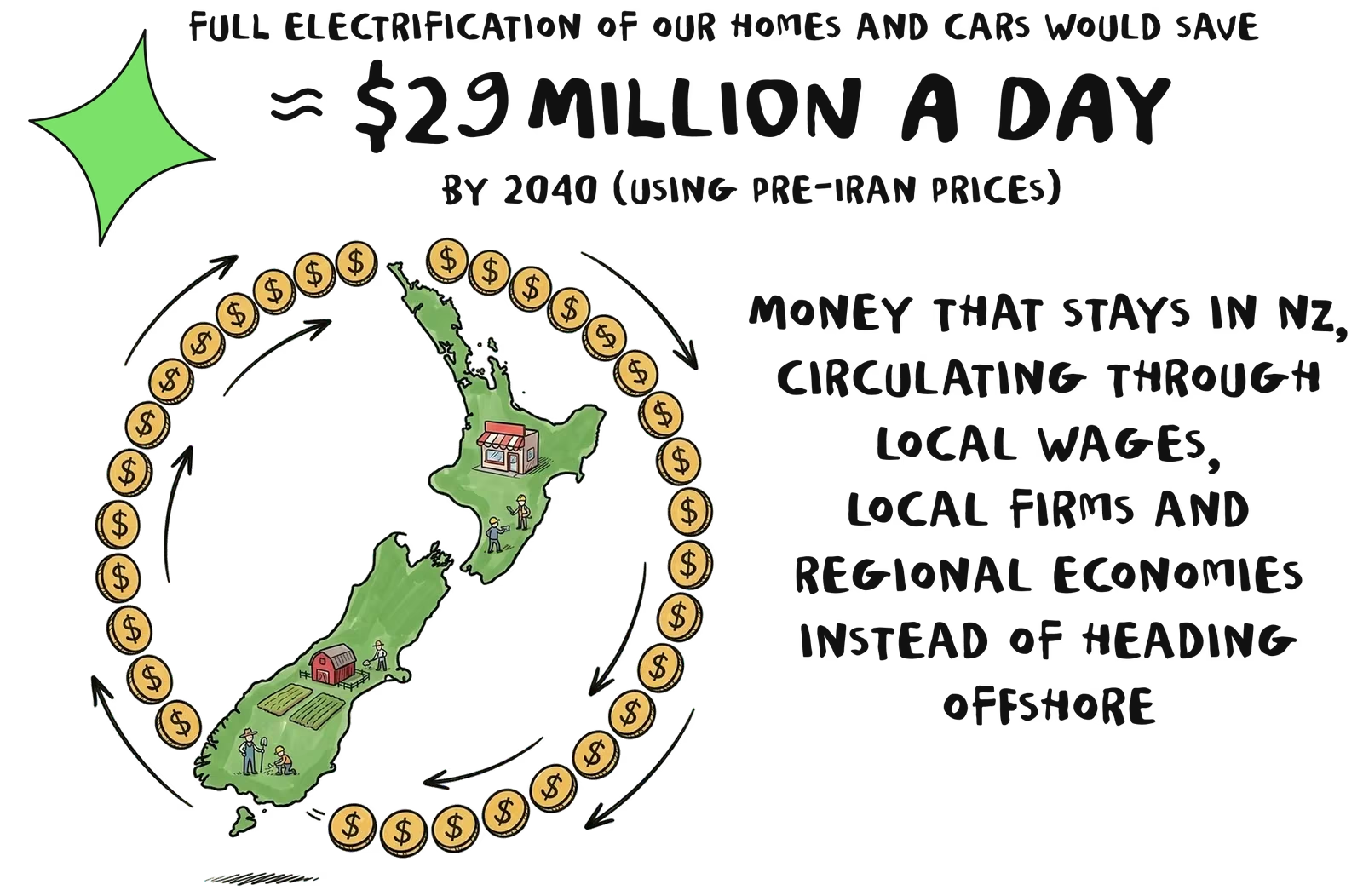
Full electrification of New Zealand’s homes and cars would save approximately $29 million per day by 2040, and that is money that stays in New Zealand, circulating through local wages, local firms, and regional economies instead of heading offshore.
An EV incentive should be thought of in the same way as investing in industrial modernisation and capacity. If we can save an essential worker $2,000 a year by helping them get into an EV, while delivering net benefits to the economy greater than the cost of those subsidies, then that is a good investment in the interests of New Zealand.
Doing so would create net savings for the vehicle owner, and it would also then be charged with electricity from New Zealand. There are negative perceptions around electricity companies right now, but most of that money would flow through the New Zealand economy, rather than just being sent offshore. And if you’re charging your vehicle using your own solar, the savings will be even greater.
Every EV on the road reduces the need for fuel imports and means our existing liquid stocks will last longer in an emergency for the vehicles that really need it. Modern EVs can also be used to power buildings or appliances after natural disasters. And for these reasons, the Government could get its own house in order and electrify its assets, something we laid out in a policy think piece called 'Powered from Within'.
Channel Infrastructure, the country’s largest fuel importer, said that “petrol and diesel demand will remain higher for longer as weaker economic conditions slow vehicle replacements”. This might be good for Channel and the fuel industry, but it’s bad for the economy and it is a good reason for the Government to get involved, speed up adoption of electric vehicles and reduce that reliance.
Electrification buys not just protection from this fuel shock and the next, but a permanent structural upgrade to the New Zealand economy: cheaper to run, cleaner, more productive, impossible to blockade and providing extra resilience in emergencies. Countries spend fortunes on energy security they hope never to use. This would be energy security that pays for itself whether the crisis comes or not.
What can Australia teach us?
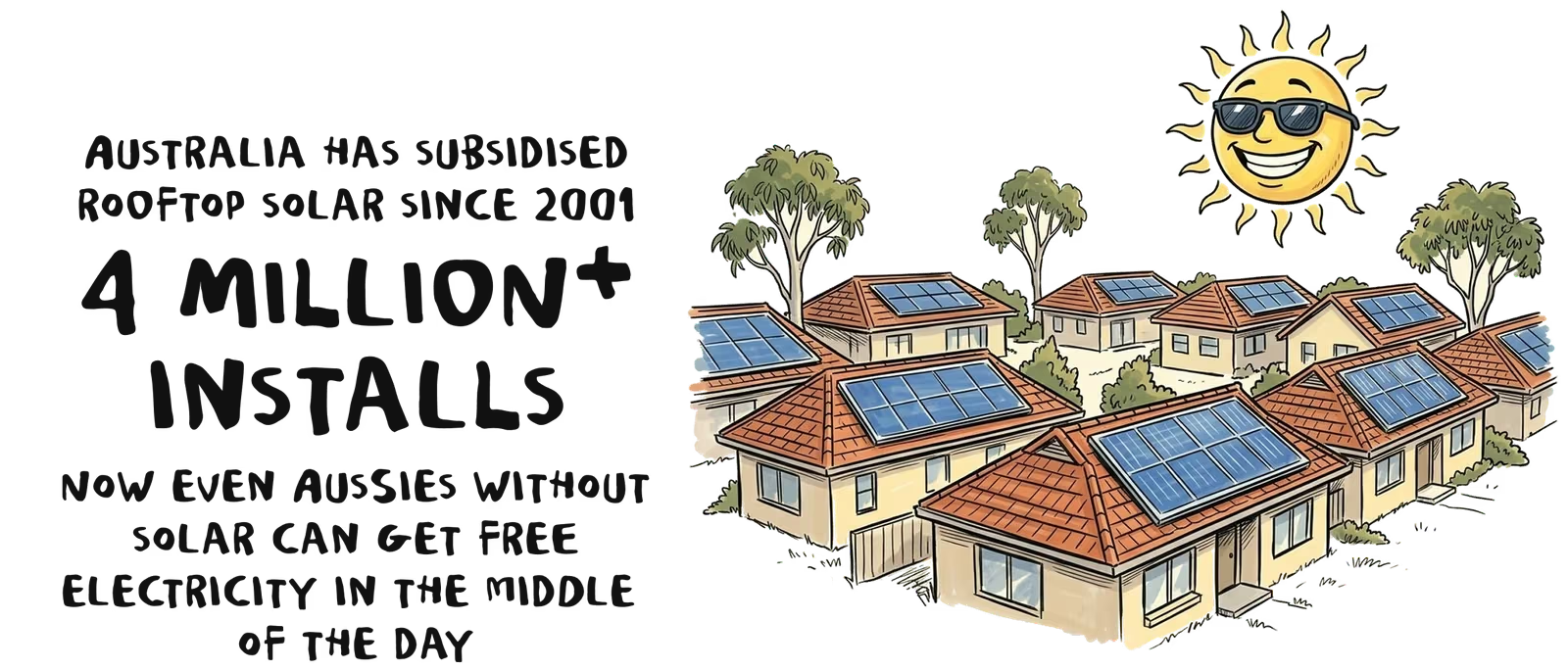
Australian federal and state governments have used subsidies to reduce emissions, build energy infrastructure, decrease reliance on imported fuel and create new industries.
First, there were generous subsidies for rooftop solar as part of John Howard’s Renewable Energy Target in 2001. Back then, solar was very expensive and Government support was needed to make it accessible.
Export rates were also generous to help speed up payback and there was also significant workforce development.
One of the main goals was to reduce the reliance on coal-fired electricity via the grid and the associated emissions. This is very different to New Zealand, which has a highly renewable grid.
There have been criticisms about the money going to wealthier households, but well over four million homes now have solar and the rapid rollout has been called the ‘solar miracle’ and created thousands of new jobs.
Government support unlocked private investment and has helped drive down the price of electricity. There is now so much excess solar in the system during the day that electricity is available to Australians for free between 11am - 2pm, which shows how benefits to individual households can expand outwards.
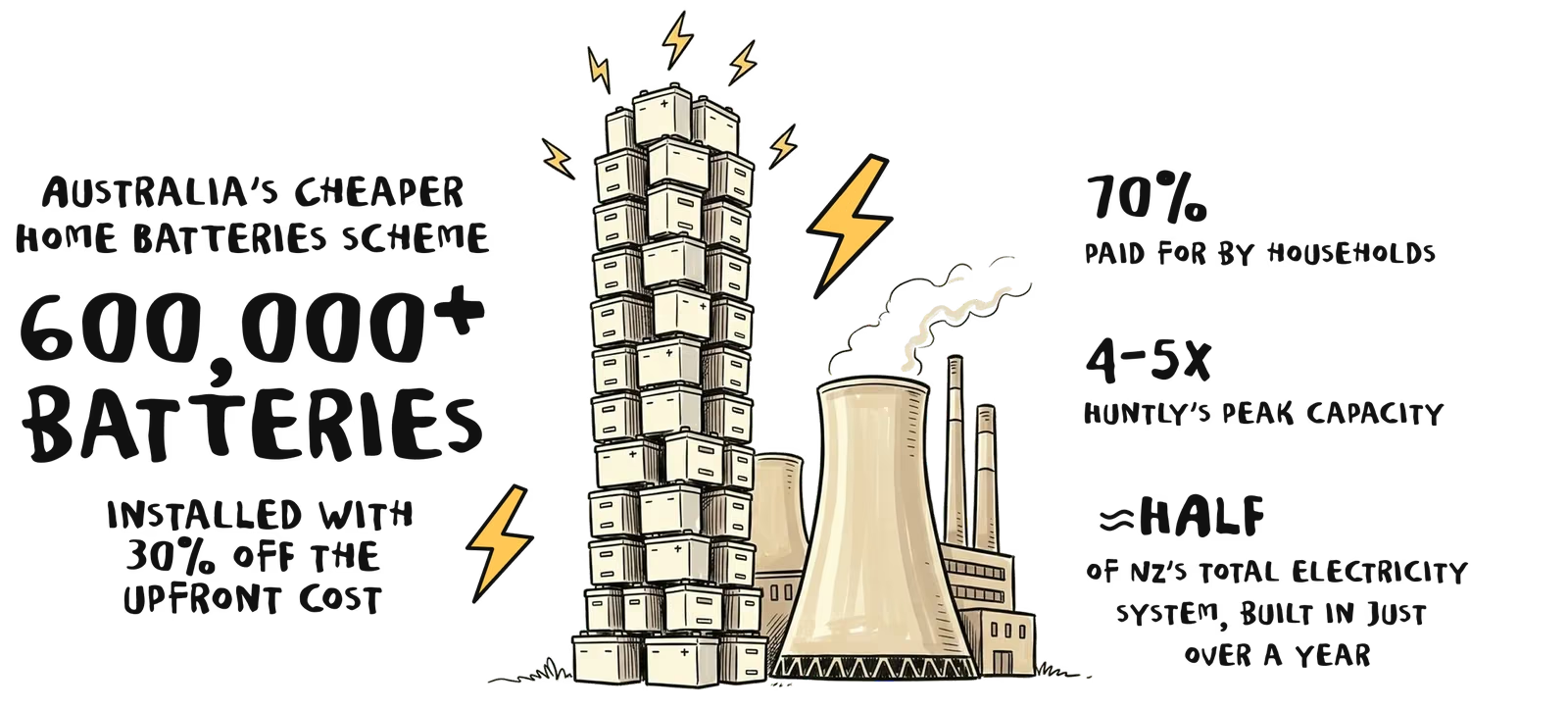
More recently, the Australian Government has increased incentives for businesses to install solar on larger rooftops and introduced the Cheaper Home Batteries programme, which offered a 30% discount on the upfront cost and has led to over 600,000 batteries being installed since it launched in July last year.
The Australian battery scheme has built around half of New Zealand's total electricity system in just over a year - or around four or five times Huntly’s peak reduction capacity - and households have paid for 70% of it.
It’s extremely unlikely that one of our gentailers would pay 70% of the cost to build an investment of this scale (and it would be impossible to do it that quickly) and yet there it is in Australia’s energy system, helping to bring costs down for everyone else by lessening the need for gas at peak times and expensive upgrades to poles and wires.
Australia has also decided to support EV adoption and sales of electric vehicles overtook petrol vehicles for the first time in August. Around half of those EVs were purchased through a ‘novated lease’ scheme, which allows employees to lease a new or second-hand EV using pre-tax income at a lower cost than a comparable petrol car.
EVs do not need to pay Fringe Benefit Tax and a 5% import tariff on eligible electric vehicles that met specific fuel-efficiency criteria was removed.
The Government spent a lot more on the novated lease scheme than it budgeted, but rather than removing it, it has adjusted the settings, keeping the benefits strongest for essential workers. We are proposing a lower-cost scheme that would provide significant benefits to workers, but at a more manageable cost to the Government.
Australia also charges higher fees for high-emitting vehicles than New Zealand to ensure more low-emitting vehicles are imported. In New Zealand, while the Clean Car Standard was wisely retained, we have reduced the fees for high-emitting vehicles.
What’s the best way to do it here?
Many people would like an EV - and those who earn the least spend a higher proportion of their income on fuel so would benefit the most from the savings - but the upfront costs are the biggest barrier.
It’s clear that the opposition is sensitive to the criticism it received over the Clean Car Discount, but just because this subsidy was not particularly well-designed and overly complex doesn’t mean subsidies aren’t valuable. The context has changed considerably since it was in place - in terms of the technology that’s now available, the cost-of-living crisis and a geopolitical situation that's driving up fuel prices.
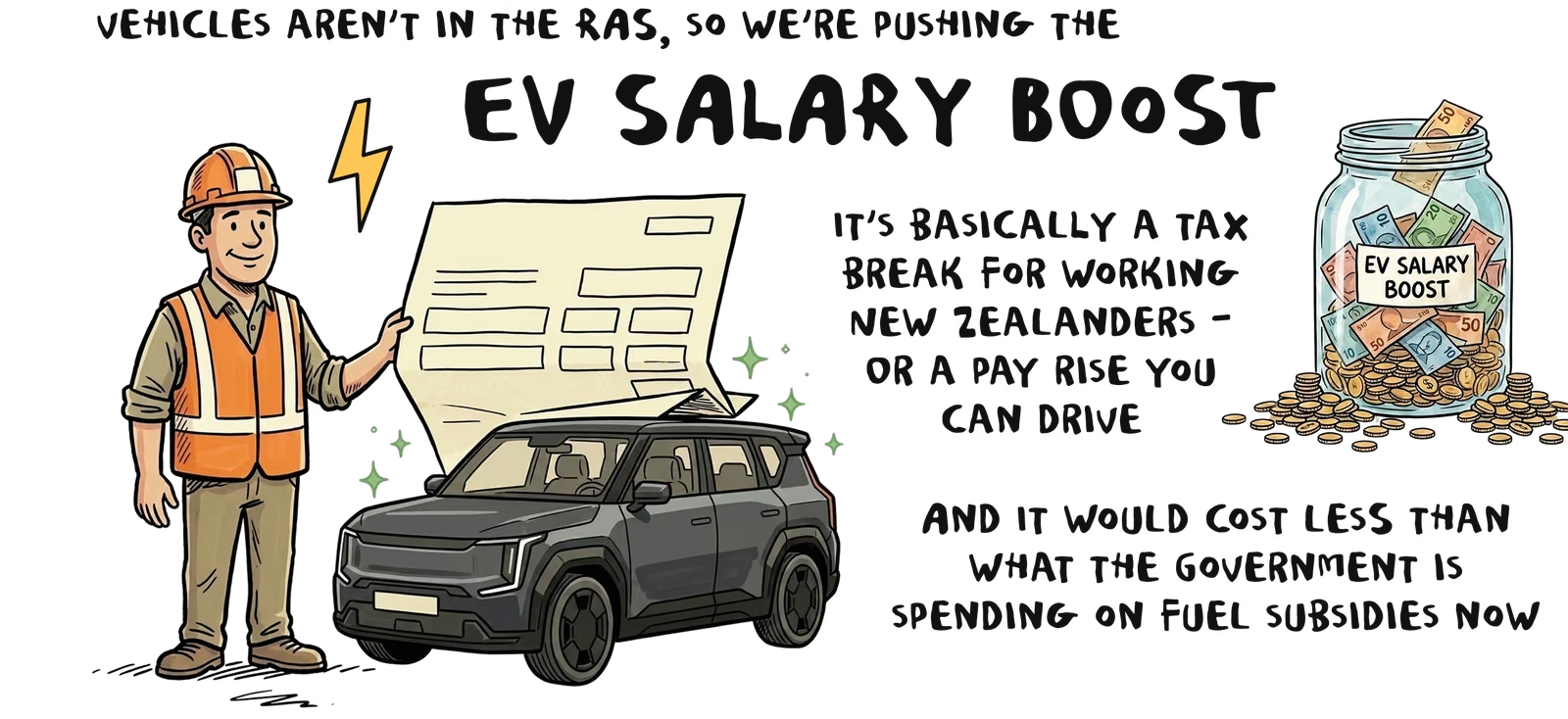
The policy we favour is the EV Salary Boost, which is basically a tax cut that’s specifically aimed at workers who may have previously found it harder to get into an EV. Rather than an upfront discount, this scheme would allow employees to lease a new or second-hand EV using pre-tax income at a lower cost than a comparable petrol car. Or, as we like to say, it’s a pay rise you can drive.
This is a tax break for working Kiwis so the Government misses out on some tax revenue, but it would come at a lower cost than what the Government is currently spending on fuel subsidies (and it doesn’t need to pay anything out of its accounts).
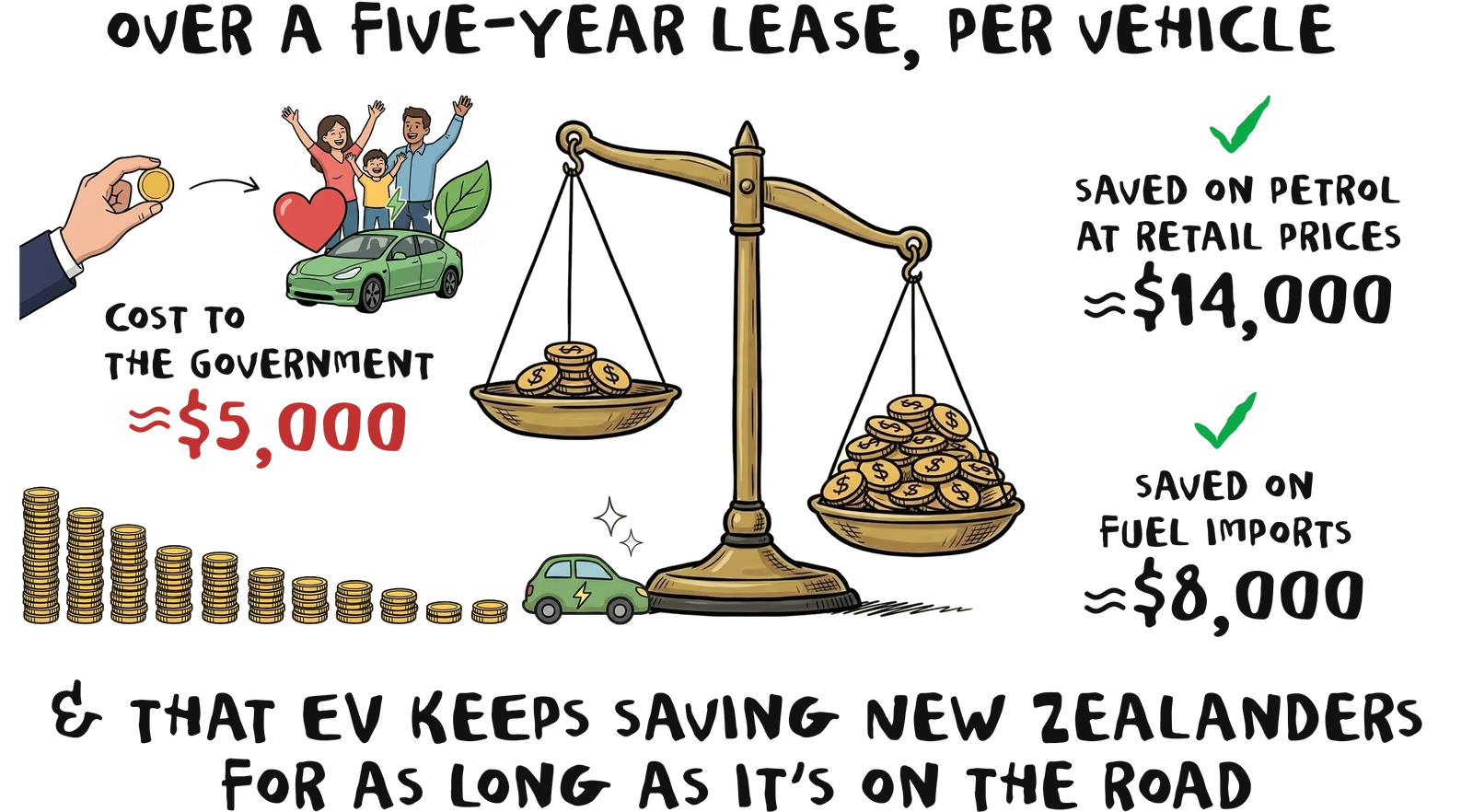
If the cost of this programme to the Government was about $5,000 per vehicle over the five years of the lease, that worker wouldn't be buying petrol, which at current prices would save them around $14,000 (at import costs, that’s around $8,000 saved per vehicle on foreign oil products). And these benefits would last for the life of that vehicle as it goes into the second-hand market.
In addition to EV Salary Boost, an argument could also be made to offer another discount off the upfront cost to enhance energy security as it could avoid billions of dollars of economic damage from petrol price increases (or complete economic meltdown if the boats don’t show up with our petrol and diesel). Unlike the Clean Car Discount, this type of subsidy should be reduced over time to force consumer decisions to be made quickly and be tied to income levels, as many of those who have the capital are already able to do it.
Transitioning a whole fleet takes a long time because cars could be on the road for 20 years in New Zealand (we have one of the oldest fleets in the OECD). In Norway, for example, almost all new cars are now electric, yet the total fleet is only around one third electric and the Government has been incentivising uptake for decades.
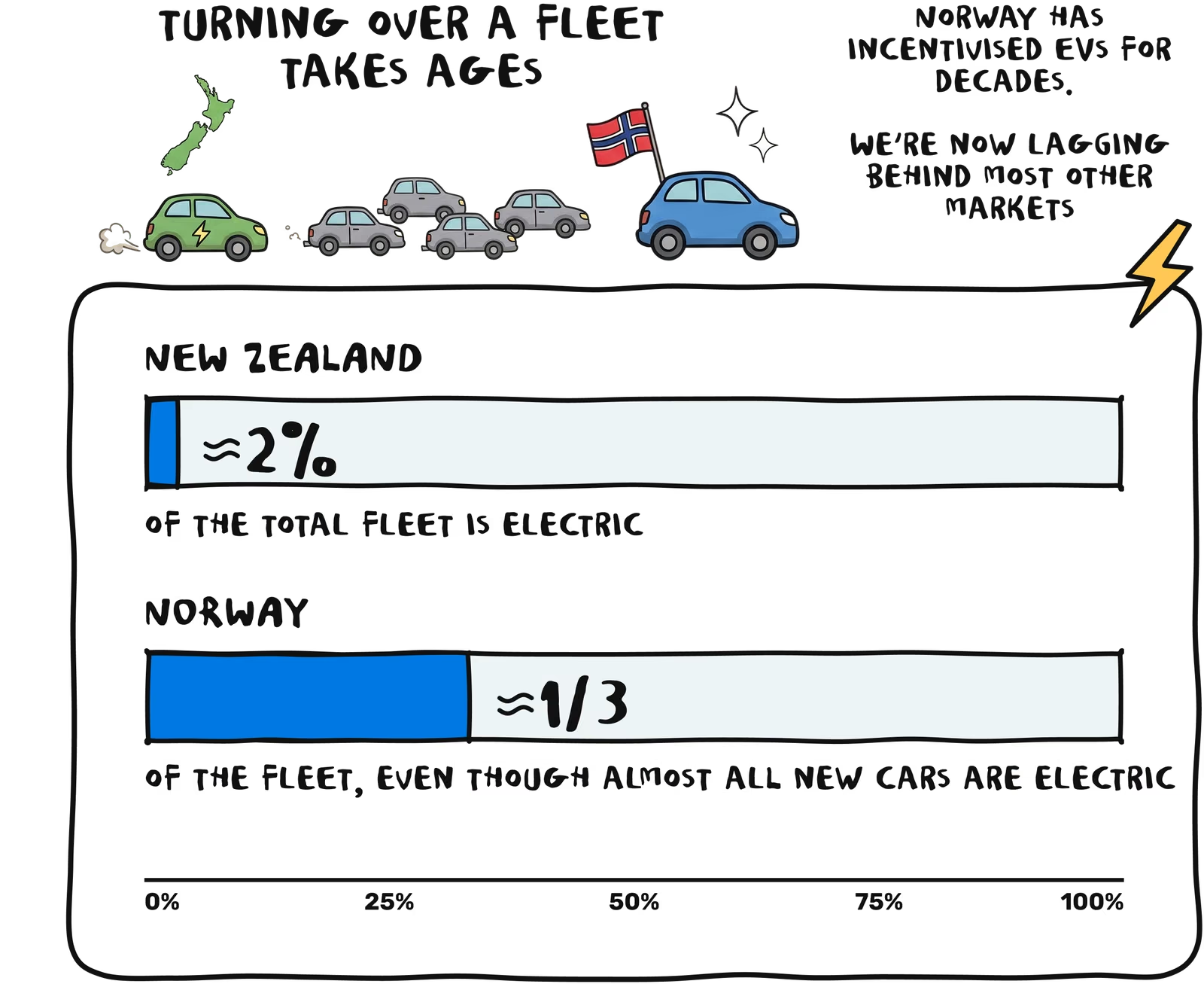
In New Zealand, around 2% of the fleet is fully electric and we are now lagging behind most other markets.
What about plug-in hybrids?
Recent sales figures show EVs at 13% share of total new cars sales this year, with plug-in hybrids on 10%. We don’t believe PHEVs should be subsidised because they don’t really help solve our problems.
PHEVs talk a good game and, in some cases, with electric range growing for some models, they can meaningfully reduce fuel use. But the battery relies on users charging it and recent research from the EU suggests they can emit six times more (i.e burn much more fuel) in the real world than in lab tests. Maintenance is also more expensive and even if users charge it enough every day to do all their driving off the battery, they often ned to burn the fuel every few months so it doesn't go off.
These days, we don’t need to half-ass it with hybrids when we could cover our asses completely with fully electric vehicles, which save owners more money and completely remove the need for expensive imported fuel.
What about incentivising solar and batteries?
Many people would like a subsidy but it is not necessary to make solar economic because it is already the cheapest delivered electricity available to New Zealand households and adoption is growing rapidly as a result. Access to upfront capital is the primary barrier to uptake and that is why long-term, low-interest loans through the Ratepayer Assistance Scheme (RAS) is such an important policy.
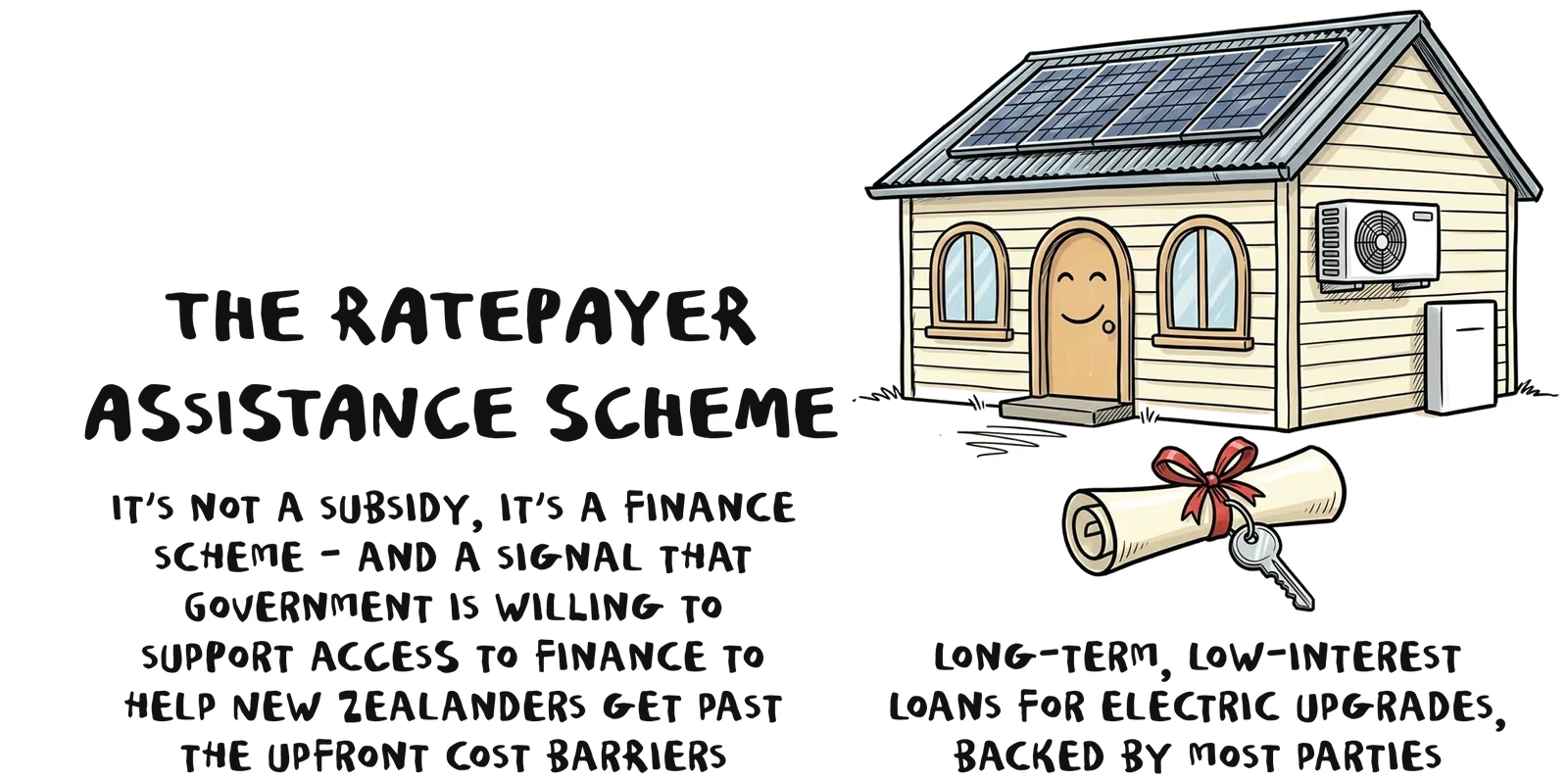
It’s important to note that if the RAS is offered at market interest rates, it’s not a subsidy, but it is a signal. It’s a finance scheme that harnesses the low interest rates that the Government is able to access. But there is an argument to subsidise solar if it was to increase energy security and create additional generation.
Right now, the Government is proposing a Liquefied Natural Gas import terminal to deal with the dry year issue, even though a range of experts and many in the sector say it is not necessary for electricity. That’s likely to be well ‘north of a billion’, as Simon Watts said when it was announced.
Solar may not be the best way to solve the dry year problem on its own. But more solar is one of the primary ways of keeping water in our hydro lakes for when it is really needed and Rewiring research from 2025 showed that a rapid solar roll out would give us almost one month of additional storage, something that's particularly important in a dry year.

It’s estimated we will need to double the amount of electricity generation in New Zealand by 2050 as we electrify transport and industry and potentially add new users like data centres. Some believe we will need more than that. Our large gentailers and energy companies are crucial but, as we have seen in Australia, distributed generation and storage adds up and that infrastructure has been primarily funded by households. In New Zealand, our estimates suggest solar installs on 80% of our homes and all our farms would allow us to double our current generation.
There is also a strong argument for subsidies to improve the economics of batteries and help reduce network costs. New poles and wires end up on customers’ bills and this has made up the biggest chunk of electricity bill increases in recent years and is set to continue. Batteries are included in the RAS (but vehicles are not) and while they don’t really help with the dry year issue, which is seasonal in nature, every home, farm or business with a battery reduces pressure on the network at peak times and can also reduce the need for fossil fuels in our electricity market.
Given the local resilience benefits and broad network savings from lots of batteries in homes, we would encourage subsidies on batteries over solar.
Is reducing emissions still a good reason for subsidies?
There has been plenty of talk about the willingness of our political parties to stay in the Paris Agreement and therefore attempt to meet our international obligations. The Prime Minister has said staying will be a bottom line, but that it won’t be “sending billions offshore to buy foreign offsets”. These emissions come with a cost - and so they should - and meeting them at home by reducing emissions (rather than offsetting them through trees or overseas units) is in our best economic interests.
In preparing our Machine Count report, we counted 10 million fossil fuel machines in New Zealand. 84% of these can be electrified now economically, including EVs. The issue is the initial cost is often higher, but those emissions reductions are there for the taking, and we should just get on with it. We may still have to pay to address any shortfall, and we should, but that shortfall will be much smaller if the Government incentivises the right purchases.
What about avoiding health costs?
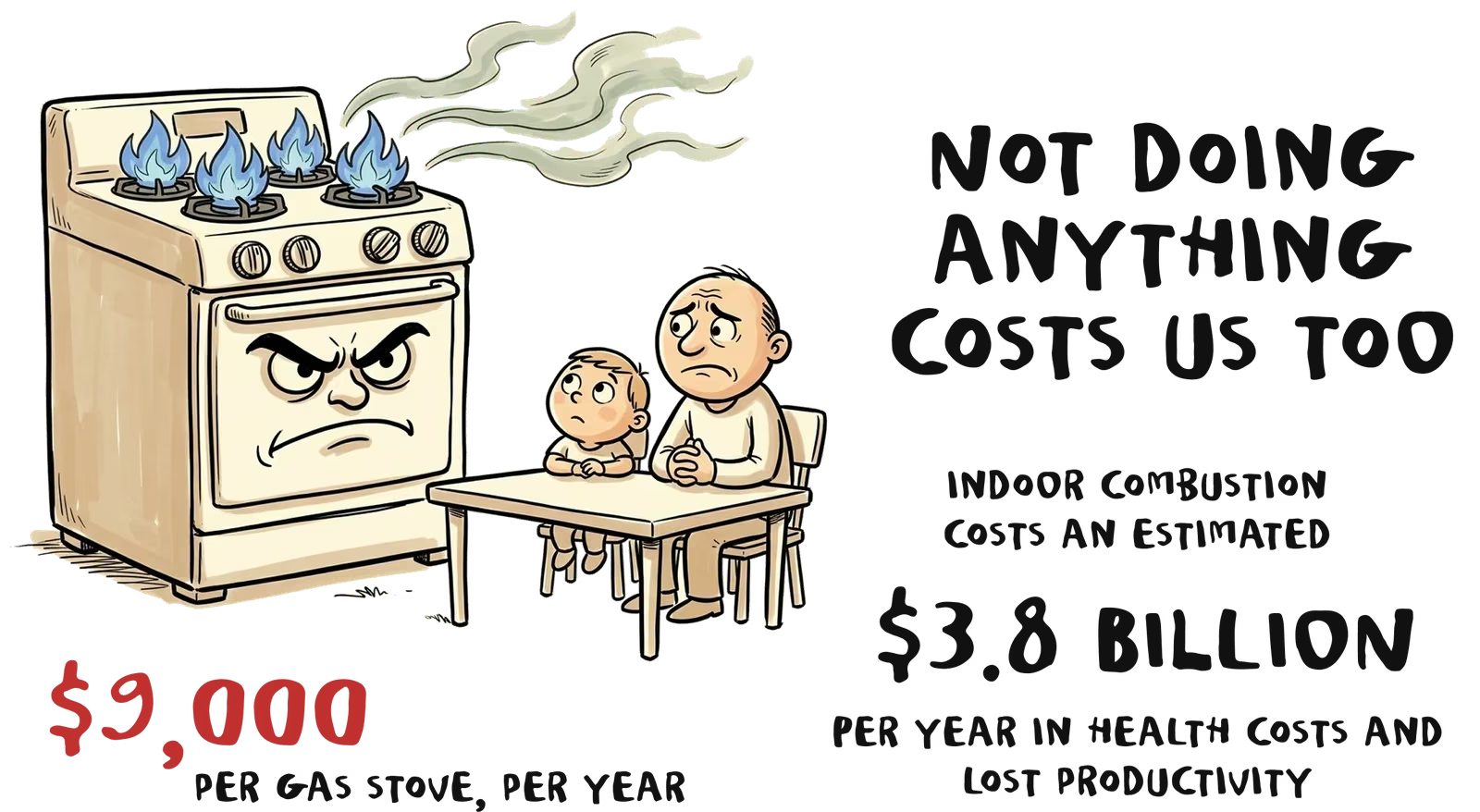
The health impacts of burning fuel or gas are often overlooked, but they are significant. Gas appliances are linked to 200+ premature deaths and 3,200+ child asthma cases in New Zealand every year. The estimated cost from indoor combustion in productivity and public health outcomes is $3.8 billion annually, or $9,000 per gas stove per year.
Air pollution from transport results in premature deaths for 2,200 adults, and an estimated social cost of $10.5 billion.
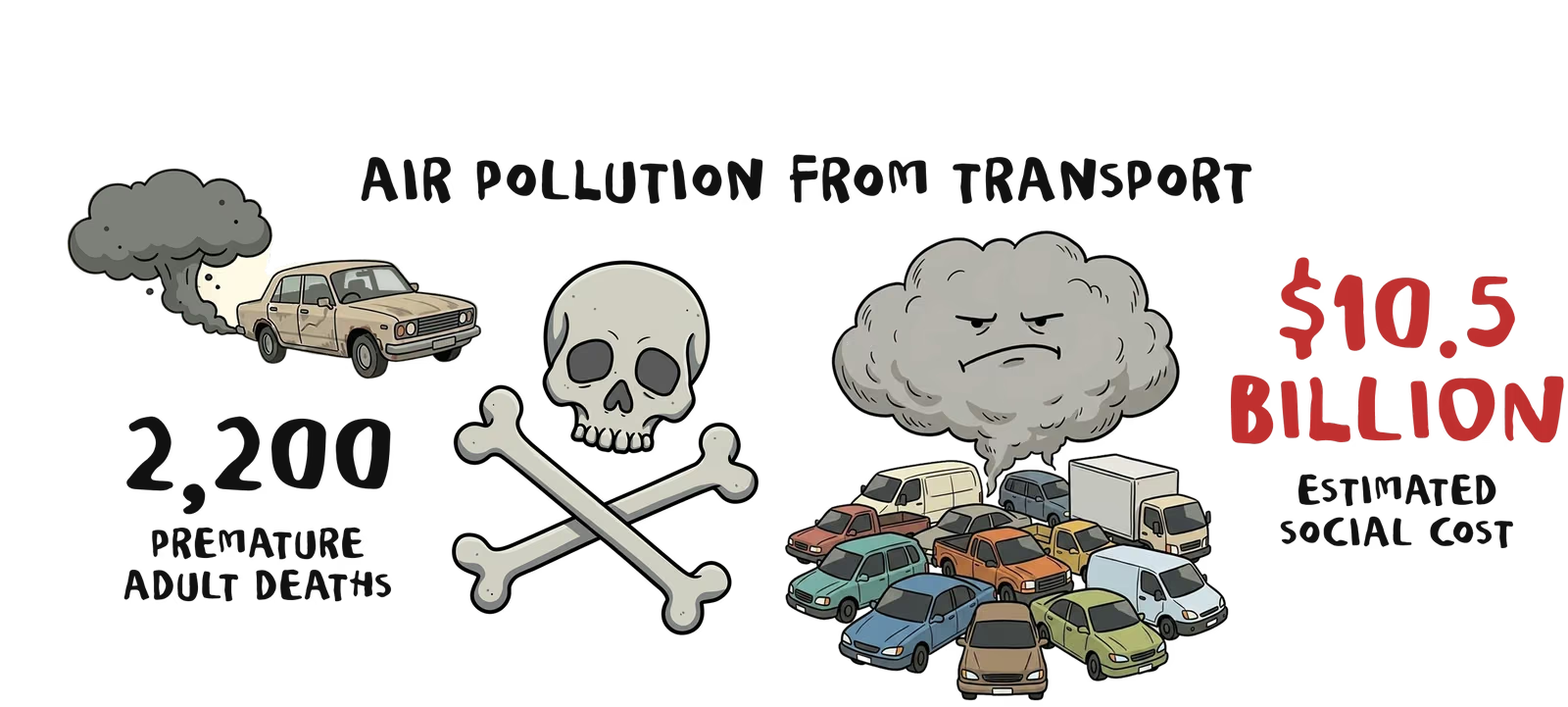
Avoiding these kinds of costs should be built into the benefits of electrification policies.
What incentives are the parties currently offering?
- Check out all the energy policies side by side here.
National announced its Investment Boost policy in May 2025. It “allows businesses to immediately deduct 20% of the cost of new productive assets … from their taxable income, on top of normal depreciation”. In the spirit of not picking winners, it didn’t restrict these incentives to electric upgrades and they could be used for anything.
It also chose to subsidise fuel costs after the war in the Middle East kicked off and offered almost 150,000 families an additional $50 per week when the price of petrol went above $3 per litre. “Finance Minister Nicola Willis said the policy is estimated to cost a one-off $373 million [or around $7 million per week] to the Government, if it runs for the full year.”
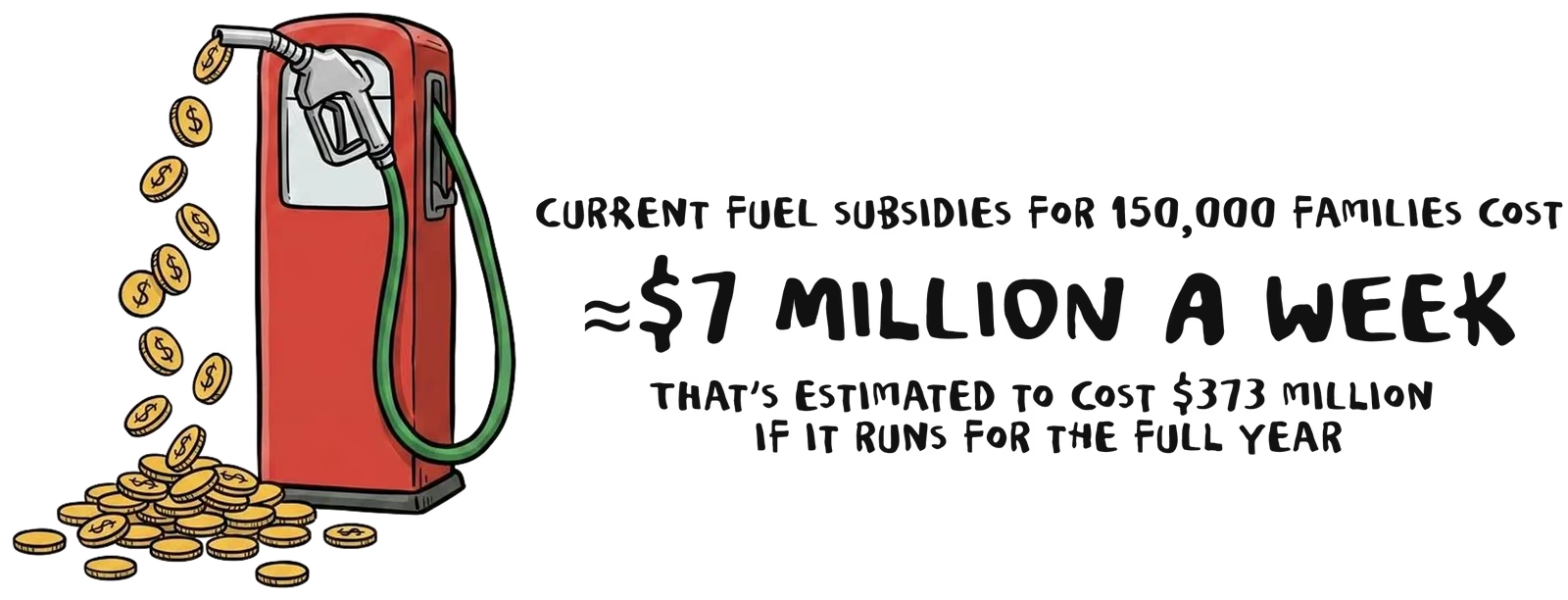
National and Labour have both agreed to delay a planned increase in fuel excise tax, which could be seen as a fuel subsidy and is another short-term band-aid that will have long-term ramifications.
National, Labour, the Greens and Opportunity are in agreement that homes and businesses need access to finance to help electrify their homes so they are all backing loans through the RAS. These loans are tied to the property and while it does require a small investment from central and local Government and legislation to get it started, the scheme will eventually wash its own face and make money.
The Greens and Te Pāti Māori are proposing to subsidise the interest rate of the RAS down to zero, which we don’t think is necessary, while both Labour and the Greens would offer grants to low-income households, which we do think is necessary. The Greens have also said they would reintroduce EV incentives but have not specified what they would be.
ACT is philosophically opposed to Government involvement, whether that’s a sweetener to reduce the upfront costs or regulations that ‘punish’ (or, more accurately, price externalities) for more harmful things like, for example, cars that create more pollution. But it also wants to restore subsidies for carbon credits in certain industries (“90% free credits for highly exposed industries and 60% for moderately exposed companies”) and was supportive of the $200 million subsidy aimed at getting oil and gas going again after the previous Government’s ban on exploration.
The coalition Government also announced a $1.2 billion loan facility for businesses looking to transition away from gas (although it ignored advice and did not specify that they needed to shift to electricity).
Meanwhile, Opportunity announced a $1 billion Energy Resilience Fund offering concessional loans, targeted grants and assistance to businesses wanting to electrify. The gas shortage is a major structural weakness in the New Zealand economy and electrification is the solution for many industries, but the path is often complex and expensive. It has also proposed accelerated depreciation and fringe benefit tax relief to incentivise businesses to buy EVs, something we have been pushing for. The goal is to help businesses reduce costs while also seeding the second-hand market.
New Zealand First has yet to release its energy policy manifesto but it is proposing the Government spends $1 billion to survey for oil and gas. This is a risky bet and will only help the fossil fuel industry. It has also proposed removing the ETS tax that is paid at the pump.
Time to dangle some carrots
It is good to see the broad agreement on the need for finance and the RAS being set as a baseline, with varying degrees of Government support added on top. But given so many New Zealanders are struggling with the price of fuel and our economy is being dragged down by these spiraling costs, it's surprising there are so few EV policies.
We continue to subsidise fuel or look for short-term fixes rather than finding ways to permanently reduce our reliance on it. But subsidies, incentives and infrastructure investment that would increase electrification are a pragmatic, pre-emptive, long-term response.
Governments often say they don’t want to pick winners and believe we must be ‘fuel agnostic’. But there's a difference between not picking winners, and not BACKING obvious winners. This agnosticism can sometimes mean that the Government ends up picking losers and turning them winners.
We need to see EVs - large and small - and distributed generation as an investment in energy security, equivalent to the Government paying to add more fuel storage. We need to see solar as an investment into a more productive economy and a way to create cheaper electricity for more of our homes, farms and businesses. And we need to see electrification incentives for consumers as an investment into job creation and electrification incentives for businesses as an investment into job protection.
While subsidies can cost the government money in the short term, billions more would eventually flow through the local economy if we ran more of it on New Zealand-made energy. Sometimes, as the old phrase goes, you have to spend money to make money and if the Government incentivises electrification, the dividends will far exceed the investments.
Related posts
More Watt Now? posts from Rewiring Aotearoa
Dangling carrots: the argument for electrification incentives in New Zealand
Read More
Release the pressure: how the EV Salary Boost scheme would help consumers, communities and the country
Read More
Solving the dry year
Read More

Sun in a socket: plug-in solar
Read More
The case for energy loans
Read More

A bad case of gas
Read More

Scale and speed: why the climate needs electric vehicles
Read More

A future with two visions
Read More

Show me the money: the economics of going electric
Read More

Why electric vehicles matter
Read More

Why solar makes sense
Read More

Why going electric wins on emissions
Read More

Energy use in New Zealand
Read More
Closing The Loop
Read More
Electricity means efficiency
Read More
