Don't listen to Old Man Gas. Ditch LNG. Support New Zealand-made energy!

.jpg)

Rewiring Aotearoa agrees with many of the main themes in BCG’s Energy to Grow report - domestic gas is diminishing quickly and won't recover, our hydro and geothermal assets offer us big advantages in the energy transition, renewables are coming at the fastest rate ever, and bold and decisive action is needed in short term to “get out the other side with affordable and secure renewable energy”. But, just like its last report in 2022, it has largely failed to consider the people who actually pay the energy bills and failed to account for the huge role customers with solar, batteries and EVs could play in our energy system.
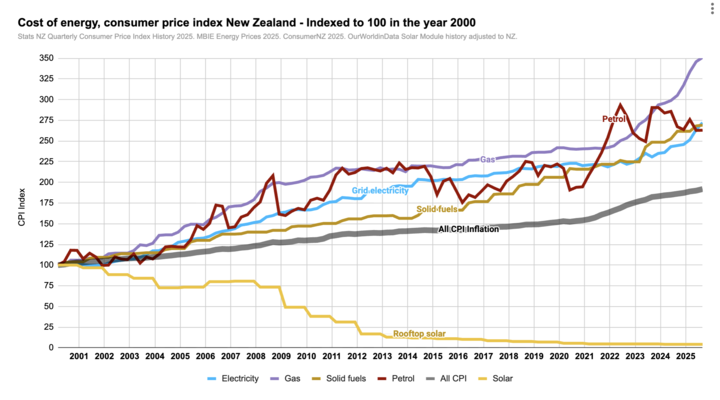
In its earlier report, The Future is Electric, BCG said that between 2022 and 2030 prices will not rise, yet since then we have already seen a slew of retailers announcing price rises due to higher wholesale prices and lines charges. Stats NZ said recently that electricity prices were up 12% year on year. Record numbers are struggling to pay their bills and people are worried about future price rises.
BCG has predicted a declining wholesale price in Energy to Grow: securing New Zealand's future and that is a good thing for the economy and our electrification ambitions, but most customers do not pay wholesale. They pay retail and the retail price of grid electricity has increased at above the rate of inflation for decades, just like petrol and gas. That is unlikely to change because the companies that generate and retail electricity are motivated by profit - and they have seen plenty of that recently.
BCG’s scenario 1, where New Zealand embraces our full potential, has very high electrification and doesn’t invest in a Liquified Natural Gas terminal, will bring the strongest economic growth and we agree because electrification is the biggest productivity opportunity the country has. This is the future Rewiring Aotearoa is pushing for, but they believe it requires more drilling support and stable gas supply, which we don’t believe is necessary. They also believe that the fast electrification scenario shows the highest household electricity prices.
Importantly, the report largely ignores the economics of household generation. The updated version of our 2024 Electric Homes report is set to be released soon and it shows the gap between fossil fuel homes and cars and electric homes and cars powered by solar and batteries has got even larger. We need a stable grid and more large-scale renewable generation, but the demand side (i.e. customers generating and storing their own electricity) continues to be overlooked. And that is a massive missed opportunity for the country.
Once again, there is a bias towards bigness in the report. The four gentailers paid for it (just as the Gas Industry Company paid Castalia to do its recent report), so it’s not surprising there is very little mention of rooftop solar and batteries because these technologies are a threat to their business.
As we keep pointing out, the cost of rooftop solar has continued to drop and it is now the cheapest delivered electricity available to New Zealand households, even when factoring in interest on a loan.
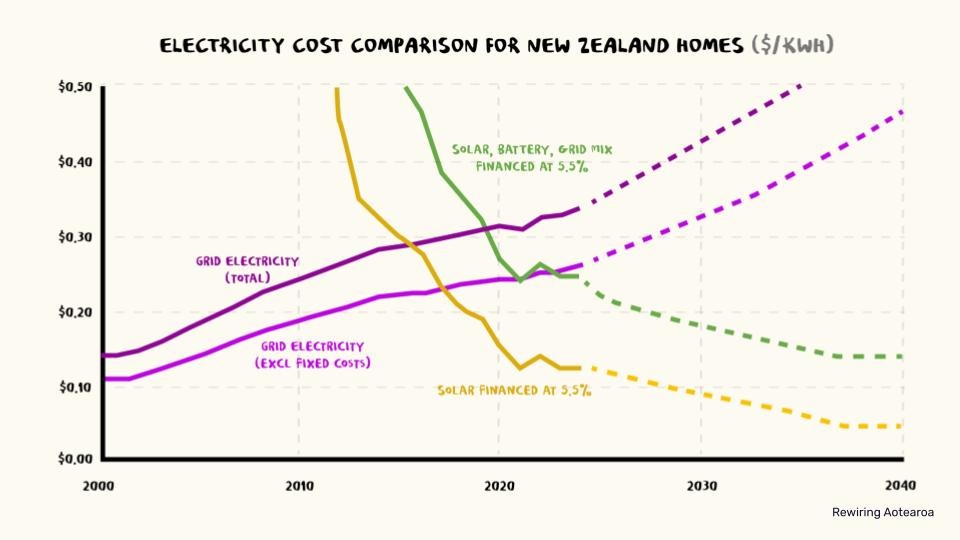
This is why the Ratepayer Assistance Scheme is such an important idea, because it will help get people past the hurdle of higher upfront costs, save them money on their energy bills from day one (unlike short-term green loans from banks) and provide the country with a lot more renewable energy.
The average home with solar can save $1000 a year with a long-term, low interest loan, including all repayments and interest and if 10% of homes - around 200,000 - had solar and battery storage exporting to the grid, this would equal the peak response of the Huntly power station.
This is not pie in the sky stuff. Australia is currently installing over 1,000 household batteries a day as part of its subsidy programme, and nearly 40% of homes have solar. Even at our currently low installation rate of residential batteries, by 2030 there would be 280MW and that would equate to the ninth largest power station in the country.
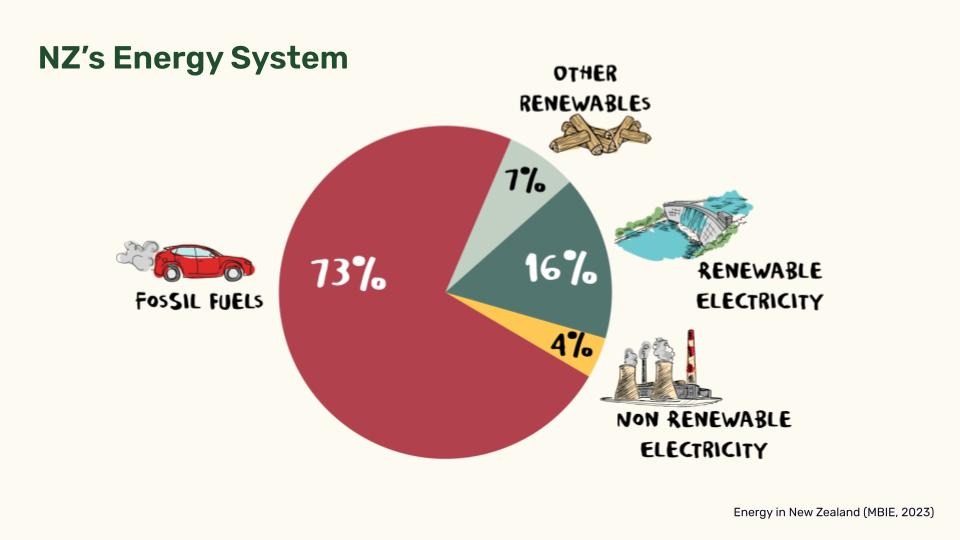
The report is clearly focused on the electricity industry and it says we can reach 98% renewables by 2030. That's impressive and puts New Zealand in a good position to transition, but a common misperception in New Zealand is that we have a highly renewable energy system. We do have a highly renewable electricity system, but around two thirds of our energy still comes from imported oil products that are used in fossil fuel machines. That’s what we need to replace - for economics, for energy security, for resilience and for emissions reduction.
The section on electric vehicles talks about increasing demand, but it doesn’t talk about the role they could play through vehicle-to-grid (V2G). In a future where most cars are electric, just half of the vehicles owned by households in New Zealand could together output more capacity than all of the nation's power stations combined. Business fleets, buses, trucks and more can add to this further.

BCG’s previous report included a big number that stuck: $42 billion worth of generation, storage and network upgrades were required by 2030 as the economy electrified ($8 billion and $22 billion would need to be invested in transmission and distribution respectively each decade). It became a go-to figure, but it also failed to take account of the role that rooftop solar and batteries could play in deferring or possibly avoiding that excessive investment.
We need to invest, but we cannot over-invest. Lines companies are incentivised to build new assets, but we believe they should be required to prove other technologies can’t do the same job for less.
New Zealand homes may spend around $150 billion on electric vehicles over the following decades, representing by far the largest battery in the power system, and in output capacity by far the largest power plant in the country if doing V2G. If New Zealand homes continue adopting solar, they could spend another $30 billion on solar and battery systems, which could easily be the largest generation power plant in the country (as it already is in Australia). Households could be the owners of the largest generation source and the largest battery in the country, by far.
This is a crucial point: the largest electricity infrastructure investors in the energy transition might actually be households. And yet they can't even get a level playing field for the infrastructure they buy, let alone a guaranteed return on it like we give to electricity networks.
Households are also paying for a huge portion of the billions that get spent because it appears on their bills and is set to make up the biggest increases in the coming years. Generation only makes up around half the price customers pay and it is households who foot the bill for an inefficient and underperforming energy system.
.jpg)
We also don’t believe the EDBs are doing enough to enable customers to play a role in the energy system and many of them continue to fight against things like increasing export limits to a default 10kW, as seen in the recent EA submissions.
The report says: "Networks have also made significant progress integrating distributed energy resources like solar and electric vehicles. This is maintaining grid stability right down to the street level as new consumer resources connect to the network." Have they? BCG may have written parts of this for another country, because that is not really the case in New Zealand. I’m sure the networks tell themselves this but the evidence speaks for itself here. Australia has over 40% of households with solar and some communities are well over 70%. New Zealand has closer to 3% and networks still bring up problems that have already been solved and are a long way down the track for New Zealand. Some EDBs have been more progressive and increased export limits without being compelled by regulation, removed application fees, sped up approvals and showed interest in V2G, but they are in the minority, as our EDB scoreboard attests.
As the gap between grid electricity and solar and batteries grows bigger, there is more incentive to leave the grid, but that is not what we want. We want all customers to be incentivised to contribute to the energy system, which was why we were so disappointed by the EA’s proposed limit on the types of customers that distributors are required to provide peak distribution export payments to.
We agree that a $100-200m Industry Resilience Fund to get businesses off gas is a good idea - and a much better use of public funds than subsiding oil and gas exploration. We need to use our existing gas reserves more strategically (and definitely not in our homes), just as we need to use our hydro lakes more strategically (increased solar production in a dry year can help keep the lakes topped up in the critical summer and early autumn periods). A number of reports show just how much of our existing gas reserves could be reallocated to those businesses that don’t have as many options to electrify.
We have made our position on gas very clear, and the BCG report says there will be no new abundant era of gas. It shows that reserves declined by 45% in the last six years and are forecast to halve again in the coming five years. Like the Frontier Report, it also says LNG is an expensive option and while it said LNG may be worth pursuing if gas reserves continue to fall, we believe there are much cheaper ways to ensure dry year security that will not lock us into using another expensive imported fuel.
“New LNG infrastructure would cost $400–800 million” - which is a large range and one of the lower estimates - “excluding fuel costs”. The fuel is more expensive than domestic gas and much more expensive than electrification.
Political Power has gone local! Dr Nick Smith, mayor of Nelson and ex-National Party minister, is an early adopter when it comes to electric machines but, through his efforts with the council and his close involvement with the Ratepayer Assistance Scheme, he's also embracing one of Rewiring's core mantras: once you've electrified your own life, electrify someone else's life, too.
Read moreDownloadWhether it's the growing number of electric buses, new electric trains for the lower North Island and City Rail Link, or new electric ferries, we love seeing more electric transport options in our big cities. It's also good to see some of our smaller cities like Palmerston North, Timaru and Nelson going electric and, as is almost always the case, the drivers reckon it's better on electrons. At the Electrify Nelson expo, we spoke with one driver Lee about the city's electric buses. And he definitely wouldn't go back to diesel.
Read moreDownload