Te Whakahiko i ngā Marae | the Electric Marae report

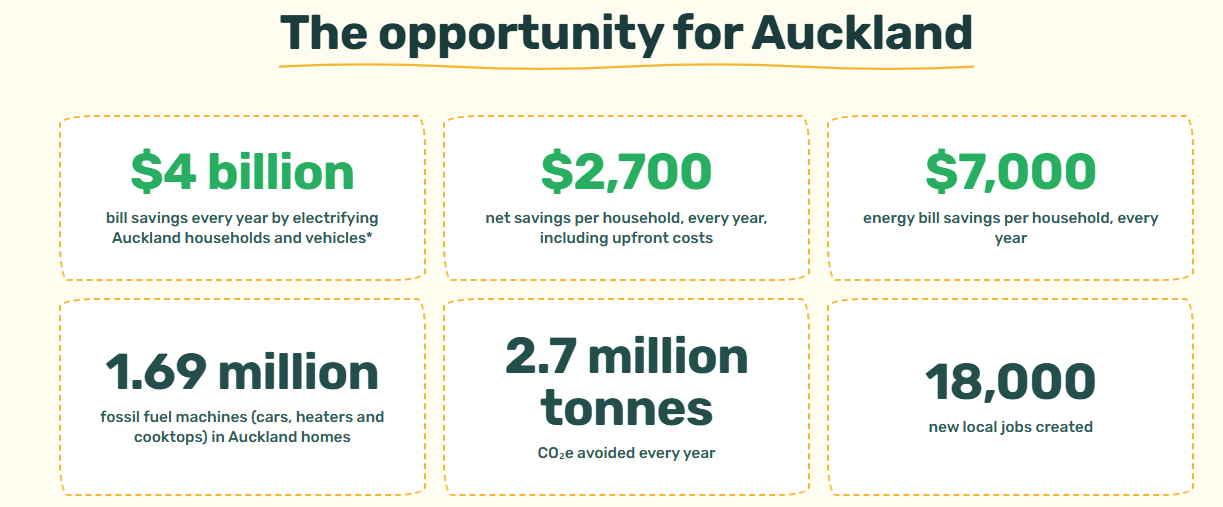

Just as every home is slightly different, so is every region. And our newly-released Regional Reports, which combine Rewiring Aotearoa’s Electric Homes and Vehicles 2026 and Machine Count research, show how different places around the country can benefit from upgrading their fossil fuel machines to electric equivalents.
We've categorised the reports into councils, district councils and regions to showcase the potential savings for each home in that location, the cumulative savings and jobs on offer if the whole region electrified, and the emissions reductions available from getting off the pipes and pumps and onto the plugs.
Rewiring Aotearoa’s Machine Count report calculated the number of fossil fuel machines across the country and ranked them on how easily they could be electrified.
“The research showed that 84% of them could be electrified economically now," says Rewiring Aotearoa CEO Mike Casey.
Across the country, New Zealanders spend around $55 million at the pump on fossil fuels every day to run all these fossil fuel machines.
“That’s petrol and diesel for vehicles, and most of that money heads offshore, and gas for hot water, heating and cooking. It’s expensive – and it’s been even more expensive this year – it’s inefficient and it’s bad for the environment and our health. Upgrading to electric equivalents is a no brainer.”
The additional labour required to install heat pumps, solar, and EV chargers combined with the community savings that flow through the local economy would create tens of thousands of jobs across the country and create a positive economic feedback loop in the regions.
While electric machines are generally more expensive upfront, they require less energy to run and that’s where many of the long-term savings come from. The community savings also scale up nationally: the bill savings would be $12.9 billion per year, while net savings would be $63.8 billion over 15 years to 2040, as homes electrify over time.
While there is plenty of talk about the rising price of electricity, the grid is still much cheaper and more stable than fossil fuels, while the price of solar has dropped significantly and it is now the cheapest form of delivered electricity available to New Zealanders.
Casey says households are a larger part of our energy sector than often recognised and there is growing awareness of the role that households, farms and businesses can play in the energy system.
“A lot of a little is a lot. If more homes had a 9kW solar system and a 10 kWh battery and if more of our EVs had two-way charging, this would provide an unprecedented level of energy resilience in the event of an emergency and would also lead to lower bills for the homeowner and everyone else.”
To provide accurate long term representation, the volatile fuel price rises seen in 2026 have not been included in the Regional Reports, but as Casey says, imported energy is inherently volatile and we are likely to see more price spikes in the future.
“Going electric wins on economics, energy security and emissions.”
Independent economist Cameron Bagrie, who peer reviewed Rewiring’s Electric Homes and Vehicles 2026 report alongside the University of Auckland’s Shaun Hendy, says electrification can help address short-term cost of living problems and build a more productive economy in the long-term.
“We have passed a key inflection point, where the economics of solar have become compelling. Households represent the country's largest energy-consuming sector, and shifting that consumption onto domestically generated renewable electricity reduces the import bill, keeps spending within the New Zealand economy, and delivers further savings through the inherent efficiency of electric machines.”
Just as there is a big bill gap between electric and fossil fuelled homes, there is another gap when it comes to accessing those technologies.
“Not everyone can get these savings right now because high upfront costs are a big barrier and they can’t access finance. There is a clear market failure here. And that’s what the Ratepayer Assistance Scheme hopes to address by offering long-term, low-interest loans for electric upgrades.”
About Rewiring Aotearoa
Rewiring Aotearoa is an independent non-partisan non-profit working on energy, climate, and electrification research, and supporting communities through the energy transition. Primarily funded by New Zealand philanthropists, Rewiring Aotearoa is fiercely independent, and completely self-determining in its work.
Rewiring Aotearoa's Matt Newman: "For marae, however, there aren't a huge amount of places where they could turn to unless they're engaging professional services around electrification. We know that that hasn't often been in the funding piece either. You know, funders will happily fund upgrades for marae, but they won't fund the due diligence that's necessary to support marae in making really good decisions for the long-term future."
Read moreDownloadRewiring Aotearoa CEO Mike Casey told Andrew Dickens plug-in solar is a simple process, which many countries including the US, UK, and places across Europe have made the most of. Labour's policy is similar but says changes to enable plug-in solar would be within 12 months of a government it leads taking office.
A shocking increase in the power bill for a marae that converted to solar energy has raised concerns about installers and regulation. The monthly power bill for Taranaki's Owae Marae has rocked to as much as $2000 a month, up from about $400. That's despite installing a solar system on its wharekai to save money. Matt Newman from Rewiring Aotearoa spoke to Lisa Owen about this issue and our new Electric Marae report.

