Te Whakahiko i ngā Marae | the Electric Marae report



We commend MBIE and the Government for recognising the critical role that Electricity Distribution Business (EDB) efficiency plays in energy affordability and the electrification of our economy. This is likely the biggest opportunity for EDB reform for many years, and we encourage reform that matches the scale of the transition we are in, the scale of the risk of getting it wrong, and the scale of the opportunity of getting it right.
Rewiring Aotearoa is an independent non-partisan non-profit, funded by New Zealand philanthropy. It is a registered charity working on energy, climate, and electrification research, advocacy, and supporting communities through the energy transition. The team consists of New Zealand energy, policy, and community outreach experts who have demonstrated experience both locally and internationally. We’re always fighting for the New Zealanders who use the energy system, and our goal is to help build a low cost, low emissions, high resilience electrified economy for Aotearoa NZ.
The most important part of this submission is the first section which sets out the most important regulatory changes MBIE and regulators could make to improve EDB efficiency and lower costs for consumers. We ask that MBIE, when compiling submission responses, considers the first part of our response.
We commend MBIE and the Government for recognising the critical role that Electricity Distribution Business (EDB) efficiency plays in energy affordability and the electrification of our economy. This is likely the biggest opportunity for EDB reform for many years, and we encourage reform that matches the scale of the transition we are in, the scale of the risk of getting it wrong, and the scale of the opportunity of getting it right.
We recommend all tools/reforms that may be required through the energy transition are enabled through this process, even if some are not yet activated. For example measures could be made available through regulation, and if deemed necessary could be activated via an Order in Council.
New Zealand's regulation of EDBs is very light-touch compared to many other countries, relying heavily on information disclosure and guidance for regulation of investment and distribution pricing.
A lot of faith is placed in EDBs to do the right thing for customers and communities under current arrangements. This approach is no longer fit for purpose to deliver efficient outcomes for consumers due to:
In contrast to wholesale system costs, once a network asset is built, those bill rises will be felt for decades with little to no ability to mitigate those costs once the infrastructure has been built.
There are significant efficiency opportunities to gain more value from greater utilisation of existing infrastructure and reduce spending in poles and wires for uptake of batteries, solar and vehicle to grid or load. The motivation for customers investing in this technology is to lower their energy bills, and improve resilience. This kind of customer technology, along with demand flexibility from all types of customer demand with the right price signals and incentives creates opportunity for networks to deliver significantly more value for customers. There is an urgent need to ensure we don’t over invest in growth capex, when alternatives like batteries or customer flex are cheaper we also need to be looking at how we can increase network utilisation - not just allowing more electricity to flow along lines - but managing networks smartly to support customers to invest in more technology that saves them and their neighbours money on energy bills and builds greater local resilience for communities.
For example enabling higher uptake of solar, batteries and V2G and implementation of local peer to peer trading can help to better utilise low voltage networks, support customers to share and gain more value from local generation and has the potential to flatten this local load - freeing up capacity on higher voltage parts of the network to serve more customers. This means the same assets, already being paid for, can serve more customers, lowering the costs per customer.
But the current direction is not working - a step change in electricity distribution regulation is needed for the energy transition, we need to consider from first principles what is in the best interest of the New Zealand people, and how do we build a distribution regulatory environment that serves that purpose. Today’s environment is clearly failing customers. How can we deliver network services that work for the households, businesses and industry as we electrify millions of machines across our economy and empower customers to reduce their energy bills through customer technology?
The energy transition introduces two new roles for EDBs, which they need to do well.
Firstly EDBs need to innovate to limit over investment in networks, improve utilisation of current assets and ensure customers can maximise benefits from the energy resources in their homes and businesses (DER). In our experience, this is not something many EDBs have demonstrated competence in today.
Secondly EDBs need to rapidly deliver efficient new connections to unlock electrification - connecting new load and generation efficiently and quickly, so network connections are not a handbrake. It is evident these two things can be in tension if not planned and regulated well.
In this submission we explain why priority regulatory and policy changes include:
Scale flexibility (to avoid over investment in poles and wires)
Structure organisations for the energy transition
Unlocking more value for customers from the network
The way customers can access electricity and use it is changing - this provides an opportunity for networks to provide customers with a lot more value from existing networks, and to invest more efficiently. While previously it was hard to have high utilisation rates due to the realities of peaks, today the technology to do so (batteries, vehicle to grid and flexible demand) is becoming economic for homes, businesses, and farms alike.
A targeted utilisation rate metric can capture the value to customers of their changing use of distribution networks by providing incentives to maximise productive energy flows facilitated by the network (including own use of solar, exports and consumption).
As experts from University of Technology in Sydney note in their paper “Reimagining Utilisation Rates in the Era of Consumer Energy Resources”:
“[A traditional network utilisation measure like peak demand/asset capacity] does not account for two-way flows on the network and masks localised network constraints that are becoming more prevalent during the energy transition. Better measures of network utilisation can address these issues to inform network planning, highlight stranded asset risks, and incentivise the adoption of non-network solutions, such as flexible demand. Such measures will be crucial in keeping consumer prices down over the coming decades as consumers continue to adopt solar and increasingly electrify gas and transport energy use.
We propose two headline alternatives to traditional network utilisation, [that] move towards understanding the total productive energy flows facilitated by the network over the course of a year (including grid imports, exports and self-consumed solar), rather than merely focussing on how close the asset is to its capacity in the hour of highest demand.”
EDBs need targets that incentivise them to deliver outcomes for customers efficiently. Currently even traditional network utilisation rates (that reflect the extent an asset is used to meet maximum demand) are not reported on in New Zealand because the data to estimate this is not required under information disclosure. This is part of the problem as there is limited visibility over how networks are being utilised and where there are opportunities for better utilisation and how more customer benefit can be provided. However the data is still available to measure many aspects of utilisation today, and a lack of perfect data is a weak excuse by both regulators or the regulated for being inefficient with investment.
MBIE should target two positive outcomes:
If networks are successfully able to maximise Total Energy Throughput Utilisation within the bounds of capacity, reliability and quality of supply, this means that there are more units of customer value over which to spread the repayment of network costs. This has substantial potential to lower the average costs of network supply for customers.
As part of this process compliance and reporting could also be likely streamlined compared to what it is today, and a focus from first principles on the most likely areas to drive significant consumer benefit would be beneficial to both EDBs and consumer bills.
We note that MBIE’s 14 June 2025 “Further advice on encouraging EDB efficiency” (BRIEFING REQ 0015251) discusses and dismisses Rewiring’s 2025 work on the need for network utilisation metrics and targets: “However, the New Zealand Infrastructure Commission has found no evidence of EDB overbuild compared to similar countries.”
The rationale for this dismissal is flawed.
The research is explicitly about transmission lines, not distribution networks. While this is a nuance, this is a critical nuance. Rewiring’s focus has been on EDB network utilisation, which is also the focus of the briefing, and of this consultation document. EDB overbuild has been well reported on, for example in Australia, and is a far larger portion of bills than transmission. Furthermore, the rationale of pointing at other countries requires investigating whether the issue also exists in other countries. Could these other countries also have a regulatory capex bias as has been reported in multiple countries?
Secondly, the Infrastructure Commission research did not look at overbuild (i.e. the question of whether NZ built more of something than needed, relative to other countries), but rather at the delivery costs for infrastructure that is built (e.g. cost per km of transmission line). We have not seen relevant research comparing network overbuild between NZ and other countries, and the Infrastructure Commission work is not that.
Further to this, the opportunity here is bigger than avoiding overbuild, it is more ambitious and is about delivering more for customers at lower cost, with less expenditure. The outcomes we are targeting with increased utilisation are a step change in both economic and physics based efficiency. The opportunity is relatively new given the technology that enables it is now only beginning to see accelerated uptake.
There is now global precedent in Virginia for regulators requiring network utilisation metrics.
We are aware of a growing number of jurisdictions also exploring and pursuing utilisation metrics and targets/requirements for electricity distribution networks.
The Commerce Commission chose not to progress a utilisation target as part of DPP4 based on the following reasons:
We think that a utilisation target could easily be designed and implemented to navigate step changes in network expansions and upgrades. For example the utilisation metrics we propose in the first step measures the peakiness of demand in the peak month and tracks progress to flatten load. It does not need to include existing capacity at all so there would be no step change in utilisation rate if a large investment was made. If utilisation measures include asset capacity in the denominator, targeted increases could take account of any large network investment.
Scale flexibility (at pace to avoid over investment in poles and wires)
Under current regulation utilising default price paths the Commerce Commission cannot tell if investment in regulated network assets is reasonable. The Commerce Commission's IAEngg review of distributor Asset Management Plans found it could “not assess the reasonableness” of distributor forecasts because the underlying models, inputs and assumptions were not published consistently or transparently.
“[Asset management plans] do not include the models used by EDBs to forecast demand nor do they directly outline the relationship between inputs used in expenditure forecasts and the expenditure forecasts. Further, the AMPs do not present the inputs, in particular the new drivers, used to forecast demand or expenditure in a defined or consistent way. As a result, we were not able to assess the reasonableness of forecast expenditure.” IAEngg, 2023.
One must ask how a regulatory regime can be fit for purpose, or how New Zealanders can have confidence their money is not being wasted, if the regulator does itself not even have the evidence base to assess whether the spending of consumer money on assets is reasonable or not.
Under current regulation EDBs subject to price-quality regulation are disincentivised to bring forward predictable and forecastable supply of flexibility, through use of cost reflective pricing or development of liquid flexibility markets.
EDBs are incentivised to implement efficiency that cannot be predicted at the start of the regulatory period through the IRIS (Incremental Rolling Incentive Scheme) put in place to incentivise EDBs to find efficiency savings, for example utilising non-network solutions instead of building more poles and wires. Investor-owned EDBs would gain the most benefit for their investors by setting their recoverable revenue allowance as high as possible at the start of a 5 year price period and delivering unforecasted efficiency gains within this period.
For capital expenditure (capex), the benefit through the regulation is a fixed share of the underspend, called the retention factor. The IRIS amounts are treated as recoverable costs in the next regulatory period. They are added to (or subtracted from if over spend occurs) the revenue the EDB may recover from its customers, and they appear in its price-setting calculations and compliance statements.
The DPP4 retention factor is 32% for both capex and opex, meaning the EDB retains 32% of the underspend that occurs due to efficiency, and the IRIS mechanism should not tilt EDBs towards either type of expenditure in theory.
However the Commission's regulatory regime actively disincentivises EDBs from bringing forward forecastable uptake and provision of flexibility that would reduce capital expenditure allowance at the start of a regulatory period and means they would not be able to gain the efficiency benefits through the IRIS mechanism from reducing or delaying capital spend.
For example if EDBs implemented mass market peak price signals that reflect the LRMC of growth capex, and if retail tariff options exist that pass through these price signals, allowing customers to respond, over time this could trigger economically efficient and accelerated uptake of customer DER and predictable price responsive flexibility. There is a chance that peak price signals could help to offset growth capex investment within a 5 year pricing period, meaning EDBs receive regulated benefits from this efficiency. However the most likely outcome is that it takes time for forecastable customer flexibility to scale in response to price and by the time it does the impact is lower forecasted growth capex in the subsequent pricing period and the result for EDBs is a lower regulated revenue allowance and no regulated benefits from incentivising this efficiency. (Unhelpfully EDBs have no regulatory requirements placed on how they set pricing which is regulated through guidance and feedback from the Electricity Authority.)
Likewise, if EDBs were to help the development of liquid flexibility markets where clearly signalled prices for future flex contracts were available, it would be unreasonable to ignore these flex offers as a potentially lower cost solution to defer growth capex in asset management plans. In this scenario the outcome for the EDB is the same - lower forecasted growth capex, lower regulated revenue allowance and no regulated benefits from accessing flexibility to improve efficiency. It is no surprise then that EDBs continue to call flex markets immature while not actively looking to engage in scaling flexibility.
Moving to a situation where the supply of flexibility is forecastable in response to direct price signals or readily available via a market with clearly signalled prices will remove the incentive for efficiency through retained earnings because the efficiency will already be captured into lower capex allowances. This scenario would mean lower revenue for EDBs and lower bills for consumers - unfortunately the current regulation disincentivises this outcome, and therefore creates an environment that incentivises bill rises for New Zealanders.
EDBs are incentivised to pursue flexibility only if the flexibility cannot be forecast ahead of the regulatory period. To achieve this and maintain levels of forecastable growth capex used to set regulated allowances the EDB would need to issue contracts for flexibility within the regulatory period.
Greater scrutiny of EDB investments are needed. The cost savings to consumers from avoided over investment and decades of cost recovery will be many times higher than the additional cost of implementing a streamlined reporting and scrutiny process. This process should apply to all EDBs and include:
To assess network investment many EDBs will be running models of load flows on high and medium voltage to identify probabilistic timings for constraints. The Commerce Commission should require publication of model inputs, key assumptions, and results on a standardised basis. EDBs could also publish a base version of these models. Information provided should be detailed enough to allow the Commerce Commission to scrutinise the reasonableness of demand forecasts, and assumptions about baseline uptake of DER.
Where constraints signal new capex a standardised methodology should be used to assess the solution cost for network upgrades. Models developed for this purpose by the ENA could be helpful with transparency over input assumptions.
This must then be compared to a baseline cost to offset the upgrade based on investing in customer solar and batteries or any lower cost flexibility solutions.
The data provided, noted in a and b above, would provide the quantitative evidence the Commerce Commission requires to assess if capex is reasonable and if flexibility solutions are being fairly considered. This evidence must be based on first principles and the guardrails put in place for it to not be manipulated on technicalities as it can be today and we have experienced being done.
Customers responding to cost reflective tariffs should be the primary tool for distributors to coordinate the majority of flexibility. These prices should be available to all mass market customers and can signal a large amount of the flexibility value with the potential to reach customer technology (EV charging, V2G, pre-programmed battery operation) that can flex. Distribution price signals for flexibility should be cost reflective, be signalled well ahead of need for flex to offset inefficient investment, and provided in a signal that is open to all customers.
Cost reflective peak distribution pricing tariffs in place for mass market customers that signal the long run costs of using the network could be in place now for all distributors. However, this outcome is not being achieved under the Electricity Authority’s current regulation with both price signals and peak export payments being watered down at the EA’s recommendation - without evidenced rationale. In our view, this is a clear bias towards the desires of energy companies and against the interest of consumers. As we note above the Commerce Commission's regulation does not help by disincentivising this kind of price driven uptake of forecastable flexibility (efficiency) overtime, where efficiency benefits can not be captured through the IRIS mechanism.
Either the Electricity Authority or the Commerce Commission can implement a solution. The Commerce Commission could only allow growth capex allowance in DPP5 to be approved if pricing meets the requirements below from 1 April 2027. Urgency is required because significant network investment is needed over the next decade and distribution pricing is a primary tool to unlock customer flexibility, support better network asset management and therefore lower costs and reduce bill rises to customers.
Specifically and in the first instance distribution pricing should be required from 1 April 2027 to meet the following specifications:
Review retailer pass through of distribution peak price signals in TOU plan
Not all customers want to engage in TOU electricity pricing, but a lot of them do. Based on a Vector survey over half of Auckland residential customers are on TOU plans or are very interested in these. The main rationale for customers considering TOU plans is saving money.
Retailers don’t need to pass through distribution peak pricing signals in all retail plans - but we do need some TOU retail tariffs available that do provide these price signals to customers and that pass through peak export rebates for those customers who are interested and willing to respond to price signals. If not, retailers can be the bottleneck to a more efficient electricity market and have the ability to raise any number of excuses for doing so.
Strengthening peak distribution prices to the full value of LRMC and applying these of well defined peak periods will provide a stronger signal to retailers to pass through these price signals in TOU tariffs.
In its decision paper on Improving pricing plan options for consumers in July 2025, the Electricity Authority noted: “Large retailers are not currently doing enough to encourage consumers to shift their power use away from peak times, or to supply power from their solar system at these times, to help ease pressure on our system.”
The Authority’s decision required all retailers to develop TOU prices, by 1 July or 1 October 2026 (for category A and B retailers respectively). Presumably the Authority will be reviewing the progress to deliver TOU prices made available. It will be important for MBIE to consider whether the challenge we have heard in the past related to lack of pass through of distributor price signals persists. It will also be interesting to understand if the TOU offers in the market actually allow customers to reduce their energy bills through flexibility or if they simply compensate for lower off peak prices or fairer peak export rates with higher fixed rates. Customer energy bills for a representative household with DER that are scheduled to respond to prices for TOU tariffs and the most competitive flat anytime rate tariff.
If retail pricing innovation is not occurring to signal the value of customer flex alternative pathways should be explored.
For example more prescriptive TOU offerings could be required along side a requirement for all retailers to offer a tariff that is highly cost reflective with a variable (c/kWh) price cap - for example a tariff that charges wholesale price and direct pass thorough of distribution pricing and peak export rebates, a transparent retailer service fee, but also provides a hedged variable price cap. This kind of tariff could provide a comparator against which other TOU pricing innovation could be compared in terms of consumer bills.
Price signals for transmission connection assets are needed.
Price signals for transmission connection assets are nonexistent. There is currently no pathway for prices or export payments to signal connection asset upgrade costs. This issue is not unique to Aurora, but the Queenstown transmission connection upgrade provides a good example of the problem and highlights the additional cost customers will pay without having long term price signals in place to build up supply of flexibility to offset investment. In this example Transpower’s modeling shows that there is potential to save consumers over $500/year: “From a system perspective this deferment [with solar and batteries] could be achieved at a lower overall cost to end consumers than proceeding immediately to a new build transmission line (levelised cost per household $172pa compared to $720pa).” and yet this is not the pathway being actively undertaken, with minimal regulatory pressure for avoiding large increases to consumer bills that evidence shows are unjustified, even Transpowers own evidence.
MTR and peer-to-peer trading provide a pathway to increase the value customers can gain from their DER (both owners and other local customers).
Local peer-to-peer trading can incentivise increased demand in times when exports on low voltage networks are higher helping to better utilise low voltage networks, support customers to share and gain more value from local generation and has the potential to flatten this local load - freeing up capacity on higher voltage parts of the network to serve more customers. This means the same assets, already being paid for, can serve more customers, lowering the costs per customer.
Based on our work, the Electricity Authority has launched the design process for a regulatory sandbox for community energy trading. Shepherding in the ruleset for a modern electricity market that is lower cost, and sharing with neighbouring homes and businesses better reflects the physics involved, will set international precedents and drive an abundance of low cost community electricity to accelerate electrification.
Whilst these changes do not relate directly to EDB regulation in the context MBIE is considering they are an important part of the suite of regulation to improve network efficiency and gain greater value from network assets for customers.
Historically electricity networks were big assets, flowing downstream to consumers. Over the last decade, technology has shifted this but regulation has not kept up to date.
For example, the largest power plant in Australia is about 3GW, household rooftop solar is 30GW, and household batteries installed in just the last 18 months are about 4GW. The largest energy infrastructure owner and operator is households, both in value of those assets and in power output and peaking capacity.
The definition of infrastructure is changing, and the artificial line in the sand that was drawn at household electricity meters to determine behind the meter or in front of the meter no longer makes sense.
When a transformer upgrade happens on a street, the EDB can charge that cost to consumer bills across the street for decades, with no consultation with the homes or businesses while increasing their bills. Yet if installing batteries in some of those homes and businesses could have stopped the need for that transformer upgrade and come at net-lower cost to NZ inc, the EDB currently has minimal incentive to make that decision.
If the incentive was there, for example utilisation targets, then EDBs don’t have a clearly signalled regulatory mechanism because behind the meter was traditionally deemed out of their asset base and not where they can invest for a regulated return.
Individual customers investing in DER and operating it in response to cost reflective price signals benefits the community when it is installed and has similar outcomes as community energy.
RAB treatment could allow EDBs to finance BTM assets and recover costs over time — removing the large upfront investment barrier and enabling renters and low income homes to access the benefits of distributed energy. Customers could repay the capital over time through their network charges.
This could allow rapid scaling of BTM batteries that often outperform traditional LV builds on cost and can be deployed faster with fewer barriers - no land acquisition, no community consultation and no council approvals.
Given the advancement of energy technology, this definition should be revisited and it makes sense to allow EDBs to install batteries in homes (or pay for part of them, or finance and amortise their costs like an asset) to deliver a lower cost energy system overall. This would also enable them to install them in low income homes to deliver clear equity cobenefits, or in community resilience buildings like schools to deliver clear emergency preparedness benefits.
Providing energy generation and storage to better deliver on highly utilised community electricity networks should be unlocked for distributors to be a part of and enable more rapid development of flexibility. It would also remove some of the incentives for capex bias on infrastructure if EDBs could get regulated returns on infrastructure that is not just more poles and wires.
This type of rapid scaling could be extremely useful for situations where there is infill housing or electrification of gas networks, and provide a pathway to lower costs for all EDB customers.
We know that batteries qualify as an asset that supports delivery of the lines service, The 2016 Input Methodologies Review (Topic Paper 3) explicitly confirmed EDBs can own and control BTM batteries as alternatives to traditional network upgrades. Cost allocation IMs apply where an asset delivers both regulated and unregulated services.
The Commerce Commission should confirm that EDB owned and customer-controlled battery investment is allowable in the RAB. Statistical peak reduction (in response to prices) without direct dispatch should satisfy the lines service test. Currently this issue remains unresolved and requires clarification.
EDBs operate efficiently and effectively to deliver the energy transition
A clear example where disjointed regulatory settings are not delivering for customers is set out above:
As we set out in the section above, cost reflective peak distribution price signals are important to signal investment and provision of flexibility and are key to deliver efficient network investment.
Creating a single energy regulator would help to improve co-ordination of energy regulation to deliver the energy transition. This could be delivered by combining the Commerce Commission regulation of electricity and gas transmission and distribution, with the Electricity Authority’s role and with gas regulation (shifting the Gas Industry Company’s industry regulation role to an energy regulator). In the case of electricity networks this would helpfully mean regulation of network pricing could be delivered in a more integrated way with regulation of monopoly revenue allowances and performance.
The scope of this consultation should consider all changes to existing competition policy under Part 4 of the Commerce Act, changes under the Electricity Authority remit within the Electricity Industry Participation Code and relevant policy measures that MBIE/DPMC or the Ministry for Regulation can implement.
Fuel switching of industrial gas users and investment in heavy freight charging is increasingly urgent to maintain energy security as domestic gas supply declines and diesel prices skyrocket. EDB capability and speed of delivering large connections is key to delivering this energy security.
However, having 28 EDBs trying to deliver the step change in innovation, navigating the significant uplift in data and internal business capabilities and investment is not ideal. This is especially difficult with some EDBs having very small teams and limited resources for innovation, or to scale investment in very large one off connection upgrades. Rewiring Aotearoa team members have directly experienced the lack of capability from EDBs to innovate in a meaningful way. Economic limitations of smaller EDBs may mean delivering cost efficient outcomes for customers is not possible. The reality is that amalgamation would provide a better solution than trying to collaborate more, which could delay progress and add cost.
This is not just Rewiring Aotearoa’s view - other EDB’s including Powerco note in their submissions that “Directing collaboration between 27 differently owned EDBs is slow and, on the evidence, ineffective and costly”
To address our energy security needs and invest in energy services that align with local priorities and needs, we need local energy planning. A government funded group or entity should undertake this role working with local stakeholders to co-ordinate how we can deliver local energy infrastructure. For example accelerated fuel switching of gas requires co-ordination which can signal priority connections and investment potentially ahead of demand. Investment to address imported fuel price volatility in freight costs could require electrification and many large connections for heavy freight charging and fast charging for inter city travel in EVs. While within cities customers charging preference could mean a network of slow to medium speed EV chargers which restricted use during peak periods are preferred by many customers. This could minimise connection sizes, limit network upgrades and provide very low cost EV charging options for light and medium vehicles whilst parked.
This function could provide a key part of network planning.
Our response to this consultation is in two parts - firstly the section above highlights the priority changes to EDB regulation needed and why this is needed to lower network costs and create more value for customers and deliver the energy transition. This is the most important part of our submission.
Below we have also answered the questions set out in this consultation, although we do not agree that MBIE has identified the most important options and issues to address in this consultation. We ask that MBIE, when compiling submission responses, considers the first part of our response above.
Q1. How could regulatory settings be improved to better support or incentivise standardisation and collaboration, where this improves efficiency and service outcomes?
Amalgamating the 28 EDBs to around four of five EDBs is the most effective solution to operational efficiency and to improve standardisation across network pricing and connection processes. Doing this will
Without amalgamation, there are 28 pricing methodologies, asset management plans, information disclosure requirements and auditing processes to be delivered. None of this overhead will be reduced whilst maintaining business separation. Improved scrutiny of investment across all EDBs (as proposed later in our submission) by the Commerce Commission will also be more practical with fewer EDBs.
The process of amalgamation could be disruptive if it was forced as a sudden shift, however, it could be staged to minimise this disruption.
Scaling efficient investment for electrification provides energy security
Vector has recently announced a new strategy focused on electrification of Auckland and launch two new private ventures (outside of its regulated asset business) - Nexos and Catalyst that will leverage the scale of their supply chains to accelerate network connections and electrification of process heat users, and solve the backlog of GXP connections required for their EDB and offer this as a service. This is a very positive development to support and accelerate the energy transition. But Vector is likely to be the only EDB in New Zealand to be able to offer such a service due to the scale of its supply chain. The scale at which it imports components, and can reallocate parts and skilled workers across different projects (for example if a project is cancelled or a new connection is urgently needed), along with a strong balance sheet, means it can resource this type of business. Initiatives like this need to be replicated, so that New Zealand can meet future electricity demand.
Amalgamating our 28 EDBs down to four or five would provide them all with significant supply chains and capacity to scale investment, adopt innovative solutions, and will greatly improve New Zealand's ability to scale connections to meet future electricity demand and improve energy security.
Alongside this, the Government could implement a co-ordinated regional energy planning process to deliver the energy transition. The planning could consider issues like electrification for gas security for industrial and commercial gas users, addressing fuel security challenges for heavy freight to reduce diesel demand and for critical services. This process could identify priority connections, including where co-ordinated investment warrants investment ahead of demand.
The Commerce Commission should require all EDBs to write up and share learning from INSTA projects and have these provided to a central data base so all other EDBs can access the learning. Written in plain language and summarised for easy understanding by EDBs.
Q2. What barriers are there to standardisation and collaboration between EDBs? If so, what Government action (if any) would help address these?
Encouraging EDBs to collaborate alone isn’t going to maximise benefits from efficiency.
Encouraging collaboration makes taking action and delivering benefits for customers optional. As noted below there are many examples where collaboration has failed to deliver results (See Q3 examples below.) The biggest barrier to collaboration is lack of incentive, direction and requirements to do so in a meaningful way from government regulators.
Current action to share parts and teams to repair lines in emergencies could be formalised. However, the limited scale of supply chains that are in place for many EDBs significantly limits the ability of smaller EDBs to move at pace to reallocate parts or workforce at scale to deliver investment at pace.
Likewise, smaller EDBs have less resource to allocate to innovation and are likely to lag behind some of the larger EDBs on unlocking efficiency benefits from flexibility and customer DER to offset investment and avoid network over investment.
Some of the barriers related to optional collaboration could be addressed through being prescriptive in how collaboration should be delivered, identifying regional groups, and specifying requirements for shared operational models and steps that could deliver future amalgamation.
However, the most effective action would be to amalgamate EDBs, and to start that process now.
Government direction should ultimately make it clear to EDBs that all action to deliver efficiency and collaboration should be planned with future amalgamation in mind. (See Q1 for the rationale for this.)
Q3. What do you consider to be the likely scale of benefits from encouraging greater standardisation and collaboration between EDBs?
Encouraging greater standardisation for customers connection processes could achieve benefits for customers. At present, customers need to navigate the connection process and determine whether the solution offered is the best for their needs and is fairly priced. For an organisation working across multiple EDBs, this creates more work, adds expense, and adds significant delays. Standardising the connection process could reduce some of this challenge for connecting customers.
While the potential benefits of greater collaboration between EDBs is large, the reality of optional collaboration means these benefits are unlikely to be realised in the near term.
While voluntary collaboration should be encouraged and incentivised, historical and more recent experience has shown it cannot be relied upon and is likely to fail, as illustrated in the following example.
The Asset Dynamics Limited report supporting this consultation highlights collaboration being put forward by EDBs as significant commitments:
The most substantive actions committed to, in responses to the letter of expectations relate to shared services, partnerships, and joint operating models. The December 2025 Alpine Energy/Aurora Energy joint operational services announcement, the February 2026 Counties Energy/The Lines Company Shared Platform and Services Partnership, and several other partnerships under development represent a wave of collaboration that could deliver consolidation-like efficiency benefits without requiring ownership change. 5.3
Soon after the report was delivered in April, the Alpine/Aurora collaboration broke down (in May):
www.thepress.co.nz/nz-news/361005385/alpine-energy-and-aurora-energy-drop-plans-merge-operations
This breakdown adds yet another collaboration to the list of arrangements that have failed. Asset summarised our perspective on many voluntary EDB collaborations well: “Announced partnerships that do not progress or lead to benefits also risk creating an appearance of action without substance.”
More tailored approach to economic regulation
Q4. Does this chapter accurately describe the current situation?
The chapter highlights the importance of information disclosure to allow consumers to assess EDB performance.
Information disclosure and reporting should also be a key consideration in the Commerce Commission’s assessment of EDB performance and investments. Further, the metrics used to reflect efficient network use are important in monitoring innovation and efficient investment.
Network utilisation provides the clearest metric of network efficiency. Implementing reporting of network utilisation is the most important change to information disclosure that could be implemented to achieve improved visibility of network investment and innovation efficiency. Please see the section on pages 3 - 6 above for details of what we propose with regards to network utilisation metrics reporting.
Q5. Do you support the options outlined in this chapter? Please give reasons.
Yes, per Option 1A, the prohibition on comparative benchmarking should be removed and the Commission required to publish conclusions based on this. We note that a few EDBs/parts of networks may be shrinking rather than growing, and are not fairly benchmarked as a result.
The focus of the Commission should be on consumer benefits (as should everything the Commission does, per its purpose).
The Commission should have expanded information gathering powers per Option 1B, to more closely reflect the information disclosure powers introduced for water services, including collection of information about unregulated businesses.
This would allow the Commerce Commission if concerned to test and guard against revenue from regulated network services being diverted to other uses, and against EDB customers being overcharged through inflated cost allocations. Both threaten the core aim of sufficient, efficient investment in the networks.
Q6. What do you consider to be the costs, benefits, or unintended consequences of these options?
Both options 1A and 1B would provide the Commerce Commission with the ability to better collect data that could identify negative outcomes for EDB customers, and provide the Commission with the opportunity to take remedial action.
Unlocking additional information gathering powers should have a net benefit. However, once granted, the Commerce Commission needs to avoid adding unnecessary compliance burdens that add cost without improving outcomes for consumers. Some reporting and auditing requirements that are in place now could be rationalised so that a streamlined and efficient approach to information gathering, assessment of future investment and setting of future revenue allowances could be redesigned from the bottom up to make it both more effective and more streamlined. See our proposed data provisions to improve investment scrutiny “Using the right tools and data to better scrutinise EDB investment” on pages 9-10.
Any additional resources required by the Commerce Commission (i.e. to accurately scrutinise and assess performance and allocated by EDBs to provide the necessary modelling and standardised data provision) will be a fraction of the savings this creates for customers through more efficient EDB operation and investment. Furthermore, most of this additional resourcing could be offset through amalgamation of EDBs, as fewer assessments would be needed.
Q7. Are there any other options or approaches that could achieve the objective(s) outlined in this chapter? Please describe them and explain why they may be preferable.
Yes, Network utilisation metrics and targets are an approach that should be pursued to achieve greater EDB efficiency. Please see page 3 - 6 section 1. Implement network utilisation metric reporting and utilisation improvement targets for more information on the specific information requirements and proposed next steps.
Improving the information provided to assess whether investment is reasonable, will also be key to improve and streamline scrutiny of investment. Please see section 1. Using the right tools and data to better scrutinise EDB investment on page 9 -10.
Responsive Regulation
Q8. Does this chapter accurately describe the current situation?
No. The Chapter provides ideas for regulatory changes, but is not taking a first principles approach to identify what is needed to better regulate efficient investment by EDBs.
Please refer to section 1 of our submission (pages 7 - 9) for a discussion of what is not working and why, as well as practical steps to address this.
A key point to note is that the current use of default price paths and the current format and information provision in Asset Management Plans, means the Commerce Commission currently does not have the information it needs to assess if network investment is reasonable when setting revenue allowances. Please see section 1 of our submission, pages 7 and 8, for more details.
Q9. Do you support the options outlined in this chapter? Please give reasons.
We support the following tools from Option 2A. These would be useful to assess performance:
Under Option 2B, Price quality regulation should apply to all EDBs. More standardised reporting and information provision within Asset Management Plans could help streamline this greater scrutiny by the Commission.
Please see section 1. Using the right tools and data to better scrutinise EDB investment on page 9 for our view on how investment in distribution network assets could be better scrutinised. Some aspects of what we are proposing could be implemented through allowing performance requirements, which we support.
Q10. What do you consider to be the costs, benefits, or unintended consequences of these options?
Costs of consumer-owned EDBs transitioning to price-quality paths would be material, though this will also encourage better collaboration and potentially lead to amalgamations. Ultimately, the argument for amalgamation is also supported by the fact that better scrutiny of EDB investment is needed and amalgamating to a much smaller number of EDBs would make this process significantly more streamlined.
It is important to consider how significant the cumulative savings for customers from more efficient network investment could be over time, and that it will be orders of magnitude bigger than the cost incurred to implement regulation needed to deliver these savings.
Q11. Are there any other options or approaches that could achieve the objective(s) outlined in this chapter? Please describe them and explain why they may be preferable.
Improving EDB efficiency isn’t just about lowering costs. It is about providing more value from the existing asset capacity in place. The first section of this submission sets out a wider set of measures that can better enable EDBs and customers to gain value from remaining connected to the network, and avoid unnecessary investment. These measures include:
Scale flexibility (to avoid over investment in poles and wires)
Structure organisations for the energy transition
Please see Section 1 for more details on these measures.
The Commerce Commission and the Electricity Authority should be amalgamated, or at minimum, brought under a single joined-up governance and planning framework. The case for this is that the two halves of the distribution problem are currently regulated separately.
The Authority sets the pricing and connection rules that shape how consumers use the network, including distribution pricing methodologies, connection charges and the framework for flexibility services. For example, pricing that rewards shifting EV charging and heat pump load away from peaks can defer or avoid significant network investment.
The capital expenditure EDBs are allowed to recover is decided separately by the Commission under Part 4.
Better coordination through memoranda of understanding and joint task forces is welcome, but it is not enough to make these decisions together. The two organisations have demonstrated a lack of coordination to the detriment of consumers. The same gap is growing between gas and electricity.
The Gas Industry Company should be brought in under the same regulator, even if the Commerce Commission and Electricity Authority remain separate.
As gas networks decline, households and businesses leaving gas will add load to electricity networks, and the timing, location and scale of that shift will directly affect how much EDBs need to invest. Regulators cannot plan well for the end of gas networks, or for the resulting electricity build, while gas governance sits with a separate body. The Commerce Commission already regulates gas pipeline businesses under Part 4 of the Commerce Act, so part of this link already sits within one regulator; bringing the rest together is a logical next step.
We recognise that changing the regulators' structure is not proposed in this document, but we consider it one of the most effective ways to improve EDB efficiency and actively support the energy transition, and we urge the Government to consider it alongside the options presented here.
Others such as Growth NZ have recently made additional arguments for reform of the regulators.
Strengthened governance requirements
Q12. Does this chapter accurately describe the current situation?
Yes
Q13. Do you support the options outlined in this chapter? Please give reasons.
Proposed Option 3A to tighten the focus of consumer-owned EDBs is entirely sensible. We strongly support this option.
The current focus on operating as a ‘successful business’ encourages profit-seeking behaviour (albeit that much of the benefits flow to the ‘consumer owners’), rather than focussing on running the most efficient network and business. This should be changed to be explicit about what Government considers consumer-owned EDBs need to be focussed on. This should not be maximising dividends.
Rather, the goal of EDBs should be to minimise costs to consumers and increase the value they receive from networks, while delivering efficient investment, network reliability, resilience and supporting electrification.
We would recommend that consumer-empowerment (or even explicitly encouraging consumer energy resources) be added along with the proposed new areas of emphasis.
We consider that too often the fact that they are consumer owned is used by these EDBs as a carte blanche justification that everything they do is in the interest of consumers. As the their advocacy group, Energy Trusts of New Zealand Inc states in a submission to the Electricity Authority:
By virtue of their ownership model, trust-owned networks are naturally incentivised to act in the best interest of their customers. Our members are active in their communities – their profits are returned to their customers, they provide local sponsorships and fund community initiatives and they are significant employers in their regions.
While additional infrastructure build-out does lead to higher profits, the build-out is funded by consumers at the end of the day, and a significant amount of the money spent flows beyond consumer-owners.
In our discussions with certain consumer-owned EDB advisors, there is an overwhelming view that their job is to build as much network capacity as quickly as practicable to enable the transition, and minimal openness to consider how non-network solutions can deliver the same outcome at significantly less cost for consumers. Therefore they are biassed towards a more expensive system and bills for the consumers they serve, the fact they share the profits of this more expensive system, when those profits also come from those same consumers, is no remedy as the roundtrip of the money clearly has losses.
Hence, a move away from operating purely on a ‘successful business’ is overdue.
This being said, current evidence (including looking at where there is progressive pricing, active support for consumer energy resources, active work to prepare for and make the most of two-way power flows - i.e. the future of our energy system) points to non-consumer owned EDBs being slower to innovate and doing less to support consumers during this transition to two-way power flows and the potential for much higher utilisation of existing network assets.
Submissions from Energy Trusts of New Zealand Inc and many consumer-owned EDBs on various consultations over the last few years reinforces this.
Repealing the Energy Companies Act, 1992 (ECA) and incorporating necessary provisions in the Electricity Industry Act 2010 seems a sensible legislative tidy-up, though we are not wedded to the vehicle.
Per our earlier reflections on the history of voluntary commitments from EDBs, we consider it is necessary to create statutory requirements.
Q14. If you support the options in this chapter, do you agree that they should apply to consumer-owned EDBs only? If so, should this include both wholly and partially consumer-owned EDBs? Please give reasons.
No response.
Q15. What do you consider to be the costs, benefits, or unintended consequences of these options?
The main benefits of option 3A will be more efficient EDBs providing better service to their consumers, at lower cost.
Q16. Are there any other options or approaches that could achieve the objective(s) outlined in this chapter? Please describe them and explain why they may be preferable.
No response.
[Note - This Annex is part of a working document on flexibility, that is not yet complete. This paper when published will present the rationale for distribution pricing passed through in retail tariffs as the best way to signal and unlock the majority of the value for customers from flexibility. The proposed measures in this annex focus on what the Electricity Authority could do to improve distribution pricing, whilst our submission focuses on action the Commerce Commission would take - either way would work.]
As set out in this paper, distribution price signals for flexibility should be cost reflective, be signalled well ahead of need for flex to offset investment, and provided in a way that is open to all customers. Having cost reflective peak distribution pricing tariffs in place that signal the long run costs of using the network is the bare minimum that distributors should have in place. However, this outcome is not being achieved under the Electricity Authority’s current regulation with both price signals and export payments being watered down - without evidenced rationale.
To address this the Electricity Authority should add requirements in the Code for distribution pricing that improve its ability to regulate and ensure that distribution pricing is appropriate. This should be implemented with urgency because significant network investment is needed over the next decade and distribution pricing is a primary tool to unlock customer flexibility, support better network asset management and therefore lower costs and reduce bill rises to customers.
This could be done in a way that streamlines resources allocated by the Authority to the task of reviewing distribution pricing and limits additional work for network pricing teams within distributors.
Specifically and in the first instance this should include Code requirements for:
Distribution is now the fastest-growing component of the electricity bill. The Commerce Commission's DPP4 determination allows EDBs $11.5 billion of revenue over 2025–30, a 47% real increase on DPP3, with a combined capex/opex allowance of $10.4 billion. EDBs are now forecasting more than $32 billion of spending over the coming decade — roughly four times the $5.7b capex allowance signed off for DPP4. Line charges make up about a quarter of the average power bill and drove two-thirds of last year's 8% bill increase. Every dollar of growth capex enters the RAB and is recovered, with a return, for decades. Bill increases for New Zealand homes and businesses, are therefore being locked in for decades by decisions being made now.
Customers' assets such as home batteries, and vehicle-to-grid EV exports, and demand flexibility can collectively lower network peaks, improve utilisation of existing networks, avoid constraints and offset upgrades reducing growth capex investment and customer bills. Doing more with what we have means network costs can be spread over more customers and improve customer value from these assets.
If the price signal for flexibility is inefficiently weak, and limited flexibility is provided, network capex is built and consumers pay for it for decades regardless of whether the asset is needed long term. This risks significant stranded capacity, if flexibility uptake occurs after capex is committed and creates urgency to get distribution pricing and export rates right quickly.
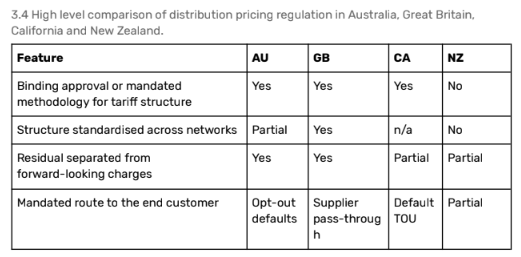
Currently regulation of distribution pricing tariffs in New Zealand comprises guidance and monitoring. New Zealand is an outlier in this respect compared to countries like Australia and the UK where requirements for pricing methodology and approval are regulated features. New Zealand also has 28 EDBs, unlike Australia and the UK which have 5 and 4 distributors respectively.
The Authority’s guidance has actively encouraged distributors to take a cautious staged approach to implementing peak payments for exports, with no evidence demonstrating that this is appropriate or would benefit consumers. Likewise the Authority’s permissive regulation requires no quantitative evidence for distributors to significantly scale down cost reflective peak price signals, and for a handful of distributors targeted peak pricing is still not in place for residential customers. The Authority is erring on the side of caution that could see over investment in networks and higher distribution cost recovery flowing into consumer bills for decades.This is not aligned with their statutory objective to increase long term benefits to consumers.
We examined 2026/27 distribution pricing methodologies from two distributors that scored on different ends of the spectrum in the Electricity Authority’s 2023 distribution pricing score cards, to illustrate how current distribution pricing regulation is being implemented.
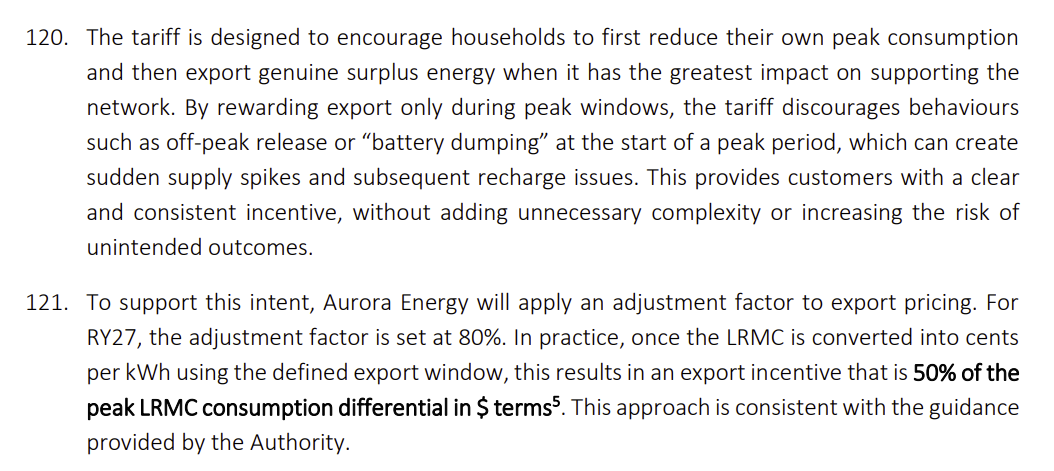
Aurora, scored highly in the 2023 scorecards (4.5/5). In 2026 peak price signals and peak export payments are scaled down significantly with no quantitative evidence to justify this, and provides no quantitative evidence to demonstrate how LRMC based peak pricing was calculated. Alpine Energy received one of the lowest scores in the 2023 scorecard review (3.1 /5). Its pricing methodology in 2026 highlights that distributors can continue with limited improvement under the Authorities distribution pricing principles in 2026 with no regulatory implications.
Aurora scored a 5 out of 5 for meeting pricing principles in the 2023 score cards and 4.5 out of 5 overall.
Since this time Aurora reports that it has:
Commercial customers can also gain value from battery exports in the pricing methodology during controlled period demand (CPD).
These are all good practices and based on the description of the method and strategy it appears Aurora should deserve a high score, however we can see that throughout its 2026 pricing, Aurora has chosen to scale down cost reflective price signals to customers with no real evidence supporting these decisions. For example:
The evidence provided in the pricing methodology means there is no way the Authority can assess if the peak pricing calculated (before it is scaled down) is cost reflective and appropriately calculated, and there is no evidence provided to support the scale back of peak price and export signals. For example:
In addition, price signals for transmission connection assets are nonexistent. This issue is not unique to Aurora. There is currently no pathway for prices or export payments to signal connection asset upgrade costs. However, Queenstown provides a good example of the additional cost customers will pay without having long term price signals in place to build up supply of flexibility to offset investment. In this example Transpower’s modeling shows that there is potential to save consumers over $500/year: “From a system perspective this deferment [with solar and batteries] could be achieved at a lower overall cost to end consumers than proceeding immediately to a new build transmission line (levelised cost per household $172pa compared to $720pa).”
Alpine Energy does not identify peak periods for its residential tariffs but instead uses daytime and night time variable rates. In its 2026 pricing methodology Alpine notes its:
“[TOU pricing] initiative is currently in the research & analysis phase as we evaluate network data, customer behaviour and operational implications. In implementing TOU pricing, we will align our off-peak and controlled charges load charges with our long-run marginal costs (LRMC) to encourage demand shifting and EV charging when network capacity is available.”
One must ask, how a distributor can in 2026, many years after time of use became an obvious way to make a more efficient electricity system, be allowed to describe it as in a “research & analysis” phase when time of use tariffs are deployed not only in New Zealand but all over the world.
Alpine does however identify “two daily peak congestion periods: 6.30 am – 9.30 am and 4.30 pm – 9.00 pm. During these periods consumers who inject electricity into our network will receive a credit rate of -$0.03/kWh. At this stage, the negative injection price applies across all seasons and days of the week.”
Alpine calculates an LRMC of 7c/kWh, however the difference between day and night rates is around 0.2c/kWh, a small fraction of this.
“Our assessment indicates that in certain areas distribution prices are not cost-reflective and so may not lead to efficient network use or investment. For example, in general:
Progress has been made in some areas - in particular for point 2 above the Authority has made providing peak export rebate for small customers an obligation in the Code. However, the Authority’s Guidance encouraged a cautious approach meaning many distributors have chosen inefficiently low default peak export price signals.
Significant progress has also been made on point 5 with regards to aspects of connection pricing transparency, and efficiency. Progress has also been made on point 6.
Our consideration of 2026 pricing practices for Aurora and Alpine provides two data points that indicate that issues still remain with delivering point 1 above. Delivering pricing principle (a)(ii) — prices reflecting the impact of network use on economic costs, is key to signal flexibility. In the Targeted Reform of Distribution Pricing - Issues Paper, 5 July 2023, the Electricity Authority noted that it was not aware of any distributor having aligned peak rates with a robustly developed view of network capacity cost specific to each consumer group. This highlighted that there was a lot of change still required in 2023. Distributors have failed to deliver this change, and the Authority has failed to require them to do so, which is meant to be its job on behalf of the NZ people.
The Authority notes that “unless these problems are addressed urgently, distribution pricing will hold back the transition or make it more costly for consumers.” Urgency is increasing as we are now in DPP4 where significant network investment is happening, with even more growth capex expected over the next 10 years. Time is running out to signal efficient uptake of customer flexibility, with delays meaning overinvestment in network infrastructure contributing to higher prices for customers. Despite this, the last time distribution pricing was publicly reviewed by the Authority was in 2023.
One of the reasons often quoted both by the Authority in its Guidance that encouraged adjustment factors to peak export rebates, and also by distributors is that strong signals that were then scaled back could disadvantage customers with batteries. So distributors suggested weaker peak price signals that are highly stable over a 20 plus year period are needed to protect customers. We disagree. First battery warranties are for 10 year and LRMC based pricing based on a 10 year asset management plan therefore is aligned to the decision time frame for customer decisions.
However customers won’t be investing in batteries primarily to access distribution pricing. Already over 50% of customers buying new solar panels are including batteries with their install.
Customers are not buying batteries to address network constraints - battery and solar’s primary benefit to the customer are to reduce total electricity costs (solar), and to offset variable consumption charges (using batteries to reduce use during peak), export payments are the icing on the cake. Higher peak to off peak differential are key to driving these actions. Many solar systems with batteries have AI-driven inverters that allow the user to input pricing, and the system will automatically adjust power draw from the grid and battery based on time of use pricing. Power use and exports will adjust, if the pricing settings are fixed. Higher peak price signals and export rates can help incentivise faster uptake - but customers are not relying on these signals to make a return on their solar and battery investment.
Distributor judgement is common throughout the pricing methodologies we examined. Distributors should not be allowed to scale back accurate and efficient pricing without providing robust evidence to justify the decision.
In some cases consumer affordability is used as a justification by distributors. This argument contradictions the argument that retailers are not passing through network price signals in tariff design. Regardless of whether improvements to TOU retail tariffs have been made or not, retailers still offer many retail tariffs with flat anytime rates that customers who are unable to shift load out of peak or who do not want to engage with TOU pricing can access. This means retailers are already acting to buffer near term affordability risks from more cost reflective peak network pricing.
However retail tariffs are passing through fixed charge increases across their low fixed charge tariffs and the phase out of the Low Fixed Charge (LFC) regulation has seen daily charges for low users increase significantly. Increasing fixed charges are adding to energy affordability challenges for many households, who are now less able to avoid costs through reducing electricity usage.
Requirements to offer LFC charges will be removed by 1 April 2027. This will allow distributors to recover residual costs that are not impacted by changing customer use through the fixed charge without a regulated limit on this charge. Distributors can therefore remove the variable charge from non-peak periods.
The Authority has recently written to EDBs clarifying that there is no expectation for an immediate and full adjustment on 1 April 2027, and asks that they balance customer impact with other pricing principles.
One way to balance affordability and other pricing principles would be to maintain some distribution cost recovery for lower electricity users in off-peak variable charges beyond 1 April 2027, and provide these customers with cost reflective distribution price signals by setting the difference between the off-peak and peak variable charge at LRMC.
The Authority should take action as proposed below in options 11 (Strengthen retailer pass-through obligations) and 12 (Transitional consumer protections) to address this situation. Distribution pricing pass through could be required in one or two TOU/wholesale retail tariffs from retailers meaning for customers that do not want to face peak distribution price signals they can avoid these through choosing retail tariffs with flat anytime variable rates, and those that want to respond and access TOU tariffs can do so. Affordability should not be used as an unsubstantiated judgement call by distributors to water down peak price signals.
New Zealand is an outlier among comparable jurisdictions in the extent of regulatory oversight of distributor pricing. Baringa’s comparison of New Zealand, Australia and the United Kingdom found that the New Zealand approach is light-handed, with correspondingly greater variation between distributors.
Our key recommendations are that the Authority makes the following changes to Electricity Industry Participation Code under urgency:
The changes could be designed to limit resource requirements from both distributors and the Authority teams reviewing distribution pricing to deliver significant improvements to distribution pricing cost reflectivity. See options 3 and 4 below for details of how this efficiency could be achieved.
Implementation should be this year. Rewiring Aotearoa is concerned that a lengthy process to develop further monitoring of distribution pricing, followed by undertaking this monitoring and finally deciding if stronger regulation is required, will delay progress on urgently needed improvements to distribution pricing.
The benefits are time critical. If uptake of flexibility is delayed, this will result in higher committed investments, translating to higher bills and cost recovery locked in and paid for by customers for decades. Once these infrastructure decisions are committed, customers have no way to avoid this cost recovery (unless they chose to disconnect and self supply).
If distributors were genuinely interested in offsetting investment in their network and lowering cost recovery from consumers, we would have seen a flurry of activity across all EDB to unlock customer flexibility, and ensure it is in place to delay capital investments where lower cost. This would have happened because we have already gone through the economic point where distributed flexibility (e.g. solar and batteries) can provide many network services at lower cost than traditional network assets.
Whilst there is some (limited) innovative pricing happening - this seems to be driven by clever motivated well-meaning people employed by some of the EDBs, and is not the norm across the 28 EDBs. We do not dig into incentives for efficiency in this Annex, but will share more on this topic in our submission to MBIE on their consultation on options to improve the efficiency of electricity distribution businesses. Building a lower cost energy system cannot rely on the good faith actions of energy companies with a vested interest against lowering costs - this is an astoundingly risky approach to regulation.
B. Improve pricing review efficiency
Rewiring Aotearoa's Matt Newman: "For marae, however, there aren't a huge amount of places where they could turn to unless they're engaging professional services around electrification. We know that that hasn't often been in the funding piece either. You know, funders will happily fund upgrades for marae, but they won't fund the due diligence that's necessary to support marae in making really good decisions for the long-term future."
Read moreDownloadRewiring Aotearoa CEO Mike Casey told Andrew Dickens plug-in solar is a simple process, which many countries including the US, UK, and places across Europe have made the most of. Labour's policy is similar but says changes to enable plug-in solar would be within 12 months of a government it leads taking office.
A shocking increase in the power bill for a marae that converted to solar energy has raised concerns about installers and regulation. The monthly power bill for Taranaki's Owae Marae has rocked to as much as $2000 a month, up from about $400. That's despite installing a solar system on its wharekai to save money. Matt Newman from Rewiring Aotearoa spoke to Lisa Owen about this issue and our new Electric Marae report.

