The 'Electric Election': energy policies, side by side


There is growing demand from voters for long-term solutions to energy and transport costs and this year we’ve seen some rare political unity around solar in New Zealand, but there is a gaping hole when it comes to EV policy, writes Rewiring Aotearoa’s Josh Ellison.
Whether you call the previous Government’s EV subsidy the ‘Clean Car Discount’ or the ‘Ute Tax’ seems to depend on which end of the political spectrum you’re on.
The policy provided discounts of about $8,000 on new electric vehicles and less on second-hand and hybrid vehicles in an effort to encourage faster uptake, lower transport emissions, drive supply chain investment by vehicle companies, and accelerate the work required to power our vehicle fleet on home-made energy (like the chicken-and-egg scenario of building charging networks, where no cars means there’s no reason to build chargers and no chargers means it’s hard to take them anywhere).
But alongside this, high-emissions vehicles were taxed to create the financial pool for discounting the electric vehicles. The stick paid for the carrot. And those high-emissions vehicles were especially big diesel utes.
The Clean Car Discount in general was smart and had both the New Zealand people and our economy at its heart. The Ute Tax was not and lacked understanding of both technology and emissions.
The problem was that all of the early electric vehicles were small cars like Nissan Leafs and non-off road vehicles like Teslas. It might have made sense to add costs to vehicles like these that had legitimate electric alternatives, but it made little sense to punish those who bought vehicles for which no legitimate substitute existed at the time.
Making a farmer pay an extra $5,000 just because they weren’t willing to take a Nissan Leaf onto a high country cattle station was an almost perfect recipe for social division and this policy came to be used for political point scoring. The Opposition used it as a stick to beat the Government with, calling it middle class welfare and saying that its wasteful spending only helped millionaires in Remuera get discounts on their Teslas, while suggesting to its rural base that they had been unfairly targeted.
The discount did as planned and drove demand for EVs and New Zealand was well above the global average in terms of EV adoption in 2023 before it came to a screaming halt when the subsidy was removed.
In international climate circles, the country is now seen as something of a cautionary tale. And rather than incentivise vehicles that would permanently reduce our need for fuel, the Government is now subsidising fuel because it’s become so expensive.
Up, up and away
In ‘normal times’, we pay some of the highest prices in the world for fuel and it’s a massive drag on our economy. According to Stats NZ, petrol was the largest upward contributor to the annual inflation rate.
Driving a Toyota Hiace van or Ford Ranger normally costs about $2,800 per year in diesel, at prices around $1.90 a litre. At current prices, it’s about double that at $5,500.
Driving an equivalent electric option (e.g. A Kia or Farizon Van or a Riddara Ute) costs about $800 for a year of driving at average New Zealand electricity prices. If charged off solar, that drops to about $350 per year. Both diesel and electric vehicles pay the same RUCs, so it’s an even comparison.
So there would be around $2,000 a year of savings in an average year, or almost $5,000 a year in savings at current prices.
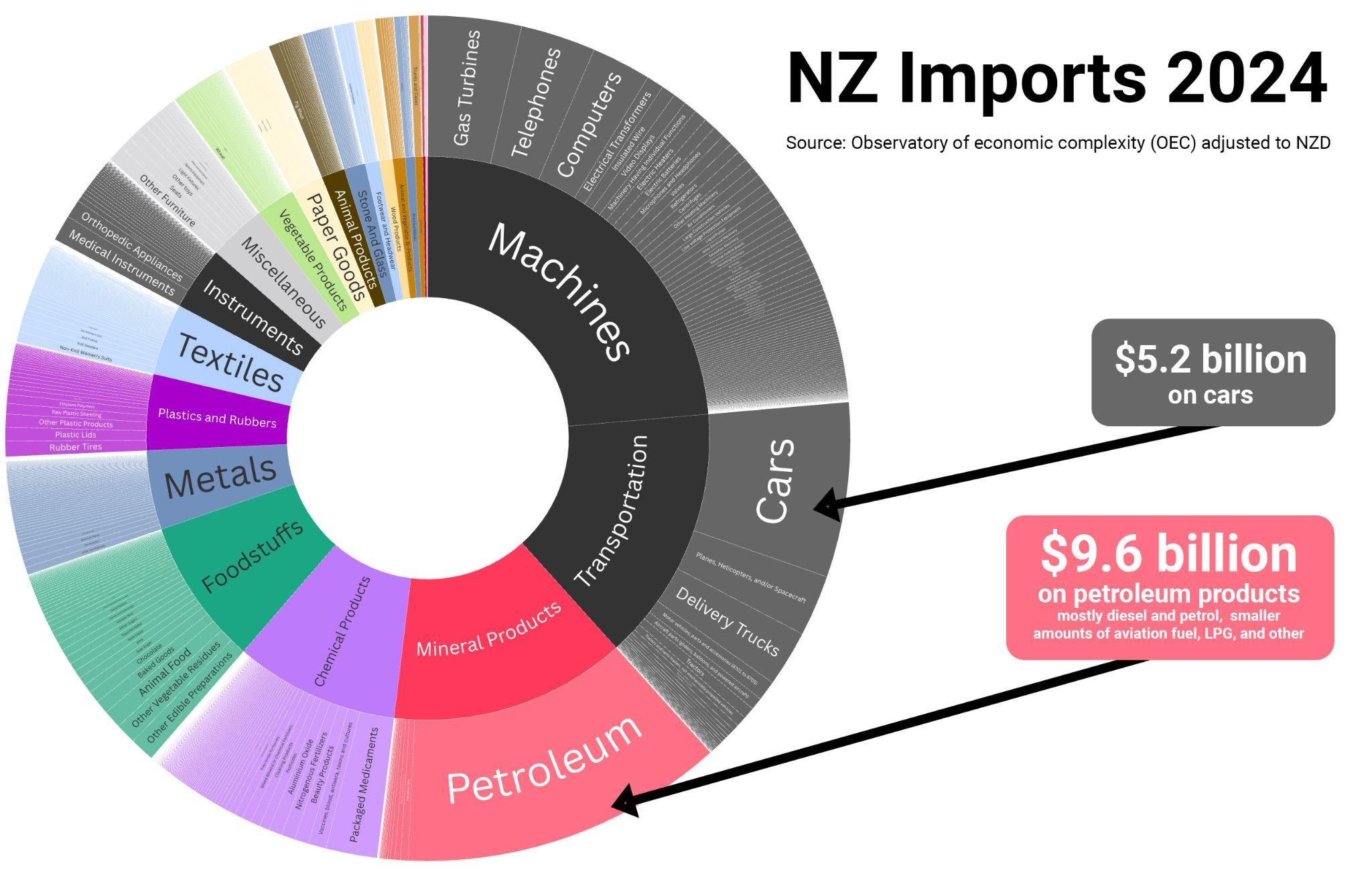
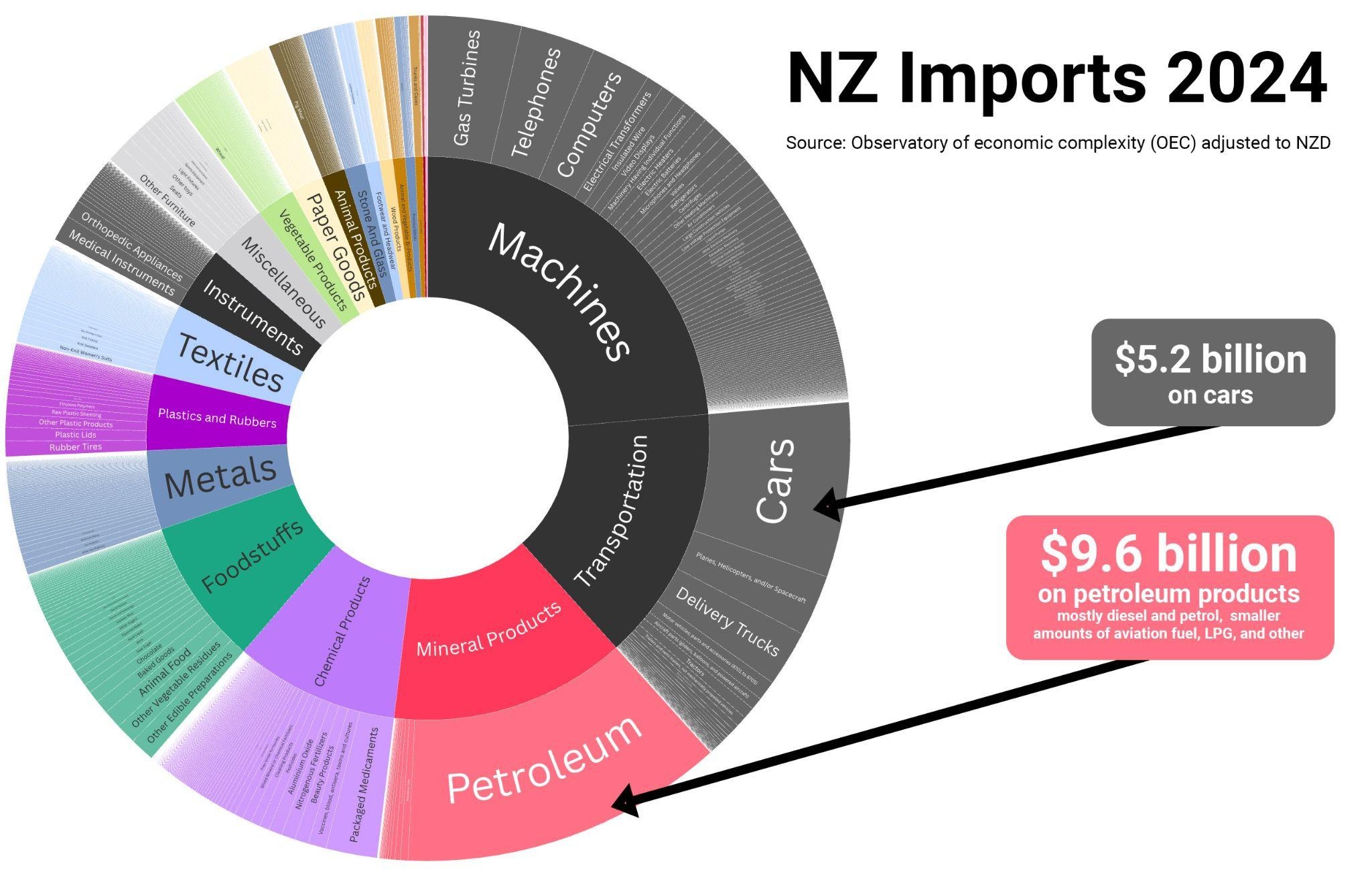
In 2024, New Zealand spent almost twice as much per year importing fuel than it spent importing cars and we’ve spent more than $2 billion extra on fuel imports in the year to date.
Vehicles last about 20 years. Of course, there are exceptions to this. I love a 1960s series Land Rover and own an old Morris Minor. Electric vehicles can last a long time, too. A new electric Ford Mustang was recently recorded as having done over 500,000km of driving. That’s the equivalent distance of 50 years of average New Zealand driving, with no major maintenance, just tyres etc. No new battery, no new motors.
Over a vehicle’s lifetime, fuel costs really start to add up. If prices remain at current levels, it would cost around $110,000 over 20 years and that’s what’s really being committed to when a new diesel vehicle is brought into New Zealand. It doesn’t matter that it might be going through many owners, it will keep burning diesel that we need to import, through increasingly fraught supply chains. And we have absolutely no control over that price.
If that vehicle was electric, the savings over its life would add up to about $96,000 - more if they charged with solar, or less if they mainly charged on ultra fast public chargers (according to Consumer, 80% of people doing more than half their charging at home and most charge overnight on cheap rates).
Those savings to the driver come with a second benefit. When we buy diesel, a lot of that money flows out of New Zealand, but an electric vehicle powered by a home or farm solar system provides local jobs to tradies, and an electric vehicle charged off the grid sees money flow back through the nation's power companies, many of which are part-owned by the Government.
Some hope that fuel prices will come down and they might. But even if they halve from what they are today, the electric vehicle will still save about $50,000 over its lifetime. No matter how you spin it, running vehicles on imported foreign fuels rather than New Zealand electricity is a waste of money and a leech on the New Zealand economy.
De-americanising our electric vehicle debate
There’s an almost patriotic dedication to petrol and diesel vehicles by some, and this seems to be inherited out of America. Well known for setting new personal bests in social division, the USA’s electric vehicle discussion has been heavily influenced by domestic oil companies and vehicle manufacturers - both having a clear vested interest against newer electric vehicles that don’t run on oil.
New Zealand does not have a huge domestic oil industry and we don’t make cars. We have no patriotic reason to be defending industries that cost us dearly and make our people and industries poorer than they could be if we ran our vehicles on New Zealand-made electricity.
In a recent poll by Talbot Mills, almost 70% of New Zealanders said long-term solutions to energy and transport costs would be a critical factor in their vote. And well over half wanted incentives to help individuals and businesses get into EVs. The price of fuel jumped from fifth to third when it comes to voter concerns in a recent survey.
96% of EV drivers say they won’t go back to combustion and there are over 100,000 New Zealanders now driving EVs. Maybe they’re crazy, or maybe they are onto something and the culture wars are just getting in the way of what would be a significant cost-of-living response for households and a major productivity boost for businesses.
Rewiring Aotearoa is backing the EV Salary Boost policy, a leasing scheme that uses pre-tax income and is based on similar schemes in the UK and Australia. It will help more working New Zealanders cut their transport costs permanently while reducing emissions. Changes to depreciation and Fringe Benefit Tax rules are also important to get more businesses buying EVs and seeding the second-hand market.
Given so many New Zealanders are struggling with the price of fuel and our economy is being dragged down by these spiraling costs, tax breaks for workers and businesses that would increase electrification of our transport fleet shouldn’t be seen simply as a cost. They should be seen as investments, because they are a pragmatic, pre-emptive, long-term response to our reliance on imported fuel.
While tax breaks reduce government revenue, the money saved by households and businesses will be spent elsewhere in the economy. Plus, billions more would eventually flow through the local economy if we ran more of it on New Zealand-made energy.
Government policy is crucial to speed this transition up. Expanding the charging network and strengthening emissions standards for imports is good, but it’s nowhere near enough. So, as we asked in our recent ‘Hey Chris!’ campaign, where’s the EV policy? Where’s the long-term strategy? Why are you asleep at the wheel? It’s clearly in our national interest to get off the pump and onto the plugs and that’s something we should all be able to agree on.
The installation of a vehicle-to-grid (V2G) charger at the Arrowtown Community Centre has made it one of the most resilient emergency hubs in the country. The bidirectional Starcharge unit, which was fully commissioned last week, can not only charge an electric vehicle (EV) but also draw power from the batteries of compatible EVS to provide backup power for the building in the event of an emergency.
Read moreDownloadThere is growing demand from voters for long-term solutions to energy and transport costs and this year we’ve seen some rare political unity around solar in New Zealand, but there is a gaping hole when it comes to EV policy, writes Rewiring Aotearoa’s Josh Ellison.
Read moreDownloadWe always like to celebrate a lift in EV sales at Rewiring, but we’re not celebrating too hard, because new Zealand is lagging behind most other markets when it comes to adoption rates. While sales are up by around 170% on the same time last year, just 10% of new cars sold were electric in October, down slightly from previous months (at a regional level, Nelson took the prize for highest share with 25%, followed by Wellington and Tasman).
Read moreDownload
