Don't listen to Old Man Gas. Ditch LNG. Support New Zealand-made energy!



Fisher & Paykel takes the crown for the country's biggest rooftop solar array - and more big businesses that start generating, the better; Octopus and Fletcher Living start a Zero Bills experiment in Canterbury; Australia shows that batteries can help the grid even if they're not tied to a virtual power plant; energy expert Michael Lieberich has a look under the hood of New Zealand's energy system and says 'don't panic'; Saul Griffith documentary looks at his electrification vision and the impact of community; and FTN Motion's Streetdog gets a seal of approval from Brisbane.

Biggest of the bunch
Fisher & Paykel is pushing electric homes through its Home Solutions business. And it’s also walking the talk with its own business, installing what is thought to be the biggest rooftop solar array in New Zealand with Sunergise.
Sitting atop Fisher & Paykel Healthcare’s Auckland campus, the system spans approximately 70,000 square metres – an area the size of seven rugby fields - and is expected to generate more than 6,500 MWh of energy per year, enough to power over 800 average Kiwi households.
We're pushing for more large roofspace to be put to use. AUT researchers found that "covering just 14 of Auckland's largest inner-city building rooftops provides a solar generation capacity equivalent to New Zealand's largest centralised solar farms".
Think small
The Zero Bills Home model in the UK has been mentioned a few times in our weekly rundown. Octopus launched the first New Zealand example last year, and now it’s running a trial with Fletcher Living in Christchurch to show the benefits.
“Fletcher Living has built two identical four-bedroom homes side by side in Lincoln as part of a five-year trial. One was fitted with solar panels and a battery while the other was a standard build used as a control to measure what the solar system actually saves. The solar home was listed at $999,000.”
The Zero Bills home will come at a premium (but the savings pay off the investment). Octopus will manage the energy use and it guarantees zero bills for five years.
This piece in B2B News shows why the zero bills model is a good way to promote the benefits of solar and how the marketing has moved away from sustainability to savings.
“The researchers concluded that “sustainability framing is basically absent from solar marketing”. Buyers use a simple heuristic: solar equals premium. They are not calculating payback periods or lifetime savings. That is a problem for any developer trying to recoup the cost of installing panels. Fletcher Living’s Christchurch trial is an attempt to solve this from the product side rather than the marketing side. If you build a home where the power bill is close to zero, the economics become self-evident regardless of how the agent pitches it.”
Our new Electric Homes and Vehicles report is set to be released soon and it shows that going electric is the smart move over the long term. Keep an eye out for that.
An orchestra of electrons
Australians have been installing batteries like they’re going out of fashion as part of the subsidy scheme (over 400,000 and counting). The Government assumed these batteries needed to be enrolled in virtual power plant systems and centrally controlled to provide value to the grid (and therefore, all Australians). But they were wrong. It is happening without such central control.
The head of the Australian Energy Market Operator Daniel Westerman told a conference recently: “Even acting in passive mode, so a consumer with complete control over their battery, just soaking their own solar or using a free power period during the day, actually has enormous benefit to our grid, reducing their own costs and reducing the costs for everyone involved. If you had have asked us 12 months ago, would we have seen such an impact on the grid from passive home batteries? I think we wouldn’t have pointed to such an impact.”
This is exactly why we need to think small when it comes to the energy system, because lots of a little adds up, and homes, farms and businesses can play an essential role when it comes to reducing peaks and eventually reducing infrastructure costs.
Solving all the problems
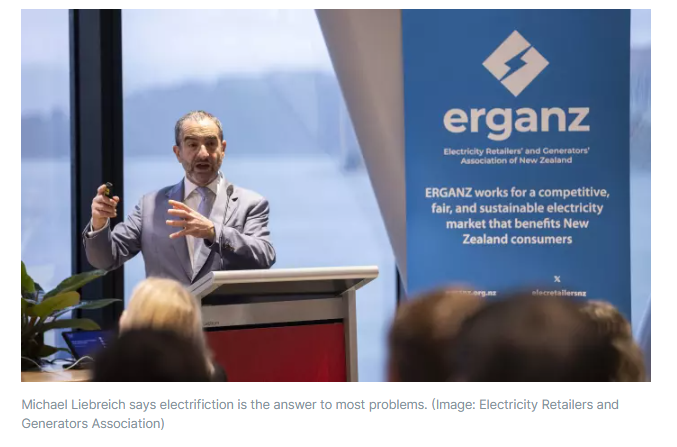
Energy expert Michael Liebreichwas in New Zealand recently and he explained the primary energy fallacy, why electrification works because when you buy solar/wind you're buying an asset that produces energy, and how an LNG terminal would create one point of failure.
His overall assessment of the market was that it was working pretty well, and that there was a need for insurance, not panic. But we couldn’t help but notice this excellent photo caption in BusinessDesk, which said ‘electrification is the solution to most problems’. Maybe not all problems, but definitely many of the problems we’re focused on.
Better call Saul
Saul Griffith started the Rewiring movement in the US, then brought it back to this part of the world. He was featured on ABC News Indepth where he talked about the role electrification can play when it comes to productivity and emissions reduction - and the role that communities can play to make it happen.
Dog eat dog world
Saul Griffith has his solar-powered scooter, the Lightfoot. But there are some other good two-wheeled electric options, including the Streetdog from New Zealand company FTN Motion.
We talked to co-founder Luke Sinclair for our Bright Sparks series recently and, as this case study shows, it’s the perfect urban machine for Frank Licastro.
“As the founder of Frank Developments, he’s helping shape the future of modern living in Brisbane and the Gold Coast. And when it comes to moving through the city himself, he rides a Streetdog. It's a different way to experience the city. No traffic stress. No searching for parks. No noise. Just a smoother, more connected way to move through life.”
Political Power has gone local! Dr Nick Smith, mayor of Nelson and ex-National Party minister, is an early adopter when it comes to electric machines but, through his efforts with the council and his close involvement with the Ratepayer Assistance Scheme, he's also embracing one of Rewiring's core mantras: once you've electrified your own life, electrify someone else's life, too.
Read moreDownloadWhether it's the growing number of electric buses, new electric trains for the lower North Island and City Rail Link, or new electric ferries, we love seeing more electric transport options in our big cities. It's also good to see some of our smaller cities like Palmerston North, Timaru and Nelson going electric and, as is almost always the case, the drivers reckon it's better on electrons. At the Electrify Nelson expo, we spoke with one driver Lee about the city's electric buses. And he definitely wouldn't go back to diesel.
Read moreDownload