Don't listen to Old Man Gas. Ditch LNG. Support New Zealand-made energy!

.png)

How the sun led to higher salaries for teachers in the US and why this should be happening here, too; how "the once-rigid link between economic growth and carbon emissions is breaking across the vast majority of the world" as electrification gives more countries a productivity boost (and how that would allow New Zealand to keep embracing our long, languid summer break); solar continues to weather storms and provide 'free resilience'; Dunedin laundry company Preens goes electric and saves over 300 utes worth of emissions; the company that wants you to drink diesel exhaust; and a wonderful rundown of the Kill Bills tour - and the national electrification opportunity - from one of the tour sponsors.

Rays to raises
We often bang on about the opportunity to save cash through electrification, and particularly solar. Our Investing in Tomorrow report put it at $29 million a day, just from the households of New Zealand avoiding all those expensive fossil fuels. That’s lots of money that stays in New Zealand, and it's a lot of extra revenue for hospitals, schools, bridges and railways. It could also mean better pay for teachers and nurses.

Over in the US, an Arkansas school put the money it saved through solar and the money it made from sending power back to the grid into a significant pay rise for its teachers.
The story is from 2021, and the price of solar has fallen a lot since then, but by installing over 1500 panels, the school saved $600,000. As the installer said, that means they have been able to decrease the cheques they write to utilities and increase the cheques they write to the teachers, in some cases by $15,000.
We’ve been pushing hard for more solar for schools. It makes so much sense from a usage perspective, as recent modelling showed, and it could also play a role in the wider energy system, especially if batteries are included.
We’ve heard there may be some news coming out on this soon, but it’s important that the schools are able to benefit from the savings solar offers and that the money can be spent in other areas of the school, rather than simply reduce the costs for the ministry.
Workin' it
There’s not a huge amount of good climate news around these days, but The Guardian’s report on the Energy and Climate Intelligence Unit’s report offers some hope: “the once-rigid link between economic growth and carbon emissions is breaking across the vast majority of the world”.
John Lang was one ofthe report's writers and he has told an unapologetically positive story about the structural shifts that have taken place since the Paris agreement was signed ten years ago today.
As he says, overall, 92% of the global economy is decoupling (reducing emissions while growing the economy), either relatively or absolutely - up from 77% in the pre-Paris period. 46% of the economy has absolutely decoupled emissions from growth since 2015 - up from 38% pre-Paris.
As always, China is an important bell weather.
“For the past 18 months, its emissions have plateaued and many analysts believe they may have peaked. If China can turn the corner, the rest of the world should follow.
As Lang said: “We are approaching a historic point when emissions start to go down. That is super exciting.”
The Spinoff went through all the reasons for our average productivity but, strangely, energy wasn’t included. We reckon electrification is our biggest productivity opportunity. We can keep those long and languid summer holidays. And we can also keep having long showers. We just need to produce more with less energy, and that’s what electrification allows us to do.
As Rod McNaughton writes in The Post, The World Economic Forum singled out New Zealand's electricity system and said “improving the reliability and affordability of electricity is now a prerequisite for the investment New Zealand needs to lift its weak productivity growth”.
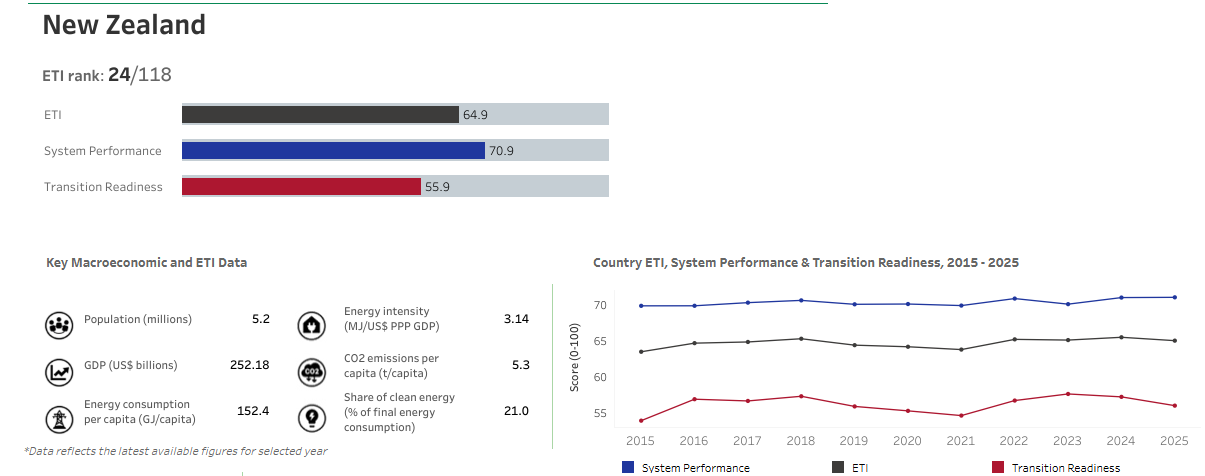
On its country dashboards, New Zealand comes in at 24th out of 118 countries in terms of how it is placed for an energy transition.
Solar weathers storms
There's a big difference between survival (a gas bottle for the barbie and a wood burner) and resilience (solar, batteries and, soon enough, cars to keep the house and water warm, the food cold and the cars charged). This is also resilience that pays itself off through lower bills.
Fairbank Farms was a good example of this after the recent storms as it was able to keep milking and keep the milk cold while other farmers scrambled for diesel generators. There were a few examples after Cyclone Gabrielle. And over in Jamaica, solar panels have also been a godsend after Hurricane Melissa.
The morning after Hurricane Melissa tore through Jamaica, Jennifer Hue, a retired tax auditor living close to hard-hit Treasure Beach, woke up to devastation. Her mango, breadfruit and papaya trees were lost, their tops snapped off by 180-mph winds. There was water everywhere.
But her roof was intact, and just as importantly, so were the solar panels she had installed two years ago. Most of her neighbors didn’t have electricity. But she did.
While many were without power for days and many buildings were destroyed, one local solar installer said none of his 300 installations had reported any damage.
We’re also an island nation with threats lurking above and below, so that’s worth paying attention to.
Lost in transition
RNZ’s Kirsty Johnston just published an excellent piece that looked at the businesses ‘lost in transition’ and struggling to cope with increasing gas prices and declining supplies but also unable to cope with the high capital costs of upgrading to electric.
To some degree, this is what’s often called ‘creative destruction’, where businesses that invest in new technology tend to prosper while others that are too slow to invest tend to falter. But in this case, the Government plays an important role, both in terms of managing the transition away from an increasingly scarce and expensive resource so the economy actually keeps going, and also helping out with grants something the current Government has done less of in recent years.
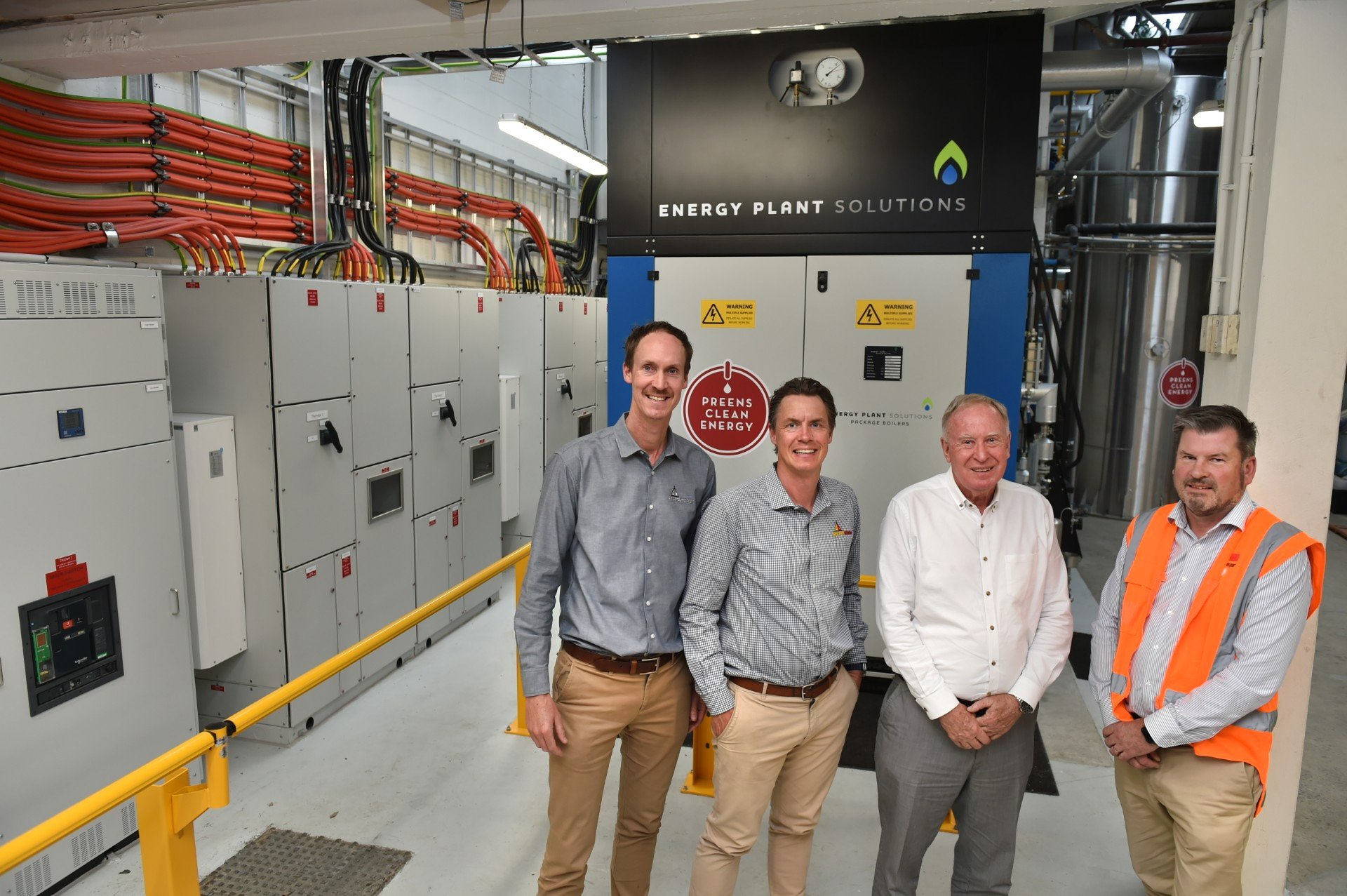
Rainbow Nursery's Andrew Tayler is glad the company got a GIDI grant when they were still available and they used it for a $2 million project that connected 32 heat pumps to two massive water tanks. Down south, Preens also got some help and recently became the first commercial laundry in Australasia to install and commission a 2MW electric boiler with advanced European heat recovery technology.
It provides the majority of process heat for Preens’ Dunedin operations and, with our highly renewable electricity grid, managing director Rick Wellington said it was one of the world’s lowest-emission commercial laundries, with the new boiler taking the emissions equivalent of over 300 utes off the road.
There were plans for solar panels next year which would further enhance sustainability, while water efficiency had also improved. Heat recovery and water reuse technology had halved water consumption across the facility.
This start-up wants you to consume diesel exhaust
We’re keen on anything that promotes a more circular economy and electrification provides that. But a Detroit start-up called Remora has found an more direct way to turn waste into revenue.
While the supposed solutions of the carbon capture and storage industry have largely proven to be fanciful, Ashlee Vance visited “a gritty industrial facility in Detroit and visited a company “taking a brute-force approach to climate change by strapping massive carbon capture devices directly onto the tailpipes of semi-trucks and locomotives”.
Instead of waiting around for an electric future that might be decades away for heavy transport, the team is betting they can trap carbon right now, filter it through specialized "adsorbent" pellets, and turn the world's dirtiest emissions into beverage-grade fizz for your soda.
Remora has bought its own locomotive and is running 4,500-horsepower experiments to prove they can scale this tech without destroying the economics of shipping. It’s a loud, heavy, and complicated solution that involves vacuuming CO2 out of tiny pores, but the logic is hard to argue with: why are we mining carbon out of the ground in Mississippi just to truck it to Florida, when we’re already spewing tons of the stuff into the air for free?”
Big fan
We wrapped up our Kill Bills tour a few weeks back and what a tour it was. Daikin was one of our generous sponsors and head of sustainability Ryan Philp has written a great wrap up from his perspective.
As he wrote:
After three months travelling Aotearoa with the Rewiring Aotearoa Kill Bills Electrification Tour, I’ve seen first-hand the energy, curiosity and momentum building across the country. From town halls and community spaces to coastal roads, pie shops and plenty of cows, the conversations were practical, grounded, and focused on lowering bills and improving everyday lives. New Zealand is at a genuine electrification tipping point — our grid is already clean. Now we need to turn that advantage into everyday benefits for households.
Done right, electrification is the rarest of public-policy creatures: a win for households, a win for the energy system, and a win for climate and public health.Here are a few reflections from the journey on homes, hot air balloons, cash and cows.
... From the Electric Homes Report, to the Policy Manifesto, to insights on the Machine Count, emissions profiles, household economics, grid impacts, and regional analysis — the depth, clarity, and rigour of Rewiring’s research is genuinely remarkable.
As we head deeper into the summer months, remember this:

Political Power has gone local! Dr Nick Smith, mayor of Nelson and ex-National Party minister, is an early adopter when it comes to electric machines but, through his efforts with the council and his close involvement with the Ratepayer Assistance Scheme, he's also embracing one of Rewiring's core mantras: once you've electrified your own life, electrify someone else's life, too.
Read moreDownloadWhether it's the growing number of electric buses, new electric trains for the lower North Island and City Rail Link, or new electric ferries, we love seeing more electric transport options in our big cities. It's also good to see some of our smaller cities like Palmerston North, Timaru and Nelson going electric and, as is almost always the case, the drivers reckon it's better on electrons. At the Electrify Nelson expo, we spoke with one driver Lee about the city's electric buses. And he definitely wouldn't go back to diesel.
Read moreDownload