Don't listen to Old Man Gas. Ditch LNG. Support New Zealand-made energy!

.png)

The unfolding situation in the Middle East is devastating for people across the region and for their loved ones around the world. Our thoughts are with those facing the human cost of conflict. As the crisis escalates, another reality is becoming clear here at home: New Zealand is exposed.
Oil markets are already reacting. Politicians are bracing for rising petrol prices, potential rationing, renewed inflation pressure, and the knock-on effects across the economy. We spend $40m at the pump every day, and that is set to rise as prices surge.
“Every household and business will feel it, but the impact will fall hardest on those who can least afford it,” says Rewiring Aotearoa CEO Mike Casey. “Our lowest-income households already spend around 12% of their income on transport, around four times the portion of their income that the highest income households spend. When petrol prices spike, those families have no choice but to absorb the cost. They still have to get to work, take their kids to school, and buy groceries.”
The Government’s decision to establish a Ministerial Oversight Group focused on fuel and supply chains is an important step. But the real test will be how the Government responds.
“Finance Minister and Chair of the Group, Nicola Willis, has been cautious about calls to cut fuel taxes - and rightly so. Lowering prices at the pump might ease the pain for a few months, but it would be little more than a short-term sugar hit. The underlying risk would remain, especially if unrest in the Middle East is prolonged.”
We cannot control global oil markets, but we can control how exposed we are to them.
The solution is simple: use less oil. The fastest way to do that is by electrifying our vehicles. Fortunately, we are at a point where doing that will save us money, increase our fuel security and reduce our emissions.

“Instead of relying on volatile, expensive foreign molecules, we should be doing everything we can to use New Zealand-made electrons in more efficient electric machines. As our calculations show, electricity is the cheapest fuel and many of us can now power our cars with what is basically the equivalent of an oil well on the roof.”
“Given the economic benefits of EV uptake for New Zealand, the Government should consider policies that help move businesses and households from just ‘kicking the tyres’ to getting behind the wheel. This would be a really meaningful way to help households with the cost of living challenge now and in the future.”
There has been a spike in interest in EVs due to these recent petrol and diesel price rises - from $2,000 Nissan Leafs that are perfect for around town to more expensive newer models that can go the length of the North Island on one charge - but we need to rapidly increase uptake so we should increase both accelerated depreciation and Fringe Benefit Tax relief for EVs.
“This would incentivise businesses to add more EVs to their fleets and turn them over faster. That would help protect businesses from oil price shocks and act as a circuit breaker to the inflationary pressure that comes with them.”
Businesses also tend to turn over their vehicles every three to four years, meaning those vehicles soon enter the second-hand market that most households rely on. Around 60% of all new cars are purchased by businesses and if those purchases shift to electric now, they will eventually flow into the used market.
“Most private cars are bought second-hand and this is critical in bringing forward the ability of lower income households to benefit from the savings EVs offer.”
In the meantime, we also encourage the Government to consider longer-term policies that can facilitate access to EVs and reduce exposure to oil price shocks. For example, Australia allows EVs to be purchased through employer salary-sacrifice schemes (paired with corresponding Fringe Benefit Tax relief).
This lets households access electric vehicles at a lower total cost, saving participants around $10,000 on the cost of their EV. It is thought close to half of all new EV purchases in Australia are now using this financing method.
“As New Zealand’s largest employer, the Government could offer this to its workforce, providing teachers, nurses, firefighters, and police with access to EVs on favourable terms.”
Removing the Clean Car Standard would be a mistake. The policy ensures vehicles entering New Zealand become more efficient over time and prevents our market becoming a dumping ground for high-fuel-use cars.
Removing it would result in more of the most inefficient fossil fuel cars being brought into the country, lock in decades more exposure to volatile oil prices, decrease our fuel security and place us alongside Russia as the only OECD country not to impose standards.
Electrification of transport reduces our reliance on oil and an MBIE report on fuel security compared different options based on cost and effectiveness. It showed that accelerating the transition towards electrification outlined by the Climate Change Commission was the best bet and was twice as useful and five times cheaper than restarting Marsden Point.
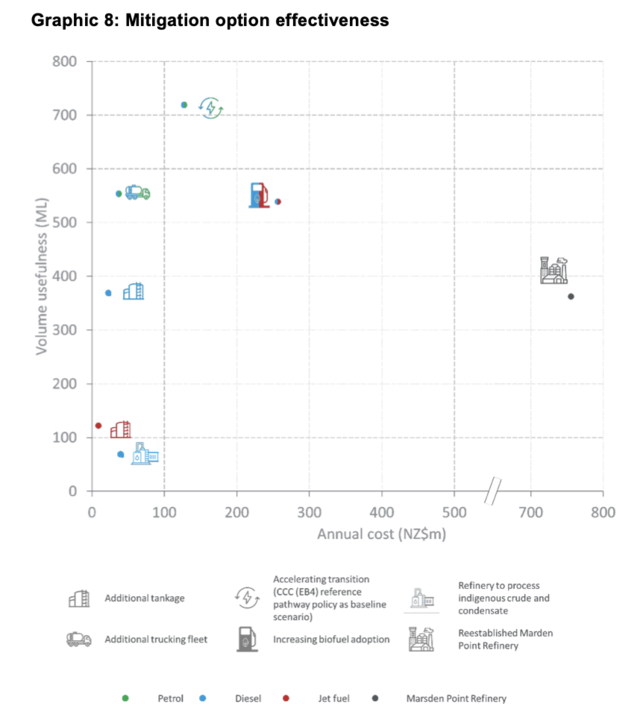
“New Zealand is basically the Chatham Islands of the world and right now we're all hoping the boats turn up. There is a chance they won’t and that supplies will be diverted and our economy will grind to a halt because we are so reliant on imports. But just as solar can help keep water in the lakes, electrifying our transport could help keep diesel in the tanks.”
The country only has a few weeks of petrol and diesel storage. Our analysis shows that if we approximately doubled the number of full EVs on the roads, that would give us an extra day of fuel storage. And if we electrified 25% of the light vehicle fleet, that would give us another seven days of fuel storage.
Many wealthy countries are rapidly adopting EVs, but there are plenty of other developing nations like Nepal, Vietnam and Ethiopia that are actively embracing them, too. Climate policies are not driving this, either. This is mostly about economics and trying to reduce their dependence on fossil fuels.
“Some have targets to phase out imports of fossil fuel cars or bans, others offer a variety of incentives to drive uptake. But going electric is the clear direction of travel in most markets because it is more secure, more affordable and more stable. A future government should be looking at a combination of carrots and sticks.”
“The Ethiopia story is fascinating,” said Colin McKerracher, head of clean transport at BloombergNEF. “What you’re seeing in places that don’t make a lot of vehicles of any type, they’re saying: ‘Well, look, if I’m going to import the cars anyway, then I’d rather import less oil. We may as well import the one that cleans up local air quality and is cheaper to buy.’”
When global crises hit, New Zealand has a choice: we can temporarily soften the blow of fossil fuel price spikes, wait for the next shock and repeat, or we can take a proactive approach and permanently reduce our exposure to them.
“The real solution is not cheaper petrol, it is needing less of it.”
Political Power has gone local! Dr Nick Smith, mayor of Nelson and ex-National Party minister, is an early adopter when it comes to electric machines but, through his efforts with the council and his close involvement with the Ratepayer Assistance Scheme, he's also embracing one of Rewiring's core mantras: once you've electrified your own life, electrify someone else's life, too.
Read moreDownloadWhether it's the growing number of electric buses, new electric trains for the lower North Island and City Rail Link, or new electric ferries, we love seeing more electric transport options in our big cities. It's also good to see some of our smaller cities like Palmerston North, Timaru and Nelson going electric and, as is almost always the case, the drivers reckon it's better on electrons. At the Electrify Nelson expo, we spoke with one driver Lee about the city's electric buses. And he definitely wouldn't go back to diesel.
Read moreDownload