Don't listen to Old Man Gas. Ditch LNG. Support New Zealand-made energy!


The Electricity Authority recently consulted on two important issues: 1) Who is able to access rewards for supplying power at peak times. And 2) How much energy consumers can export. We have again been blown away by the response from the people of New Zealand on these important proposals, and humbled that a large number used the information provided by Rewiring as the foundation for powerful submissions. Here's our summary of the responses and our take on the consultations.
"We don't get the subsidies like Oz but let's not strangle the golden goose with arbitrary red tape that serves no purpose except protecting a monopoly." Nicholson Poultry
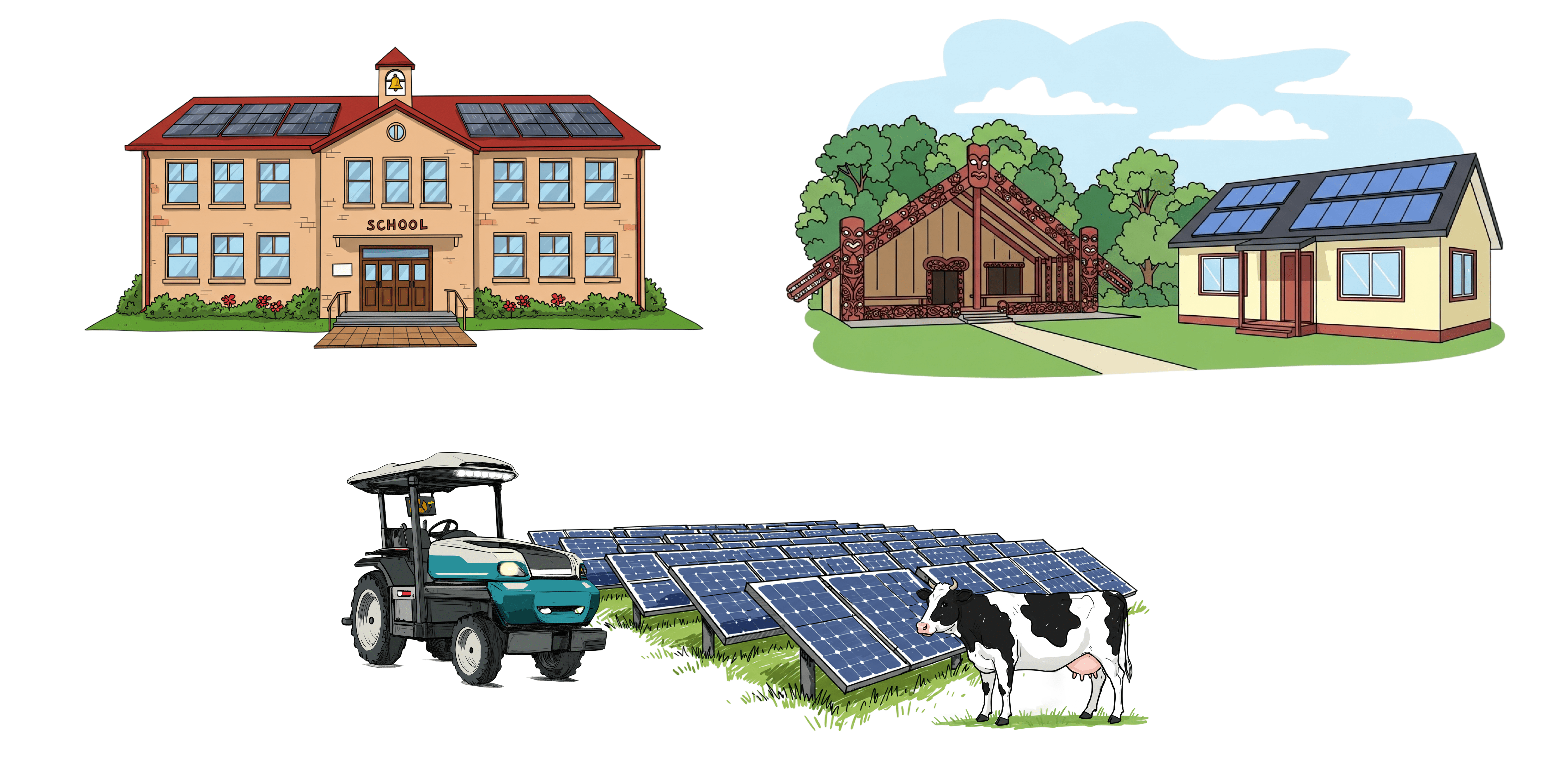
Plenty of farmers, but also marae, folks working with schools and churches, and even a remote family-run wilderness retreat, submitted to the EA and showed how they would be excluded from being fairly rewarded for exporting electricity back to the network at peak times.
This can help reduce network congestion and reduce network peaks, helping to offset and lower the cost of network investment for all customers and provide greater local resilience. These exports have demonstrable value and it was great to see the Electricity Authority’s decision in June this year to require distribution networks to fairly reward customers by paying a tariff for exports that reflects the long-run marginal cost that this export avoids.
But it was not great to see the Electricity Authority propose limits on who they protect with fair export pricing (with a 45kVa limit on connection sizes and 45kW limit on generation capacity). These limits are far too low and they will exclude many of the energy customers the policy was intended to protect - those who are not well placed to negotiate with their EDBs for fair pricing.
We have seen from the Australian experience how beneficial investing in battery systems alongside solar is for all customers. The decision to invest in a battery often happens at the same time as investment in solar. You need to switch to a different kind of inverter to add batteries to your solar system, so having fair payments for peak export from batteries there now as uptake of solar is really starting to ramp up in New Zealand is crucial to encourage customers to invest in batteries with their solar.
The Electricity Authority’s decision paper back in June this year was clear that the intention of the policy was to provide a fair deal for those small business customers who are not well placed to negotiate with their EDB. The definition of who the policy applies needs to reflect this intention and fairly capture those customers.
Feedback from customers was resoundingly clear: the proposed limits were far too low and would exclude many small business customers who struggle to negotiate with their EDBs. While there were many who submitted against the proposed low bar, a few stood out to us.
Jeff is a dairy farmer who has installed 75kW solar and, despite being a below average in size dairy farm, he would be excluded under this proposal. The farm is considering batteries given the various benefits, but payback period is the "main barrier." We especially appreciated Jeff's honest assessment that:
"We do not have the time or expertise to negotiate getting better terms or do we believe that this is an option ... There are already too many barriers.”
FarmGen, one of the companies meeting the increased demand for rural solar installations, wrote that in its experience 50kW systems outsell 25kW systems 10:1. All these farms would be excluded.
"With solar + Battery Energy Storage System (BESS) irrigation can avoid morning/evening peaks and reduce feeder load by 50–200 kW" but noted the proposal "effectively prohibits irrigation from participating.”
This sentiment was reinforced by IrrigationNZ, which suggested the farms among its nearly 5,000 members would be excluded, including dripline irrigation on modest sized blocks.
"Setting the generation limit at 45kW would therefore exclude the vast majority of farms and orchards from accessing peak-export incentives, even though they are exactly the customers who cannot realistically negotiate bespoke arrangements with their Electricity Distribution Business (EDB)."
Many other submitters reinforced the view that, despite the EA suggesting otherwise, they wouldn’t be able to negotiate directly with their EDB.
Raewyn on behalf of Te Pa o Moki Marae said:
“As a small marae with limited financial resources, our time is stretched managing facilities, events, and community support. We simply do not have the technical expertise or the administrative capacity to engage in complex negotiations with our local Electricity Distribution Business (EDB) to secure a fair peak export rate. Imposing this limit guarantees that we miss out, despite making a valuable investment that benefits the entire network.”
We were not surprised that EDBs overwhelmingly support the low bar for who will be rewarded for export, which excludes many small businesses and many important community organisations. The broken regulation of our electricity distribution monopolies means they are guaranteed a profit for building bigger networks. And as networks are built for peak electricity demand, the more who are keeping the peak down, the less EDBs can build and therefore make.
There is clear evidence that batteries deliver financial benefits to all consumers on a network, and are disappointed that Energy Trusts of New Zealand has, on behalf of “consumer owned” networks, reminded the EA of its belief that rewarding consumers who export at peak is “a poorly designed subsidy for battery owners to be paid for by existing customers.”
We expect increased penetration of batteries in households and businesses will avoid significant lines upgrades and save every household hundreds of dollars per year in the future, separate from direct financial benefits to those households that have batteries. They also play a critical role in community resilience in power outages which we would have hoped Energy Trusts of New Zealand would have appreciated. There is no downside, only upside to doing it widely now.
In our rural communities solar and batteries on farms is a win-win. It can provide a valuable revenue stream for farmers using very little land (eg: 1.5 hectares) and help lower electricity system costs for local customers, providing more resilience and creating an opportunity for the roll out of on-farm public EV charging options and the development of EV charging corridors in rural communities. The same is true in our communities for our schools, for our marae, and for any other community or small business building. All of these should be protected and paid fairly rather than having an arbitrary cut off point where fairness no longer applies.
It’s not too late for the Electricity Authority to do the right thing here. There are a range of ways to define small businesses, and in this case to make the definition workable and fair it should be based on maximum exportable generation capacity of distributed generation and it should reflect the intention of the definition; that is to include all small business customers and other small organisations that don’t have the bargaining power to negotiate directly with distributors to get a fair deal.
The 45kVA connection size cut off would result in a penalty for small businesses who are doing the right thing and reducing their emissions through electrification of their fossil fuel demand. For example, in many parts of the farming sector, bigger connections don’t necessarily map to bigger businesses. Connection size is not related to revenue, profit or staff count, but it is related to the ratio of electric to fossil fuel machines. It means the assumption that small businesses can be defined based on kVA limits is fundamentally flawed and actually penalises those that are working in the best interests of the climate and New Zealand.
Quantifying how many small businesses will be eligible based on current connection sizes represents a fundamental misunderstanding of energy system evolution. As small businesses electrify their energy use - whether that is heating, irrigation for farms or their vehicle fleet - they will increase their consumption of electricity, often by two or three times what they use today. This will inherently require more electricity to be consumed and therefore larger distributed generation installations and upgrades of connection sizes to support the electrification of the economy.
We think a reasonable level of up to 1MW of maximum deliverable generation and storage export capacity is sensible. It includes local community organisations and businesses, but would exclude utility generators and large industrials who would be well-placed to negotiate their own contracts.
Any concerns about the impact on network reliability of exports from small businesses and organisations with solar and battery capacity up to 1MW can be dealt with via other measures, for example through appropriate export limits. EDBs have the discretion to define peak times and export rates by customer group so efficient export rates can be allocated to these groups. If the impact of exports on network long run marginal cost from individual large customers does not match with that in its current customer pricing category, more granular pricing could be implemented.
The proposed definition of small business (45kVA connection limit and 45kW generation capacity) does not align with the Authority’s statutory objective to promote competition in, reliable supply by, and the efficient operation of, the electricity industry for the long-term benefit of consumers, or the additional objective to protect the interests of domestic consumers and small business consumers in relation to the supply of electricity to those consumers.
In fact, it does the opposite and ensures that a barrier to accessing fair export payments remains in place for many small business consumers, and maintains a barrier to provision of distributed flexibility that can lower electricity system costs for the benefit of all consumers.
The whole community would lose out if the proposed limit goes ahead.
We are pleased that there is almost universal support for the intent of the Electricity Authority’s proposed changes to increase the amount of energy that consumers can export.
Daniel C summed up the sentiment of many:
"So much generation is wasted that could be utilized... This [proposal] is pro consumer."
An overwhelming majority of submitters (more than 85%) support moving to a default 10 kW export limit for customers connecting under a streamlined, 10 day connection pathway. This includes a handful of EDBs, the Electricity Engineers’ Association and Electricity Retailers’ and Generators’ Association of New Zealand.
For submitters in favour, it wasn’t about trying to profit, but because of a "wish to contribute more to the grid" from an existing system (G Sanson) and concerns of waste:
“A waste of the bit of extra power that we could be exporting to help support clean energy in our neighbourhood and region." Bevan J
“It could be a step towards easing energy hardship” Climate Justice Taranaki
“While the amounts are small, the combination from rooftops could help reduce the pressure on electricity production” Chris T
“Prevents the network from accessing clean, locally-generated electricity that could benefit other consumers” Blaise S
Those against the 10kW comprised EDBs and one individual. While supportive of the overall intent, they are concerned (as are we) of certain areas of networks that may not be able to safely take 10 kW export from future systems, and prefer to (slowly) go straight to implementing Dynamic Operating Envelopes that maximise exports in real time based on actual system constraints.
While we are heartened many lines companies are worried about there being a high number of distributed solar installations that local networks are unable to cope, and afraid of equity issues around "first mover advantage", the reality is that at 3-4% solar penetration, we are many years off this being an issue as it was when South Australia was at over 30% rooftop solar penetration.
In our view, the proposals overall include Code changes to ensure these safety concerns can be proactively addressed and EDBs can have a bespoke limit that is less than 10kW in parts of their networks that can’t handle it.
We are big fans of implementing Dynamic Operating Envelopes, as explored in our submission. We agree with Vector that these "yield the greatest benefits for customers and the system as a whole."
While overall reviewing submissions was positive, there is some worrying misinformation among some EDBs, such as the belief that all inverters are stuck with the export limit programmed at installation (with many able to be updated remotely), and that voltage changes to 10%+/- are not yet in place (they are!).
Most worrying however was pointing to concerns associated with high solar uptake that are years off as an excuse to defer action now. We remain of the strong opinion that New Zealand needs to avoid unnecessarily wasting energy needed this year due to concerns about a “problem” that may not exist for five years or more.
Those EDBs we are aware of, that have invested to better understand their networks, have already moved to 10kW limits. We continue to encourage other EDBs to follow suit!
There were a lot of helpful technical points made that we are confident the EA will appropriately consider and reflect.
This seems to be one set of proposed Code changes where the EA will be able to advance in a manner that satisfies all substantive perspectives. For Rewiring, this looks like Code changes to ensure:
Regardless of these final decisions, we hope those EDBs lagging behind change their modus operandi and put to rest the concerns of Bruce G:
“The industry appear to act like luddites as far as solar power is concerned. It is just amazing to watch the roadblocks that the industry create.”
Old Man Gas will be featuring in a few newspapers and billboards this week discussing the proposed LNG import terminal. Not surprisingly, he has his justifications, but they don't stack up. It is a multi-billion dollar tax on Kiwis that many experts and sector players think is unnecessary.
Read moreDownload"The sentiment around making the electricity market fairer and cheaper for customers is great, but there's still something missing." That's Rewiring Aotearoa CEO Mike Casey's summary of Act's energy policy announcement today.
Read moreDownload