Don't listen to Old Man Gas. Ditch LNG. Support New Zealand-made energy!

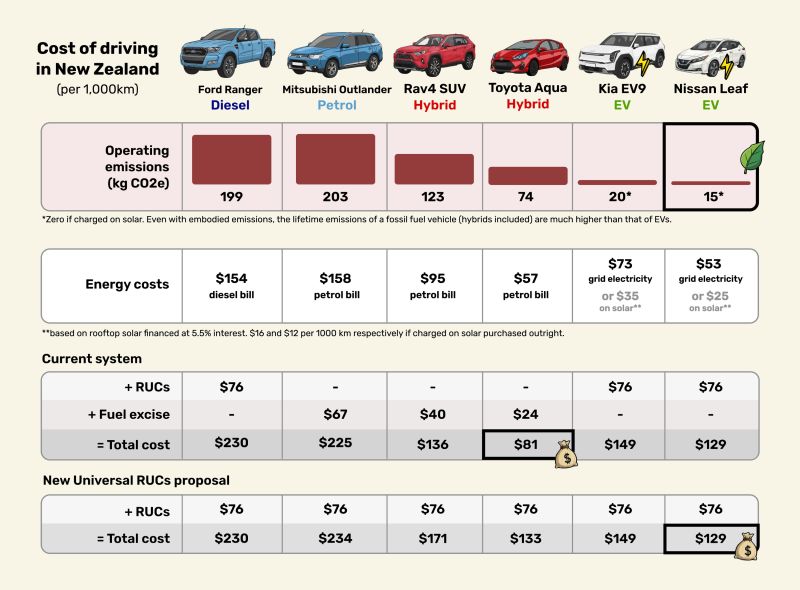

Rewiring Aotearoa is in favour of universal Road User Charges as we believe it will address an artificial market distortion for vehicles that is not in New Zealand’s economic, fuel security, or resilience interests. Here's what we told the Select Committee.
Rewiring is a fiercely independent non-profit funded by New Zealand philanthropy to represent the interests of everyday New Zealanders in our energy future. Our goal is to build an energy system with lower bills, lower emissions, and higher resilience.
We are a data-led organisation. We love to be wrong. True to the scientific method of constantly trying to prove your own hypothesis wrong, to continually see the world more illuminated than ever before. I say this as what we are about to go through on RUCs may be different to what you thought was the case.
We support a move to universal RUCs, as it will remove an inaccurate market distortion in vehicle economics and lead New Zealand towards a better energy future.
To state what is perhaps the obvious, diesel vehicles and electric vehicles are charged Road User Charges, RUCs, at a rate of $76 for every 1,000km they drive.
For petrol vehicles, fuel excise is assumingly meant to recover a similar amount. However, it does not. This creates an artificial distortion that does not serve the future of New Zealand.
To recover $76 over 1,000km at a rate of 77.4 cents per litre of fuel excise, a petrol car would need to have an efficiency of about 9.8L/100km.
The question must then be asked, of the cars New Zealand has in its fleet, and the cars we buy new today, how efficient are they, and how much do they pay?
Of the reported fuel economies in our existing fleet of petrol vehicles, only about 9% of vehicles are above this 9.8L/100km. On reported efficiency numbers, 91% of the fleet underpay. It’s worth noting at this point that manufacturer reported efficiency figures are often overly ambitious, which means the tipping point may be somewhat lower than this. If we assume vehicles are 20% less efficient than reported, it’s still about three quarters of the fleet underpaying.
Of the top 15 selling vehicles last year, none of the petrol vehicles had an efficiency that would make them pay their fair share in road user charges. On average, the efficiency of new petrol vehicles sold was about 5.9L/100km.
To put this into real world perspective, a Toyota RAV4 hybrid, one of New Zealand’s most popular new cars, has an efficiency, according to Toyota, of 5L/100km. With that petrol consumption, for every 1,000km, it pays about $39 in fuel excise. In contrast, a Toyota Electric SUV of similar size to the RAV4, pays $76, nearly double the hybrid.
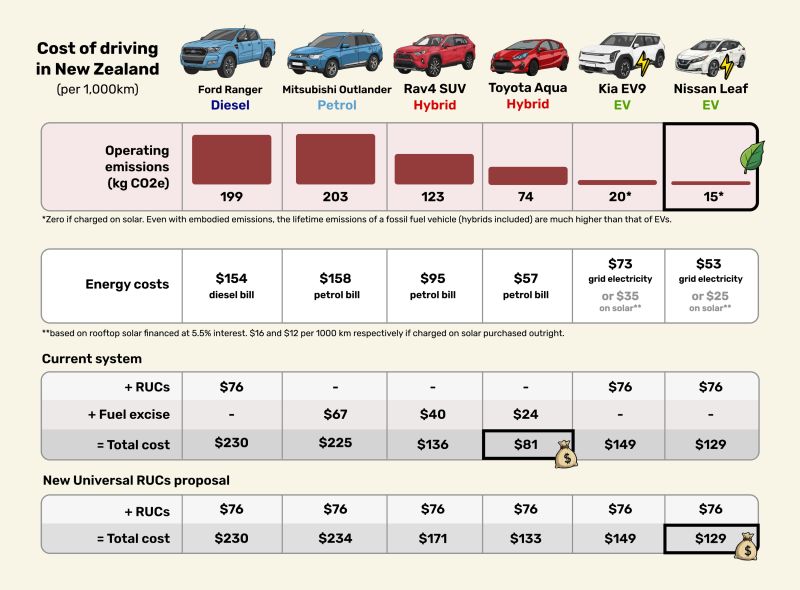
We have heard from individuals, fleet buyers, and Uber drivers alike about this distortion. This applies to second hand vehicles too. The new Toyota Yaris Hybrid, previously known as the Aqua, would pay about $24 per 1,000km. A similar sized Nissan Leaf pays $76. These differences in cost are not based on the cost of energy. This is an artificial market distortion caused by fuel excise methodology and it's a distortion that does not serve New Zealand’s economic, fuel security, or resilience interests.
The broader context is also illuminating.
New Zealand spends about $15 billion a year at the pump buying petrol and diesel, all imported from foreign nations, and subject to disruption.
MBIE’s own report into our nation's fuel security concluded that it would be five times cheaper and twice as useful for the fuel security of the nation to electrify more of the vehicle fleet than to restart the Marsden Point oil refinery.
As we launch into a world where vehicles can back up homes, businesses, and farms with vehicle to grid technology, providing more and easier access to energy resilience than we’ve ever had before, the benefits to New Zealand could be immense.
You must ask yourself, in a country with no oil industry, that imports almost all its fossil fuels from foreign nations, which produce minimal jobs locally, why put the finger on the scale on behalf of the fossil fuel industry? Who does it help? We don’t have a car manufacturing sector to protect (like the US does), and we are not an oil magnate. To quote Ford CEO Jim Farley on Chinese electric vehicles: “It’s the most humbling thing I have ever seen ... the cost, the quality of their vehicles is far superior to what I see in the West”.
The European automakers are catching up too. Even Toyota and Subaru are bringing more EVs to market this year, after false dreams of hydrogen have been shown to have no future in light vehicles.
A significant portion of the cost of any product is the energy that went into making it. We could run our economy with far more productivity, saving billions every year, by running on our own self reliant electricity flowing through thermodynamically more efficient and reliable electric machines. We could be installing vehicle chargers around the country, supporting far more local jobs, creating local savings that flow back into our communities, supporting our trades and our electricity suppliers, rather than overseas oil companies, and creating the energy resilience we will need in disasters to keep our lights on and homes warm.
There is no reason the scales should be tipped towards inefficient, expensive to run vehicles that do not serve our future. It is our recommendation that the committee proceeds with a universal RUC approach, and that overarchingly, as a nation we start building an energy future to benefit our people first.
Time is of the essence. Every day New Zealand businesses and homes invest in vehicles that will last in the economy for 20 years. This includes large fleets who may be looking at shifting back to hybrids from electric vehicles so they can pay less road tax. While deciding on and organising the future of RUCs, our current system pushes us towards vehicles that will be more expensive to run and maintain in the long term, and will just need to be replaced again to get to zero emissions.
We recommend that the introduction of universal RUCs is accelerated to minimise negative impacts of this market distortion occurring today, and that there are even faster short-term remedies to ensure the vehicles the New Zealand people invest in are in their and the nation's long term interest. Those vehicles need to be electric.
Political Power has gone local! Dr Nick Smith, mayor of Nelson and ex-National Party minister, is an early adopter when it comes to electric machines but, through his efforts with the council and his close involvement with the Ratepayer Assistance Scheme, he's also embracing one of Rewiring's core mantras: once you've electrified your own life, electrify someone else's life, too.
Read moreDownloadWhether it's the growing number of electric buses, new electric trains for the lower North Island and City Rail Link, or new electric ferries, we love seeing more electric transport options in our big cities. It's also good to see some of our smaller cities like Palmerston North, Timaru and Nelson going electric and, as is almost always the case, the drivers reckon it's better on electrons. At the Electrify Nelson expo, we spoke with one driver Lee about the city's electric buses. And he definitely wouldn't go back to diesel.
Read moreDownload