Don't listen to Old Man Gas. Ditch LNG. Support New Zealand-made energy!

.png)

Talk about going in one door and out the other.More people than ever are struggling to pay their energy bills. There is a system designed to help those in that situation and a total of $562 million was paid in the last financial year through the Winter Energy Payment. There are additional emergency payments on top of this. And this completely ignores the wider health and social costs of 'energy poverty.' Interestingly, a similar amount - $482 million - was paid to the Government in dividends from its shares in the gentailers Meridian, Mercury and Genesis in the last financial year.
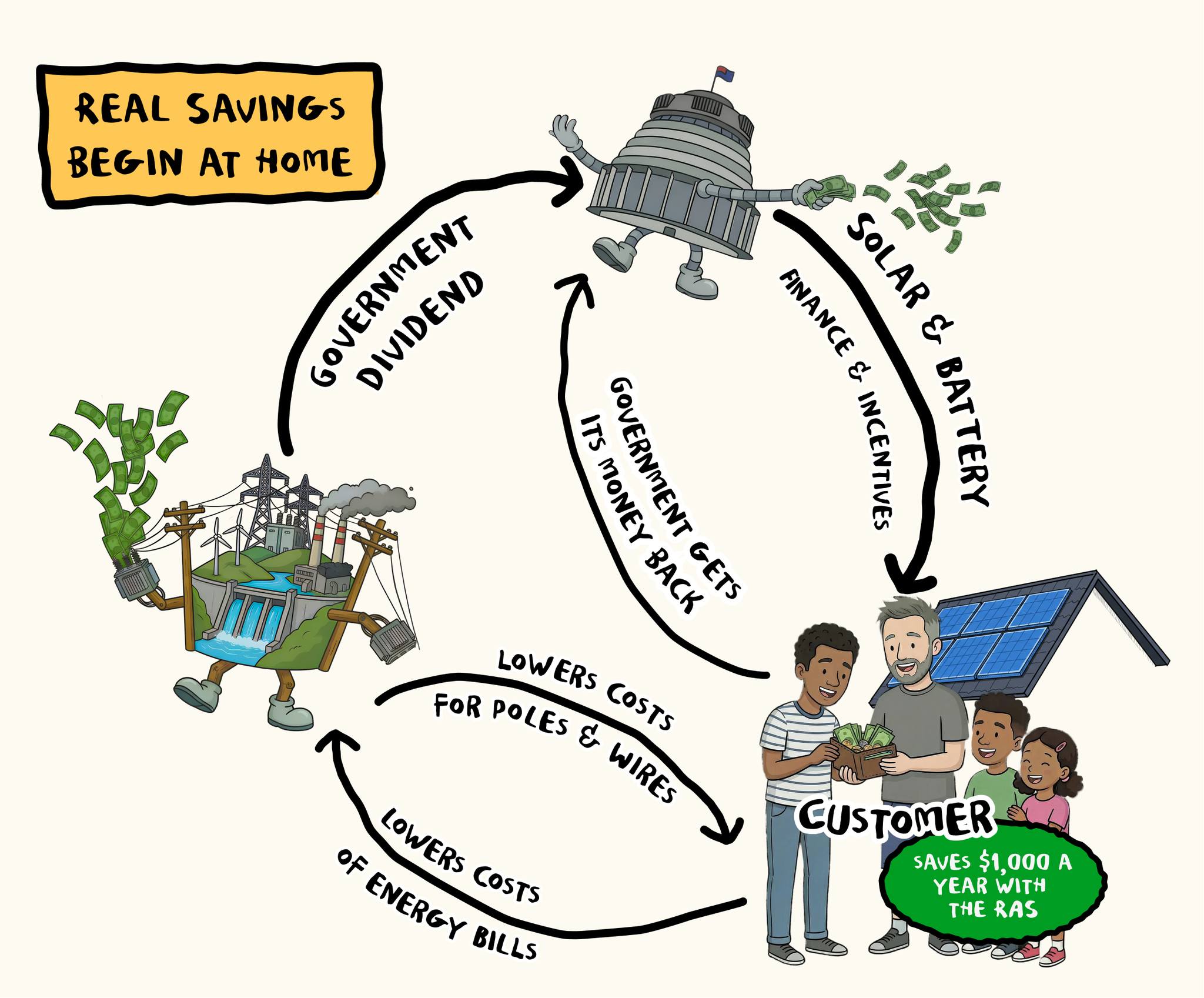
Many of us feel good about our ownership of the gentailers and what they provide back to the Government. We're in favour of a more circular economy and electrification offers a great opportunity to embrace that, but this is the kind of circular economy that doesn’t make any sense.
It is a band-aid solution and it is not addressing the root cause of the problem.
According to Statistics NZ, since December 2021, electricity prices have risen by 27 percent. Other estimates suggest prices will increase by around 30% before the end of the decade. And the latest from the Electricity Authority shows 40%, yes 40%, of households are worried they won't be able to pay their power bills in the next year.
If the Government is serious about reducing bills, it should instead be investing some of that money into solar in homes - and particularly low-income homes.
Even just $6-7 million would allow nearly every home to access long-term low interest finance through the Ratepayer Assistance Scheme. Homes with solar could save around $1,000 per year, including loan repayments. And homes with the full suite of electric kit could save around $2,000 per year.
The Government would get its money back and breaking the link with the big energy landlords that keep ratcheting up prices would be much more effective at lowering energy bills than the usual tactic of applying ‘downward pressure’. That hasn’t worked.
The current system is not a good example of ‘smart economic management’, and neither is the similarly circular decision to cancel the $1 billion GIDI fund, which was designed to get gas users onto electricity, and spend “north of $1 billion” to build a new LNG terminal that will keep them hooked on gas and do very little to lower bills.
Real savings begin at home.
Political Power has gone local! Dr Nick Smith, mayor of Nelson and ex-National Party minister, is an early adopter when it comes to electric machines but, through his efforts with the council and his close involvement with the Ratepayer Assistance Scheme, he's also embracing one of Rewiring's core mantras: once you've electrified your own life, electrify someone else's life, too.
Read moreDownloadWhether it's the growing number of electric buses, new electric trains for the lower North Island and City Rail Link, or new electric ferries, we love seeing more electric transport options in our big cities. It's also good to see some of our smaller cities like Palmerston North, Timaru and Nelson going electric and, as is almost always the case, the drivers reckon it's better on electrons. At the Electrify Nelson expo, we spoke with one driver Lee about the city's electric buses. And he definitely wouldn't go back to diesel.
Read moreDownload