Don't listen to Old Man Gas. Ditch LNG. Support New Zealand-made energy!

.gif)

The list of those who think we need an LNG import terminal is very small. And the list of those who think we don't is long and growing. Consultants, industry players, energy experts, consumer advocates and climate orgs all agree LNG is bad for New Zealand. So why is it still on the table when better alternatives exist? See ours at nzmadeenergy.nz
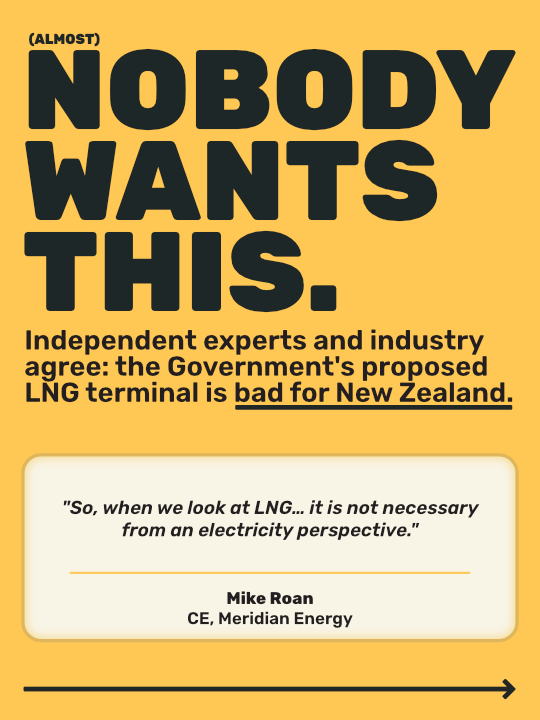
Mike Roan, Meridian CEO: "So, when we look at LNG… it is not necessary from an electricity perspective."
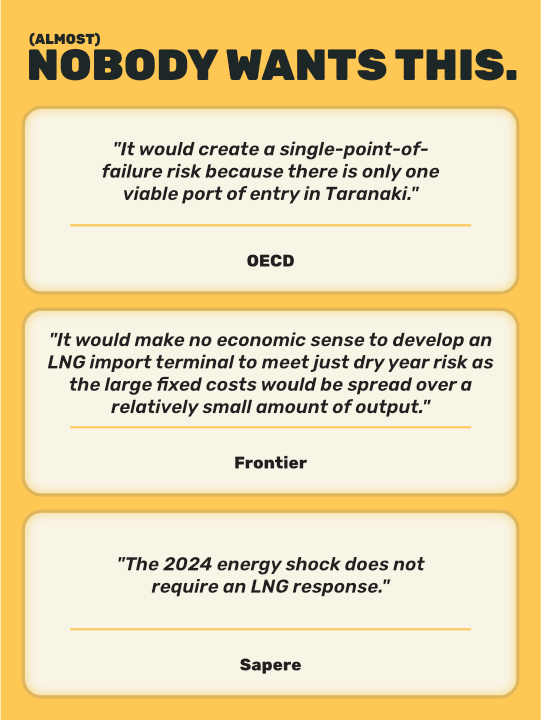
OECD: "It would create a single-point-of-failure risk because there is only one viable port of entry in Taranaki."
Frontier: "It would make no economic sense to develop an LNG import terminal to meet just dry year risk as the large fixed costs would be spread over a relatively small amount of output.”
Sapere: "The 2024 energy shock does not require an LNG response."
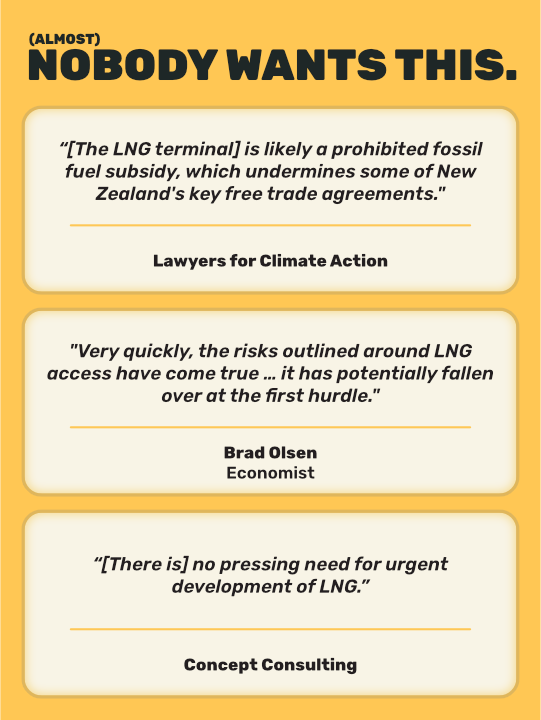
Lawyers for Climate Action: “The funding of the LNG terminal is likely a prohibited fossil fuel subsidy, which undermines some of New Zealand's key free trade agreements.” "
Brad Olsen, Infometrics: "Very quickly, the risks outlined around LNG access have come true … it has potentially fallen over at the first hurdle."
Concept Consulting, 'Outlook for the New Zealand gas market', June 2026: "Our modelling indicates there is likely to be a large net cost to the New Zealand economy (and marginally higher electricity prices) from forcing LNG via an electricity levy."
OECD: “The conflict in the Middle East underlines that introducing reliance on LNG would exacerbate New Zealand’s already high vulnerability to imported liquid fuels shortages.”
Sapere: “The most likely future is one without significant new domestic gas ... Future gas reliance should be phased out, not bridged [with LNG].”
Malcom Johns, Genesis CEO: “I think LNG stands for 'Likely No Gas’.”
Dr Saul Griffith, inventor and advocate: “LNG is really quite an expensive fuel. [It] is a bad idea for a country like New Zealand.”
Mike Casey, Rewiring Aotearoa CEO: “Mike Casey: “The Government has not fully considered whether a new dedicated dry-year fuel is even necessary, and did not do a robust comparison with the other options and we think the procurement process should be stopped because LNG is not in the best short or long-term interests of New Zealanders.”

Consumer NZ: “Imported LNG is one of the most expensive fuels you can use to make electricity – about twice as much as new renewables. Households would be hit with a new levy to help pay for the terminal.”
Dr Christina Hood, New Zealand Climate Foundation: “It's increasingly clear that the government's narrative of LNG as ‘dry year electricity insurance’ really doesn't stack up.”
Taxpayer’s Union: “You don't make electricity bills cheaper by taxing them … Make no mistake, a tax on power will hit jobs and make households worse off.”
Simon Upton, Parliamentary Commissioner for the Environment: “... An LNG importation facility raises the possibility that not only will we lock ourselves into a higher emissions pathway but will do so in a way that exposes us to higher energy costs – the worst of both worlds.”
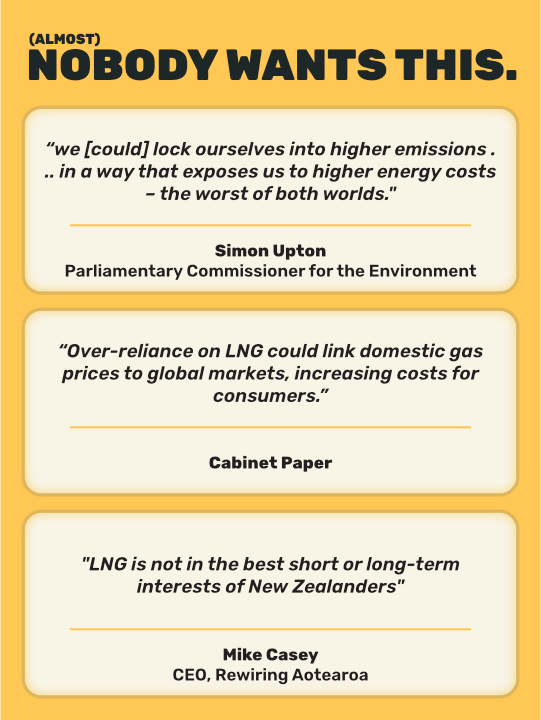
Cabinet paper: “Over-reliance on LNG could link domestic gas prices to global markets, increasing costs for consumers.”
Margaret Cooney, COO Octopus Energy: “... The Middle East conflict is likely to undermine the case for establishing an LNG import terminal, which aims to shore up our electricity system and plug supply for reticulated gas users.”
Jen Troop, Greenpeace: “This project is clearly being driven by blind political loyalty to the fossil fuel industry rather than sound economics or climate science.”
David Keat, ex-Marsden Point manager: “For some reason, New Zealand's going down the 1980s path.”
*Almost.
Old Man Gas will be featuring in a few newspapers and billboards this week discussing the proposed LNG import terminal. Not surprisingly, he has his justifications, but they don't stack up. It is a multi-billion dollar tax on Kiwis that many experts and sector players think is unnecessary.
Read moreDownload"The sentiment around making the electricity market fairer and cheaper for customers is great, but there's still something missing." That's Rewiring Aotearoa CEO Mike Casey's summary of Act's energy policy announcement today.
Read moreDownload