Don't listen to Old Man Gas. Ditch LNG. Support New Zealand-made energy!

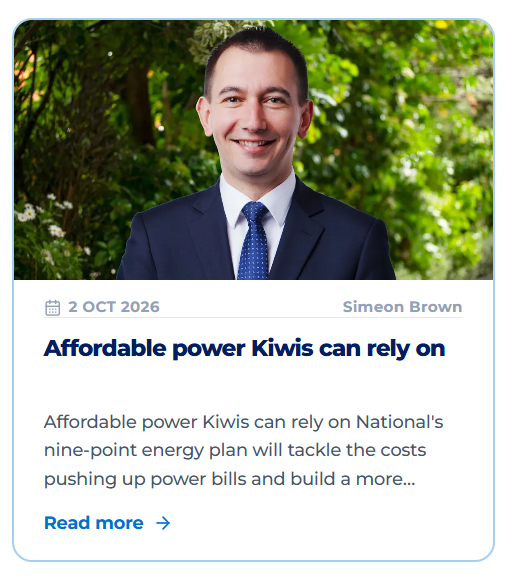

National's nine-point energy plan will tackle the costs pushing up power bills and build a more secure energy future for New Zealand, National's Energy spokesperson Simeon Brown says.
"Secure, affordable power is key to keeping homes warm, keeping businesses competitive, and supporting the growth that creates jobs and lifts wages," Mr Brown says.
"A re-elected National Government will build on our success this term with Electrify NZ 2.0, a nine-point plan delivering more supply, more competition, and more choice for households and businesses, to help make power more affordable."
Under Electrify NZ 2.0, a re-elected National Government will:
"New Zealand is experiencing its biggest renewables boom in a generation under National, with more new renewable generation built in the past three years than in the previous eight," Mr Brown says.
"That's helped lower the price power companies pay for electricity, with significant reductions in wholesale prices in the past year. That supports businesses, and puts households on a path to more affordable power.
"But the price of electricity itself is only one part of a power bill. Lines charges, red tape, weak competition, and the cost of keeping the lights on in a dry year all add to what Kiwis pay. Our nine-point plan takes on each of them.
"Lines charges accounted for around two-thirds of the rise in the average power bill over the past year. They're set under an outdated law, so we'll review it and make necessary changes ahead of the next price reset. We’ll also let Kiwis choose who does the connection work they're paying for.
"Red tape is holding back new power at every scale, even on people's own land. Environment Canterbury has required a consent for ground-mounted solar panels in case rain washes bird droppings off them. That's the kind of red tape we'll scrap.
"Reliability matters too. We need backup for when the lakes are low, but a few big power companies hold most of it, largely for their own use, and smaller power companies have no easy way to buy the backup they need to get through a dry year.
"We've already moved to give independent retailers fairer access to the contracts they need to compete with the big players. Opening up backup supply is the next step to levelling the playing field.
"New demand needs new supply too, so AI data centres will need to bring their own power rather than push up bills for everyone else.
"This term we've reversed Labour's oil and gas ban, scrapped Lake Onslow and the 100 per cent renewables target that put investors off, and sped up approvals for new power projects. We've also built up strategic fuel reserves at Huntly and started the process to deliver an LNG import facility, so a dry year is managed rather than a crisis. Electrify NZ 2.0 will build on that progress.
"Labour would put all of that progress at risk. Chris Hipkins has promised to bring back the oil and gas exploration ban, which would drive investment and jobs offshore and send power prices soaring.
"Higher power bills would come on top of the $2,263 a year in extra tax that Labour's spending promises would cost the average household.
"This election is going to be incredibly close. The choice is clear, between National with a nine-point energy plan to support more affordable power, with no new taxes. Or a Labour coalition that would push power prices up and leave Kiwis worse off with nine new taxes."
No-one likes a skite, but everyone loves perovskite, including some awesome New Zealand researchers trying to improve the efficiency of solar; why put panels on the roof when you could have panels as walls; electric trucks are increasingly stacking up when it comes to lifetime costs; an induction hob that can 'cook on yesterday's sunshine' gets the tick of approval from appliance giant Miele; CATL's new 15-year battery; and how to fight energy disinformation by talking to lots of disparate groups.
Read moreDownloadNational has announced what it’s calling ‘Electrify NZ 2.0’, a nine point plan to provide affordable power. And while it has a lot of stuff Rewiring has been asking for for a few years, there are a couple of big bits missing, says CEO Mike Casey.