Te Whakahiko i ngā Marae | the Electric Marae report

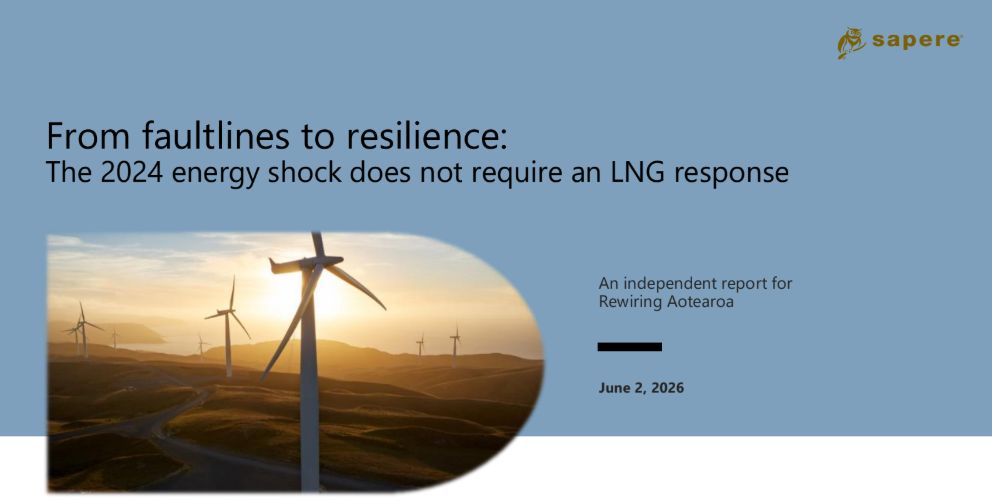

New research from independent energy experts Sapere on behalf of Rewiring Aotearoa shows the proposed Liquified Natural Gas import terminal is not the best solution for dry year cover and is a bad long-term option for gas users facing a domestic shortage.
June 4, 2026: The proposed Liquified Natural Gas import terminal is a short-term reaction that will have negative long-term consequences and there are better options available. That’s the main thrust of a new report ‘From Faultlines to Resilience’ produced by independent energy experts Sapere for Rewiring Aotearoa.
“The analysis clearly shows we should not be rushing into this LNG decision and signing something in the next few months. It appears premature and costly relative to lower-cost bridging and long-term renewable options,” says Rewiring Aotearoa CEO Mike Casey.
As the report says: “In our view, importing LNG to solve the dry year problem was not adequately compared to a feasible and competitive alternative of diesel (in the short term) and renewables (in the long term).”
“The report shows the Government has not fully considered whether a new dedicated dry-year fuel is even necessary, and did not do a robust comparison with the other options and we think the procurement process should be stopped because LNG is not in the best short or long-term interests of New Zealanders.”
The report says the 2024 energy crisis exposed three ‘faultlines’ in our system.
“Rather than invest in an LNG terminal, which is a short-term band-aid, we could instead pay a similar price and sort out the dry year, deal with our gas shortage and increase our diesel storage.”
The report instead recommends:
“Sapere’s analysis backs up what we’ve been saying as part of our New Zealand-made Energy campaign. We know cheap renewables are the key to our prosperity and we believe New Zealand has a real opportunity to lead the world given our natural resources,“ says Casey. “There is a lot of new wind, solar and geothermal in the pipeline, and eventually that generation will close the constantly lessening dry year gap, but for those who still think we need a bridging solution for the next 5-7 years, diesel is a better option in the short-term.”
He says it might seem strange for an environmentally focused NGO like Rewiring to be advocating for diesel, “but we are pragmatic and data-led and the data shows that it is actually a better pathway to renewables and energy independence than LNG” and it may not even need to be employed. It also comes with added resilience benefits to the broader economy.
The conversion of 400MW of existing gas peakers to run on either gas or diesel, with sufficient back up diesel storage, is a straight forward solution that:
Recommissioning a further 120 million litres of diesel storage at Marsden would be a much cheaper option and, based on the price the Government has paid to recommission 90 million litres recently, it could cost less than $29 million. A coastal shipping network would be required for this option.
The shortage of domestic gas was a key factor in the 2024 fuel crisis and reserves are declining more rapidly than expected.
“If we accept that gas is going to be off the table long term - and this report suggests we should - then that means we need to accelerate industrial process heat fuel switching.”
The report says the Government’s response to the 2024 fuel crisis was “deficient” and labelled the recently announced Government-backed loan scheme to help businesses transition from gas to electricity as “tepid”.
“This problem requires a much bolder policy response, and it cannot be seen as corporate welfare. It must be seen as a key component of the energy strategy New Zealand needs. The good news is that an ‘acceleration fund’ would cost less than the $1 billion plus bill for LNG, and could stretch our domestic gas reserves out for around an extra two decades, saving it for those businesses with no options to switch.”
The report shows that LNG as a solution for gas-dependent businesses is also a bad option because it’s basically a long-term subsidy, paid for by electricity users, that locks those businesses into volatile, high-cost fuel.
“The report says it may require future governments to subsidise an unknown LNG price for an unknown number of businesses for an unknown time. It’s an uncapped liability.”
LNG prices are expected to stay high for a prolonged period and LNG imports will only delay the transition to a more stable, more secure, more productive future. The money would be better spent on helping to electrify these businesses and upgrading the network.
“We have a gas industry because we discovered abundant gas and the Government decided to underwrite gas infrastructure. That phase is now coming to an end, so we face another big decision point and it makes sense to invest in the infrastructure to help homes, farms and businesses run on cheap, abundant renewable electricity. Investing in LNG would take the heat out of that ambition.”
High temperature heat pumps are well-established and can now produce temperatures of up to 280 degrees, which covers a large chunk of industrial processes.
“This is not a technology problem. It’s a policy and finance problem and it’s solvable with the right support.”
Casey says proposing one big thing to solve a big problem like the dry year may seem like an easier decision for the Government to make, but it’s not the right decision.
“And it’s also not the right decision for the regions. An LNG terminal would provide a short-term boost for one region but renewables, by their nature, are regional. Large renewable projects, network upgrades, and hundreds of thousands of rooftop solar and appliance installs around the country will be one of New Zealand’s biggest job creation opportunities. We can also regionalise our security with renewables, whereas thermal resources like LNG are in one place, with one point of failure.”
Alongside the diesel back-up and industrial fuel switching, the report suggests we need to create firm-energy contracts that protect businesses from high wholesale prices and unlock the lowest cost solution to the dry year (i.e. renewables).
“Wholesale prices surged to $800 per MWh in 2024 and they generally hover between $90 and $150. But the problem wasn’t necessarily the price, it was the lack of insurance.”
Casey says you can’t come asking for insurance when your house is burning down.
“Like the stock market, it’s very unlikely businesses will be able to time the market and there’s massive risk not to hedge against high wholesale prices. But that hedging also needs to be available and affordable and we’ve seen examples in the past where that hasn’t been the case. That’s why changes to the contracts market are needed.”
This report adds to a growing list of detractors suggesting LNG is not the right answer, including the OECD, which said it was likely to increase prices for customers and that it was unwise to tie our electricity price to a volatile international commodity.
Meridian CEO Mike Roan said last week that LNG was not required for dry year risk as other market-led solutions like demand flex agreements with big electricity users, more solar production in a dry year that can keep hydro lakes full and, potentially, extra water storage would close the gap.
Contact CEO Mike Fuge also said the dry year risk was declining and that the deindustrialisation of New Zealand due to a shortage of gas was a myth because there is so much more renewable generation locked in and many processes that can now be electrified.
Alongside Sapere’s work, Simon Coates at Concept Consulting has undertaken modelling that demonstrates New Zealand structurally has enough gas to get us through the next five to six years if we exclude petro-chemical demand (namely making urea and methanol, neither of which would be worth investing in LNG to support).
Just as we need bold policies to help businesses electrify, we also need bold policies to help households electrify. Our forthcoming 2026 ‘Electric Homes and Vehicles’ report outlines what electrification could deliver at the household and national levels.
“There is a gap there, too, but it can be closed with access to finance. The Ratepayer Assistance Scheme would remove upfront cost barriers and could save a typical gas-dependent household around $2,000 per year including repayments. It will also rapidly increase the renewable generation we need to run our homes, farms and businesses on New Zealand-made Energy.”
ENDS
Read our dry year explainer and download infographics here.
Rewiring Aotearoa is an independent charity working on energy, climate and electrification research, advocacy and education. The New Zealand-based team consists of energy, policy, communications and community outreach experts and it is funded by New Zealand-based philanthropists including Sir Stephen Tindall and Urs Hölzle. While we are selling the achievable dream of a more secure, resilient, productive, affordable and renewable energy system, we do not financially benefit from sales of solar, EVs or any of the electric technologies we advocate for.
The report was produced by David Reeve, Stephen Batstone and Corina Comendant for Sapere, a leading economic advisory, strategy, forensic accounting and valuation firm in Australia and New Zealand.
Two-way charging seen in the wild; sales of big electric rigs are growing rapidly (and more of them could helps address New Zealand's $12.1 billion energy blind spot); second-hand EVs are holding their value better than expected in Australia; the perils of Aqua ownership; and how to improve the disputes process in the wake of the SolarZero saga.
Read moreDownloadAccording to a new poll from Talbot Mills, energy will be a major factor for almost three quarters of voters on November 7 and just 12% think spending $1 billion on an LNG import terminal is a good use of Government money.
Read moreDownload