Don't listen to Old Man Gas. Ditch LNG. Support New Zealand-made energy!


Rewiring Aotearoa says the ‘electric election’ has well and truly kicked off and Labour has one-upped National with more finance options for electric upgrades, a one-stop shop to make it easy for New Zealanders, grants for low- and middle-income homes, a $30 million community battery fund and more support for tradies.
JULY 8: Rewiring Aotearoa says the ‘electric election’ has well and truly kicked off and Labour has one-upped National after this morning’s SolarSaver policy announcement.
“When National announced its support for long-term, low-interest loans through the Ratepayer Assistance Scheme (RAS) a couple of weeks ago, I said it was one of the best days of my life because we had been advocating for it for so long. Well, today’s topped it, because Labour’s policy is even more comprehensive and will help even more New Zealanders go electric.”
Labour will not only advance the RAS as a priority if elected, but also an additional finance option with electricity lines companies, where solar and batteries can strengthen the network.
“We think the RAS is the best option for a number of reasons, but a suite of options will maximise reach. More is more! We also really like the allocation of funding for EECA to build a portal or ‘one stop shop’ that makes the upgrade process as easy as possible for New Zealanders. It’s a smart move that will ensure people don't get lost along the way.”
Labour has also recognised that households in real hardship will need more than just access to finance and have committed to some tightly defined subsidies.
“We can achieve a lot without subsidies, but low income homes spend around five times more on energy as a proportion of their income than the highest income homes, so they can benefit more from these electric savings. Grants ensure the most vulnerable aren't left behind. This is a logical extension of the successful - and bipartisan - Warmer Kiwi Homes programme.”
Labour says the $30 million community battery fund will “help neighbourhoods, marae, and community organisations reduce electricity costs”.
“This is great and is helpful for resilience, but they should be agnostic on where those batteries are. In most cases, the most value comes at a household level, as we’ve seen in Australia. There’s still more room to support wider battery adoption.”
The policy also focuses on removing restrictions on plug-in or balcony solar, which was part of a review by the Ministry for Regulation and could play an important role in bringing down bills for renters, apartment dwellers and the very small number of homeowners where rooftop solar isn’t feasible. Labour says its grants could cover the cost of a full plug-in system.
“The solar rollout will create local jobs for electricians, installers, and roofers”, Labour says, so Casey says it’s great to see more support for tradies.
“This energy transition is not just about fossil fuels to electricity. It’s also about big to small and all these installs will be a massive job creation opportunity for New Zealand. Tradies will be the heroes but we need to make sure the workforce is there and ready to do a good job.”
Casey says the only thing that would top Labour’s announcement is if the Government took Cabinet decisions to advance the RAS in this term instead of waiting until after the election.
“The work is done and sitting with them. New Zealanders would massively benefit, the Greens said they can have their votes, and the only thing holding the huge cost of living relief back is the Coalition deciding not to prioritise it.”
At a time when it seems hard to find agreement in politics, Casey says that almost all the parties are supportive of the RAS or other financing mechanisms that can help New Zealanders get past the higher upfront costs of going electric. Changes to allow plug-in solar are also broadly supported.
“The main reason there’s such wide agreement on electrification now is because it’s an economic slam dunk,” he says.
Rewiring Aotearoa released its Electric Homes and Vehicles 2026 report last week and it showed that homes can save thousands every year, communities save millions, and the country can save billions - all while increasing productivity, improving energy security and slashing emissions.
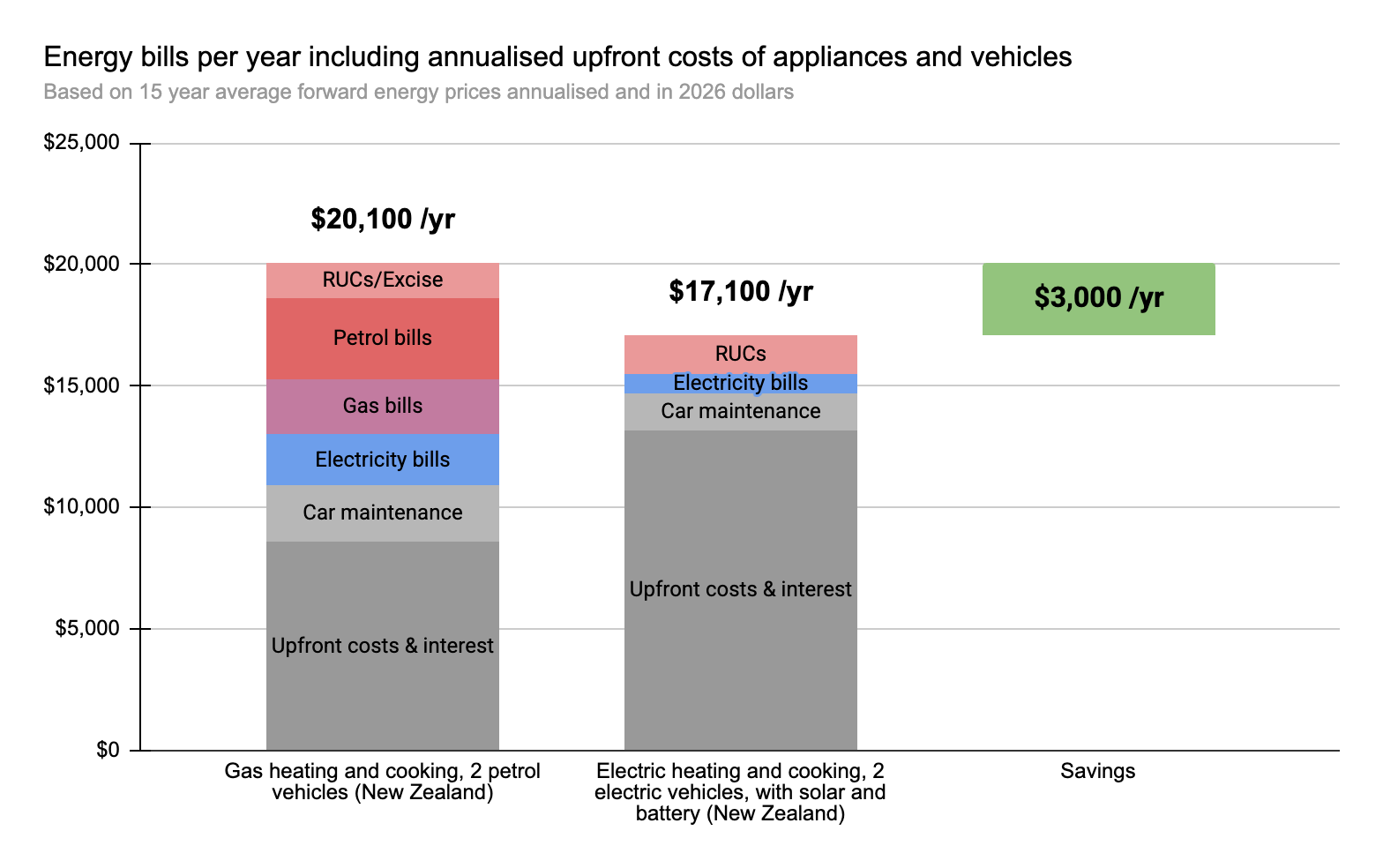
“The gap between the two ends of the spectrum - all-electric homes and cars vs. fossil fuelled equivalents - has doubled since 2024 and our research shows that an all-electric home is now around $3,000 net better off per year, including upfront costs and interest, and a net $45,000 better off over 15 years.”
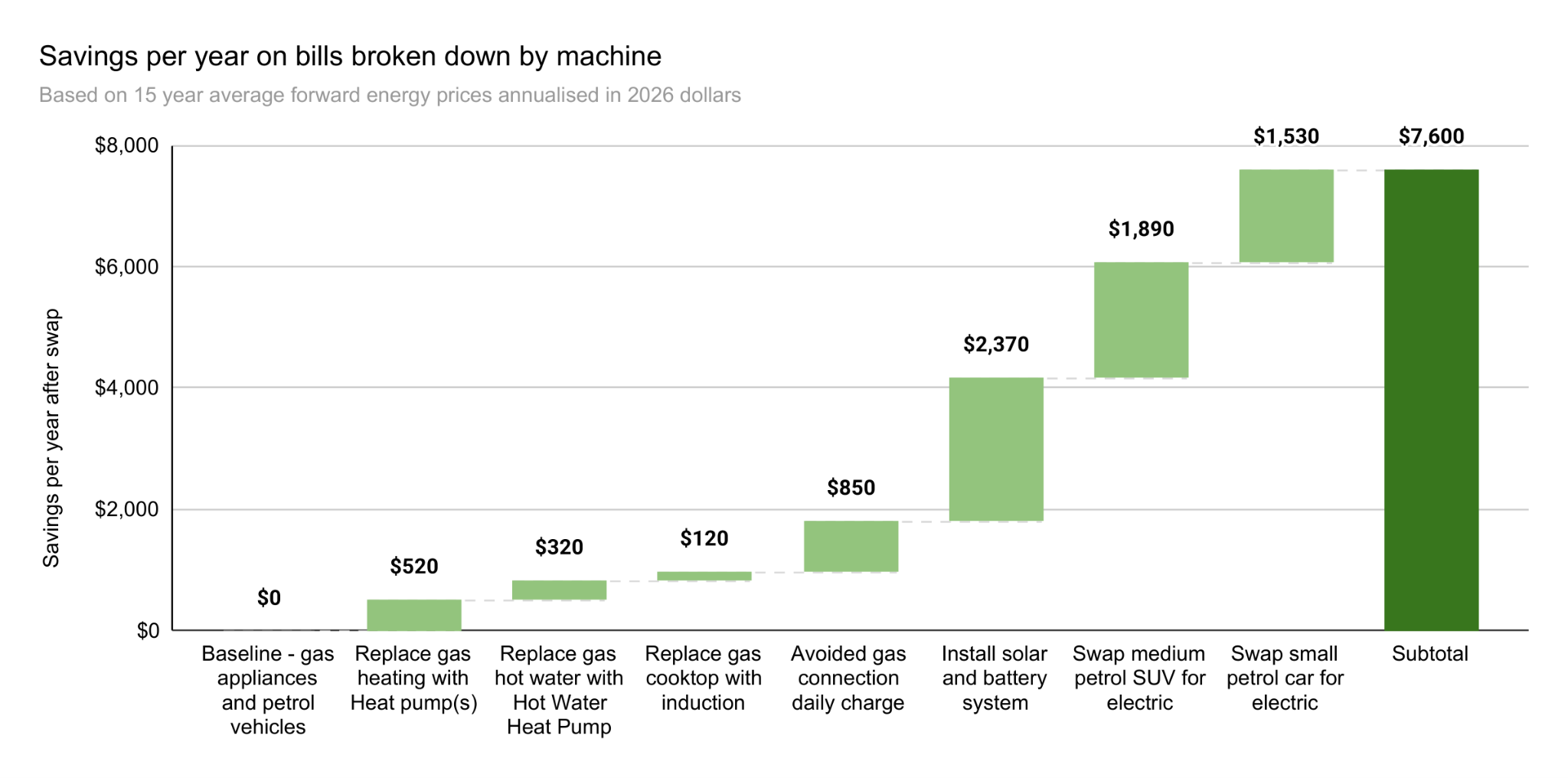
When you exclude upfront costs and interest, an average home using gas and petrol is missing out on bill savings of around $7,500 every year in comparison to electric homes and cars.
“Solar is the cheapest delivered electricity available to New Zealand homes and we’ve crossed another tipping point with solar and batteries,” says Casey. “The price of grid electricity, gas, petrol and diesel have risen at well above the rate of inflation, but the price of solar and batteries continues to fall and is now cheaper than the grid.”
Importantly, these technologies also offer a lot more price stability, which is important for those on low or fixed incomes who are currently struggling with rising energy costs.
Casey says he looks forward to announcements from the main parties focused on electrifying transport and industry and to announcements from the Greens, New Zealand First and ACT.
“We know a lot more New Zealanders are keen to upgrade to an EV but the same financial barriers are holding many of them back. Allowing New Zealanders to buy a new EV for around $200 a week and pay for it with pre-tax income would really help nurses, teachers and middle income New Zealanders reduce their energy costs. Fringe Benefit Tax reform would also help businesses upgrade their fleets and seed the second-hand market.”
More help for large businesses to get off expensive, diminishing domestic gas and onto cheaper electricity is also key - both for those businesses and also as part of the country’s energy strategy. In many cases, costs to connect to and upgrade the grid are preventing large users from making the change.
“With our natural resources, we are in a unique position to turn New Zealand into the world’s most electric economy. Running on New Zealand-made electricity needs to be seen as the country’s biggest productivity opportunity. On our all-electric cherry orchard, we produce around 90% of the energy we need to run our 21 electric machines on the farm, save tens of thousands every year by avoiding diesel, can keep running when the grid goes down, and have reduced our emissions down to almost nothing. What’s not to like?”
ENDS
For more information or to arrange an interview with Mike Casey, contact Ben Fahy at ben@rewiring.nz or 021 245 4894.
Download the ‘Electric Homes and Vehicles report as well as graphs and images here.
Rewiring Aotearoa is an independent charity working on energy, climate and electrification research, advocacy and education. The New Zealand-based team consists of energy, policy, communications and community outreach experts and it is funded by New Zealand-based philanthropists including Sir Stephen Tindall and Urs Hölzle. While we are selling the achievable dream of a more secure, resilient, productive, affordable and renewable energy system, we do not financially benefit from sales of solar, EVs or any of the electric technologies we advocate for.
Political Power has gone local! Dr Nick Smith, mayor of Nelson and ex-National Party minister, is an early adopter when it comes to electric machines but, through his efforts with the council and his close involvement with the Ratepayer Assistance Scheme, he's also embracing one of Rewiring's core mantras: once you've electrified your own life, electrify someone else's life, too.
Read moreDownloadWhether it's the growing number of electric buses, new electric trains for the lower North Island and City Rail Link, or new electric ferries, we love seeing more electric transport options in our big cities. It's also good to see some of our smaller cities like Palmerston North, Timaru and Nelson going electric and, as is almost always the case, the drivers reckon it's better on electrons. At the Electrify Nelson expo, we spoke with one driver Lee about the city's electric buses. And he definitely wouldn't go back to diesel.
Read moreDownload