The 'Electric Election': energy policies, side by side

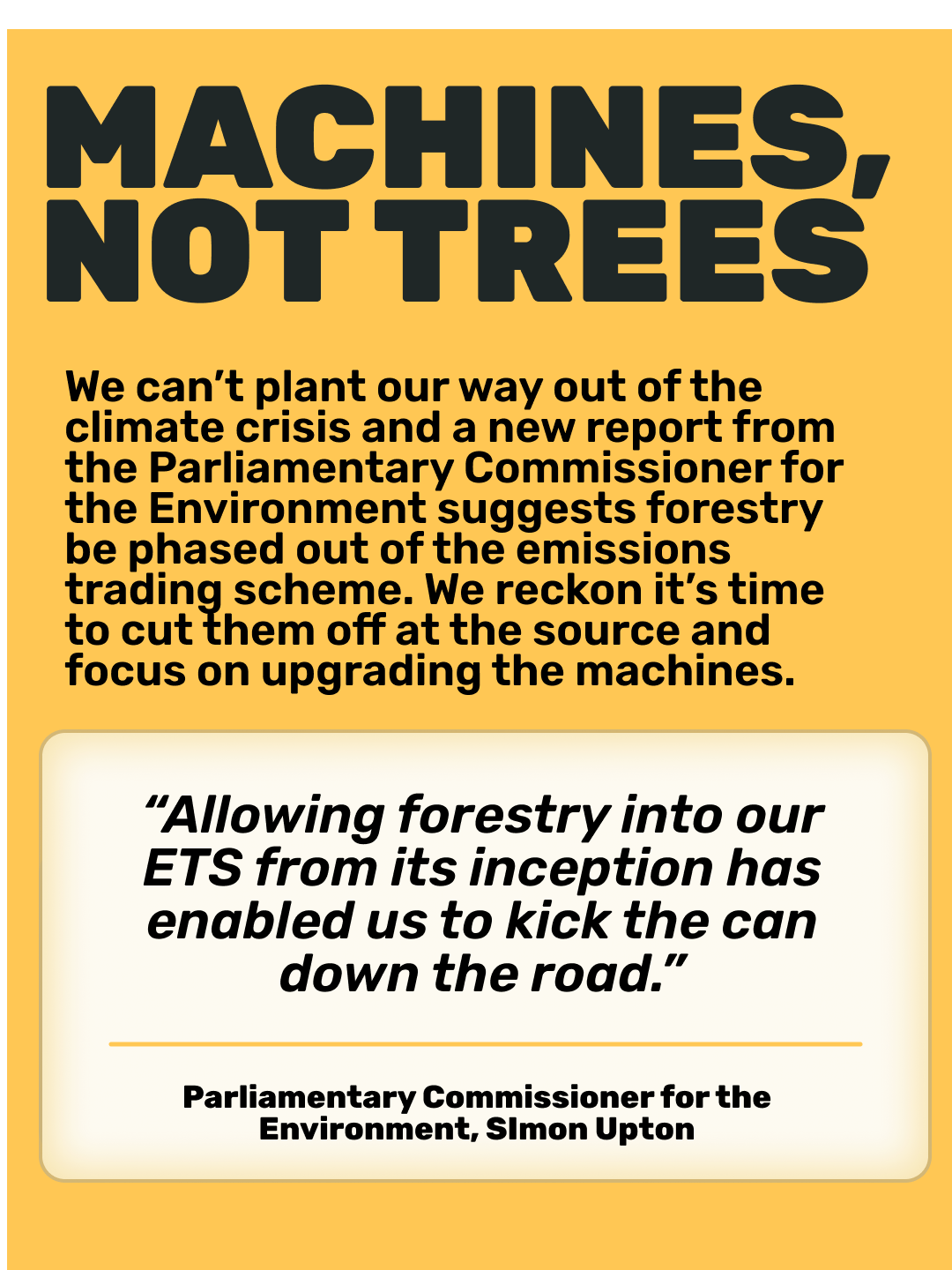

When it comes to emissions reductions, it’s time to start focusing on the machines, not the trees. We’re paraphrasing there, but that’s pretty much what Parliamentary Commissioner for the Environment Simon Upton said in a report released yesterday.
Adding forestry to the [Emissions Trading Scheme] had been designed to soak up carbon already in the atmosphere until lower-emission technologies like EVs and solar energy developed. "Tree planting seemed an economical and responsible thing to do while we waited," the report said. Those technologies were now available, and getting cheaper all the time, "but their rollout has been slow, mostly because our attempts to price carbon through an ETS have been blunted by ongoing tree planting.”
As Upton says, this change has allowed businesses to keep burning stuff and kick the can down the road.
Energy creates around 75% of the world’s emissions. Fossil fuel machines - from coal-fired power plants to gas hobs - use that energy. We can avoid those emissions by upgrading to machines that run on renewable electricity.
That’s a simple version of what Rewiring is trying to achieve. Sucking up the emissions with trees clearly doesn’t cut it (and, as Upton says, comes with other consequences like increased fire risk and land-use issues) and neither does carbon capture. We need to stop those emissions at the source and we can do that while also saving everyone money.
When you buy a fossil fuel machine, you create 10-20+ years of 'committed emissions' because that machine will continue to pump out pollution for its entire life. Once it’s been purchased, you can't run a petrol car or a gas water heater on electricity.
This is the opposite of a tree, where you are basically buying negative emissions.
Emissions offset schemes have continually failed to account for this, which has meant "real emissions reduction" is much harder to count as offsets than trees are.
Some of these trees that were purchased weren’t even real and New Zealand has paid millions to scams overseas, as the Morgan Foundation pointed out in its ‘Climate Cheats’ report.
Instead of our corporations spending money to plant bad trees here or buy fake trees overseas, they could be creating real emissions reductions in the economy and lowering a lot of community energy bills by helping low-income homes get off gas, get solar, and get electric vehicles.
When calculating the 'carbon value' of committed emissions, it is clear this would be worth a few hundred dollars off the cost of electric appliances, and a few thousand dollars off electric vehicle purchases.
We cannot plant our way out of the climate crisis. But we can start to electrify our way out of it.
'Twas the night before Chris-mas, and all through the house, all the voters were stirring, the pundits showing their nous … the election will soon be over, but the energy crisis won't, so we'll be there to pester whoever is in power about the need to run more of the economy on New Zealand-made energy; can Ethiopia's aggressive push for EVs work and how does New Zealand compare in terms of adoption rates?; a two-way charging trial from Genesis shows promise in Auckland, but there's still a way to go before it's mainstream; small electric vehicles are often overlooked when it comes to electrifying transport, but it's hard to miss this weird French one; a solar-powered cafe (and some electric coffee); and we endorse the political vandalism of Keith of All Trades.
Read moreDownloadPoliticians are being urged to adopt stronger electric vehicle incentives ahead of the election. Climate and energy advocacy group Rewiring Aotearoa is arguing that EVs are one of the most effective long-term solutions for rising transport and energy costs. They're promoting an EV Salary Boost proposal, which would allow workers to access EVs through pre-tax salary arrangements – similarly to already existing schemes in the UK and Australia. Policy and Government Relations Spokesperson Ngaio Neumegen told Kerre Woodham that even with the rising cost of power, it's still cheaper to run an EV than a car running on imported fuel.
A proposal that would let New Zealanders lease an electric car using their before-tax pay has not won a commitment from either National or Labour, with the 7 November election days away. Under the EV Salary Boost, put forward by Rewiring Aotearoa and Drive Electric, an employee would lease a new or used EV for three to five years. The payments would come out of their pay before tax, lowering the cost of running the car. The idea is based on Australia’s novated leasing system, though the groups say they are not proposing a direct copy.
Read moreDownload
