Don't listen to Old Man Gas. Ditch LNG. Support New Zealand-made energy!

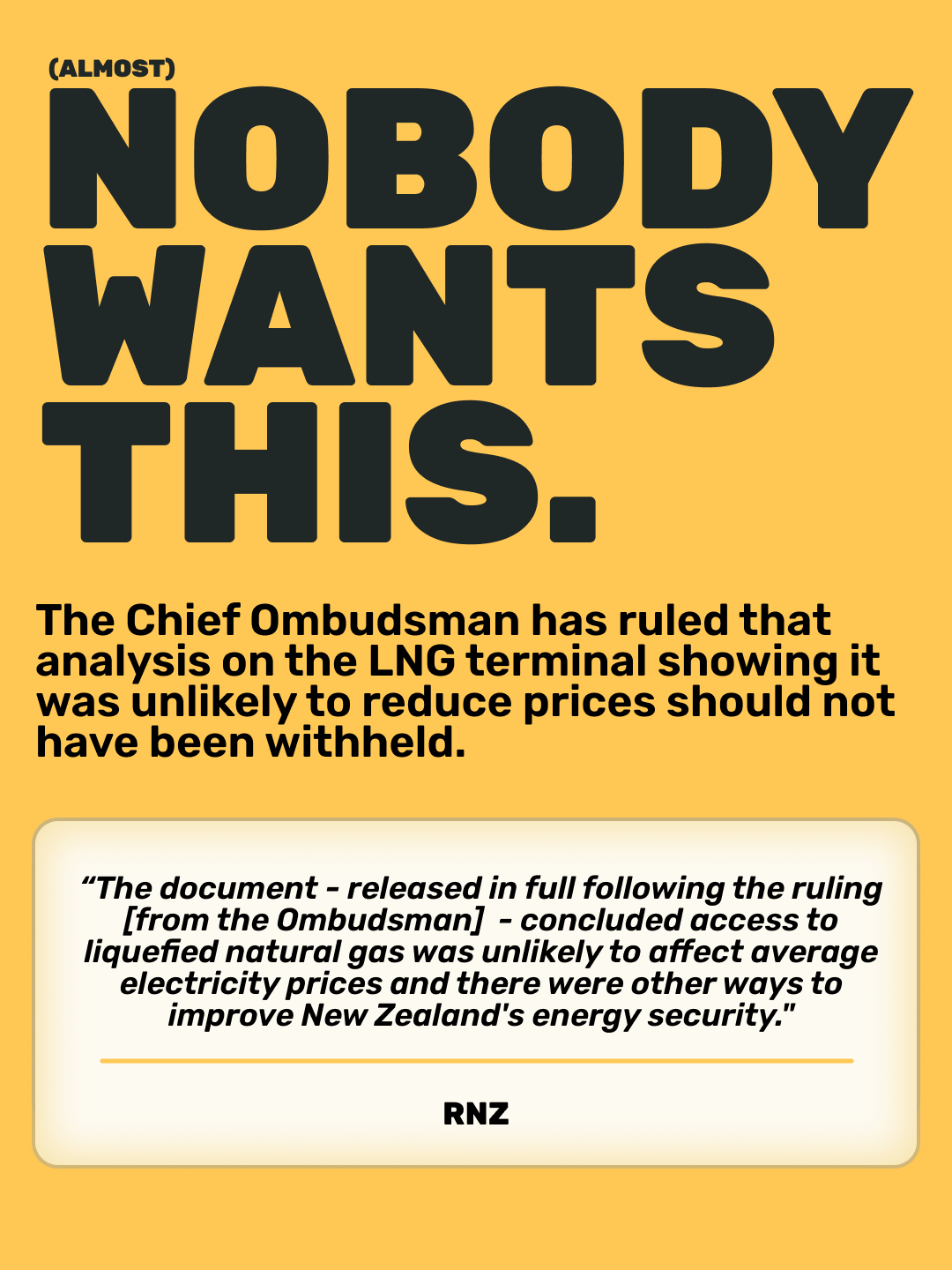

"The document - released in full following the ruling [from the Ombudsman] - concluded access to liquefied natural gas was unlikely to affect average electricity prices and there were other ways to improve New Zealand's energy security."
That's from RNZ's story about analysis from Concept Consulting that was kept secret. And it's another nail in the coffin given price reductions have been the Government's primary justification for spending so much public money.
"Chief Ombudsman John Allen found the document provided 'important context and limitations' for the advice and modelling. He found the reasons for withholding it were not valid, and even if they were, there was 'very high' public interest in releasing it, especially in an election year."
We agree. And kudos to Lawyers for Climate Action and others for pushing to have the advice released.
The secrecy is bad enough, but since the Government announced the LNG terminal, things have changed. And when things change, as the famous quote goes, so should minds.
LNG was chosen as the best solution to our dry year issue on the basis that it would add a cost of roughly $4/MWh to electricity while removing a risk premium passed through in electricity bills of $10/MWh.
In the real world that would mean households would save about $50 per year on their bills with LNG (assuming a net saving of $6/MWh).
Since this initial analysis was undertaken, however, the $10/MWh risk premium is gone - not because of the LNG announcement but because we have rapidly built a lot of new renewable generation and there is plenty more in the pipeline.
Contracts have also been put in place to share the cost of maintaining the Huntly Rankine and keep a healthy stockpile of coal to run these in a dry year.
It would have been helpful to have LNG available in 2024 when prices spiked, but electricity supply has improved a lot since then and we have time to reassess our options. It would be dead on arrival.
So why, despite all the expert views saying there are better options, is the Government still racing to lock in an investment that risks pushing electricity bills up higher than they need to be and locking this cost increase in for 15 years or more, when lower cost long term dry year solutions are available?
Political Power has gone local! Dr Nick Smith, mayor of Nelson and ex-National Party minister, is an early adopter when it comes to electric machines but, through his efforts with the council and his close involvement with the Ratepayer Assistance Scheme, he's also embracing one of Rewiring's core mantras: once you've electrified your own life, electrify someone else's life, too.
Read moreDownloadWhether it's the growing number of electric buses, new electric trains for the lower North Island and City Rail Link, or new electric ferries, we love seeing more electric transport options in our big cities. It's also good to see some of our smaller cities like Palmerston North, Timaru and Nelson going electric and, as is almost always the case, the drivers reckon it's better on electrons. At the Electrify Nelson expo, we spoke with one driver Lee about the city's electric buses. And he definitely wouldn't go back to diesel.
Read moreDownload