Don't listen to Old Man Gas. Ditch LNG. Support New Zealand-made energy!

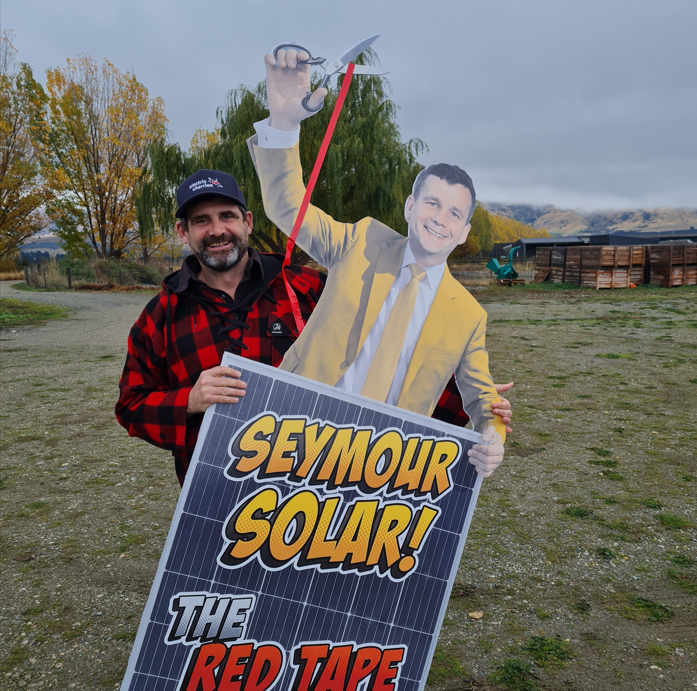

A ‘red tape rampage’ by the Government that aims to streamline solar installs is being welcomed by Rewiring Aotearoa and should eventually help to bring prices closer to those being paid in the more efficient Australian market.
Electric Cherries co-founder and Rewiring Aotearoa CEO Mike Casey says he's glad to see the Government finally taking an interest in this area and he loves the ambition that’s been laid out by the Ministry of Regulation to make New Zealand ‘the simplest place in the world to install solar’.
“Our ambition is to also make it the cheapest,” he says. “The Aussies have around 40% solar uptake now, and believe they could hit 80% solar penetration by 2050. The changes being proposed will help New Zealand catch up and unlock the cheapest energy for New Zealand households and businesses.”
The review was announced by Minister of Regulation and deputy Prime Minister David Seymour at Casey’s all-electric, mostly solar-powered cherry orchard near Cromwell today.
Casey says the primary issues with the current system are that there are too many truck trips required for a solar install, too many unnecessary approval delays and inspection layers, and too many middlemen getting in the way.
“That means Kiwi customers pay around twice what the Australians pay - not including subsidies. Our markets are not that different, so a big reason for the price gap is inefficiency, unnecessary red tape and outdated regulations.”
Casey says it’s refreshing to see the Ministry of Regulation team looking at the issues Rewiring has raised and seeing it from the customer’s perspective, rather than the industry’s.
“Rather than sitting on recommendations and tinkering around the edges, this review has stripped it right down to first principles and asked whether all these things are necessary and how the system could be improved. We’ve been really impressed with the approach the Ministry has taken because it will benefit customers in the end. They seem to be moving a lot faster than any of the other regulators or government departments we have worked with.”
Rewiring Aotearoa’s main requests are:
Casey says solar should not require a laborious approval process and WEL Networks has already launched automatic and free approvals for installs of a certain size.
“We need more of that. We keep hearing stories from customers that some EDBs are quite frankly taking the piss with how long it takes to approve solar connections,” Casey says. “We need more solar in New Zealand, it is very safe when installers are well-trained and, given our very low uptake rates at this stage, it is unlikely to affect the network. Approval should be instant here.”
Casey says lines companies often need to do work before the install starts, then drive back and do some more work after it’s installed.
“In Australia and with some lines companies here, the electricians are able to do that job.”
He says it can take weeks to get an inspection date once the install has been done and different EDBs often have different rules.
“Each additional truck trip adds costs to customers and a lot of those trips are unnecessary. In Australia, virtual inspections allow the installs to be approved remotely and much more rapidly and other countries have centralised systems that don’t require a physical visit and use an auditing process to ensure standards are being met.”
Many households already have the right smart meter to use with solar, but retailers will often trigger a new install.
“It’s likely just a software update that’s required, not a full meter replacement, and that can add another layer of cost and time.”
Casey says plug-in solar is also a growing trend overseas and New Zealanders should have access to it. Solar panels on the roof will save New Zealanders the most money on energy bills - around $1,000 every year, on top of paying off a loan and interest - but not everyone can access the capital and not every house is suitable.
“Plug-in solar is going bonkers in places like Germany and Spain, where it can often be seen on apartment balconies, and some US states now allow it, but it's still illegal in New Zealand and that needs to change. Overseas, small systems have been shown to generate 10-20% of an average home's daily energy needs so it would make a meaningful difference to bills. And these systems are easily accessible to renters and apartment owners and can move as they move."
The same solar red tape issues apply to businesses and commercial buildings, Casey says, but an additional resource consenting layer may also apply.
“The Electricity Authority has made 10kW export limits compulsory across the country and the Government has said there is now no need for building consents for residential solar. The same national standard should apply for solar installs on existing buildings and ground-mount systems as it’s not a ‘new business activity’ and does not impact the landscape like large systems.”
“We believe this needs to be a permitted activity so installs don’t get gummed up by council restrictions, which are different all over the country. The same system might require a resource consent in one jurisdiction but not in another. That makes no sense and just slows down new low cost energy being added to New Zealand.”
Casey says many of these issues should have been addressed by the Electricity Authority and MBIE when they were first raised by Rewiring.
“We told them about much of this a year or two ago. There have been some small wins, but they don’t have enough ambition and are failing to prioritise unlocking some really big benefits for customers.”
Ultimately, Casey says one of the main reasons New Zealand’s energy system is failing people is that regulation and policy has not kept pace with technology.
“Everyone in New Zealand would have lower bills today if it had, so it’s great to see a clear effort to move fast for consumers.”
Rewiring Aotearoa is an independent charity working on energy, climate and electrification research, advocacy and education. The New Zealand-based team consists of energy, policy, communications and community outreach experts and it is funded by New Zealand-based philanthropists including Sir Stephen Tindall and Urs Hölzle. While we are selling the achievable dream of a more secure, resilient, productive, affordable and renewable energy system, we do not financially benefit from sales of solar, EVs or any of the electric technologies we advocate for.
Political Power has gone local! Dr Nick Smith, mayor of Nelson and ex-National Party minister, is an early adopter when it comes to electric machines but, through his efforts with the council and his close involvement with the Ratepayer Assistance Scheme, he's also embracing one of Rewiring's core mantras: once you've electrified your own life, electrify someone else's life, too.
Read moreDownloadWhether it's the growing number of electric buses, new electric trains for the lower North Island and City Rail Link, or new electric ferries, we love seeing more electric transport options in our big cities. It's also good to see some of our smaller cities like Palmerston North, Timaru and Nelson going electric and, as is almost always the case, the drivers reckon it's better on electrons. At the Electrify Nelson expo, we spoke with one driver Lee about the city's electric buses. And he definitely wouldn't go back to diesel.
Read moreDownload