The 'Electric Election': energy policies, side by side


"The mechanism to address the dry year challenge should be technology neutral and the Government's proposed Winter Energy Reliability Obligation risks biasing thermal fuel solutions, when as the Authority rightly notes renewable dry year solutions could be lower cost. We are concerned about the process undertaken by the Government and MBIE to deliver the wider dry year solution and encourage the Electricity Authority to weigh in on policy matters, and advocate for a transparent expert to undertake this market design exercise."
We strongly support the Electricity Authority developing well designed long-duration firming contracts as a no regrets step as part of an enduring dry year solution. Right now we appear to be going into a boom market. That alleviates security of supply concern for some time, but doesn't necessarily ensure security of supply. Being prudent about security of supply would mean retaining current thermal generation (especially coal and diesel), until we have long-term solutions established. This position helpfully provides time to implement a long-term solution.
The mechanism to address the dry year challenge should be technology neutral and the Government's proposed Winter Energy Reliability Obligation risks biasing thermal fuel solutions, when as the Authority rightly notes renewable dry year solutions could be lower cost. We are concerned about the process undertaken by the Government and MBIE to deliver the wider dry year solution and encourage the Electricity Authority to weigh in on policy matters, and advocate for a transparent expert to undertake this market design exercise.
We agree with the Authority's market failure problem definition in the consultation.
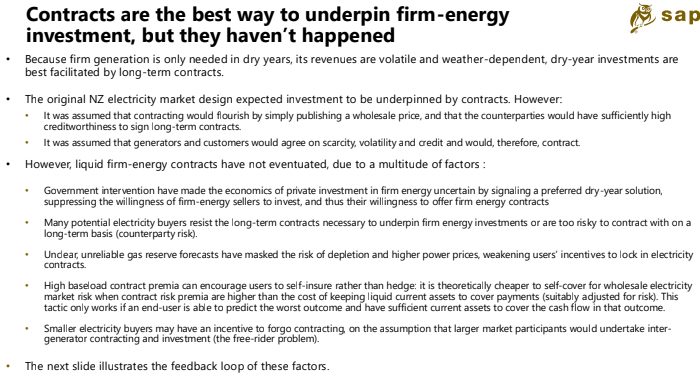
Because firm generation is only needed in dry years, its revenues are volatile and weather-dependent, dry-year investments are best facilitated by long-term contracts.
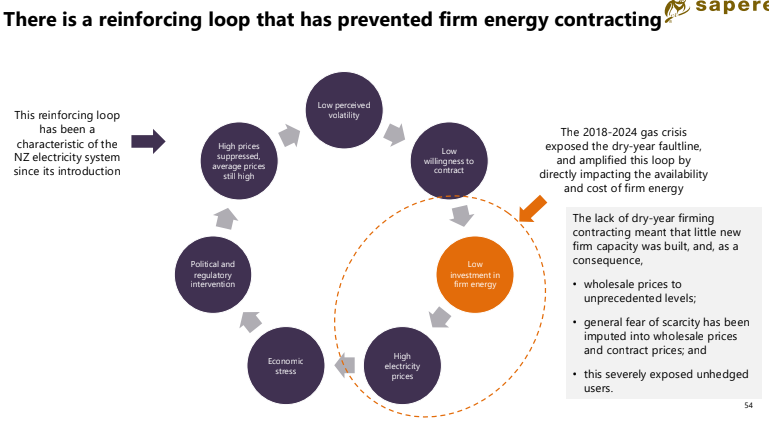
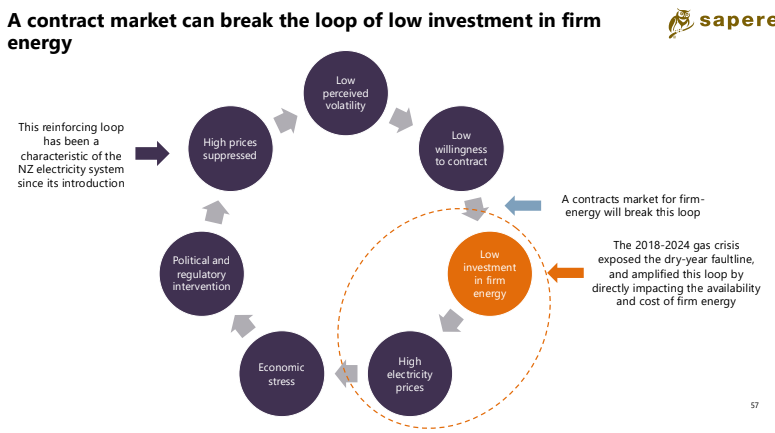
We have included a screen shot of 4 slides from a report by Sapere, commissioned by Rewiring Aotearoa called From Faultlines to Resilience that set out our views on the electricity market failure and rationale for a well designed long term firm energy market as part of the solution to the dry year.
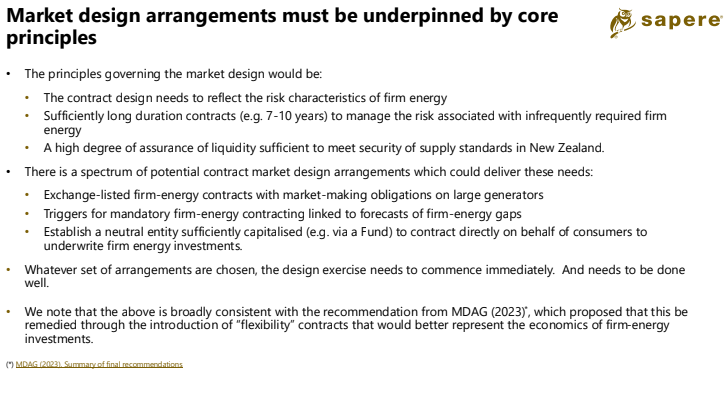
Addressing our dry year challenge through electricity market design is a key part of providing affordable electricity that increasingly underpins our economy.
We need to be looking for an enduring solution that works well into the future. One of our concerns in this regard is that the Electricity Authorities analytical focus in this paper was on short term fuel security. The analysis only considered the risk of dry year shortage given existing thermal capacity and demand response out to 2031. The energy system is rapidly changing, including the potential for significant customer energy resources (solar, batteries, EV uptake), and any interventions in the market should include modelling the possible future states of that system.
Analysing long term dry year security risk relies on forecasts of the supply and demand balance in the market. Currently we are in a boom phase with a healthy increase in renewable generation entering the market relative to demand growth in recent years.
This highlights the inherent importance of having dry year backup that is available regardless of the fluctuation in supply/demand balance associated with boom and bust build cycles in the market. It also highlights the current vulnerability of our system to this cycle and the importance of wholesale market price signals and competition in the market to bring forward build. Maintaining a healthy supply/demand balance lowers requirements for dry year back up and highlights the interconnectedness between different aspects of electricity market design.
Our view is that the wider dry year solutions should be tested through a transparent market design process, drawing on a team of experts including practical economists and experts in electricity market design.
The responsibility here does not fall on the Electricity Authority, MBIE and Ministerial direction have delivered the current Winter Energy Reliability Obligation. However, as an independent regulator, commentary and advice on how to undertake a better process to deliver enduring market design, which considers the dry year solution as part of holistic market design exercise, is fundamental to the Authority's role.
As part of this we recommend updating modelling with assumptions based on the updated technology context, in particular potential uptake of EVs, home batteries, and distributed solar.
The Electricity Authority should ensure that its work on market design to deliver dry year security is technology neutral, and delivers the Authority’s goal to ensure the system delivers reliable power at least cost to consumers.
Options in this consultation paper are intended to work alongside other measures currently being considered by the Government, including a proposed Winter Energy Reliability Obligation, and an import terminal for LNG. These policy measures to address dry year are biased to thermal fuel.
As the Electricity Authority rightly notes:
“The selection of long-duration firm energy is therefore an economic problem, not a technological one, that tends to favour lower fixed cost investment propositions (e.g., traditional thermal). However, as the variable costs of these types of firming rise, intermittent renewables may, in fact, become lower overall cost.”
As the Authority notes there are different solutions to the dry year problem. This could include a technology neutral reliability obligation (to ensure liquidity for provision of dry year firming) combined with workable well designed dry year contracts (to deliver price discovery and access to dry year insurance for purchasers).
A better designed reliability obligation that is not biased towards thermal fuels or an out of market dry year renewable strategic reserve may deliver better outcomes for consumers than the current Winter Energy Reliability Obligation option set out by MBIE.
A renewable strategic reserve could provide an eloquent dry year solution, with dry year supply being treated as another ancillary service, clear market rules that specify when it could be utilised based on lake storage and flow metrics could be defined. Thermal dispatch lifts prices in a drought, while a renewable solution would avoid this high wholesale price uplift and lower water values that set hydro dispatch prices by providing greater certainty.
As an independent regulator the Authority should ensure that it is considering solutions that deliver reliable power at least cost to consumers and part of its work on long duration firming contracts should review whether the current combination of policy measures meet these outcomes for customers.
Essential to competition is the ability of new entrants into the a market. It is extremely unlikely that any large scale hydro with storage will be built in New Zealand and as such the Authority needs to consider the structural advantages of existing hydro generators.
The analysis in this consultation supports the point that many in the sector have been making, which is that we have more time to implement an enduring well designed dry year solution, than was previously thought after the 2024 price shocks.
Both the Electricity Authority’s analysis and Sapere’s analysis show that even in the absolute worst case hydro shortage scenarios (either considered annually or over a three month period) the dry year deficit is declining.
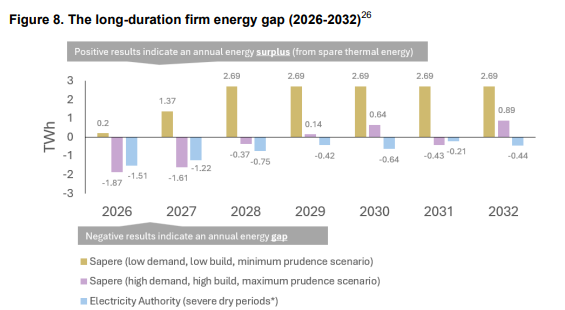
Given we are already near the end of 2026 the material risk identified for this year has passed. 2027 does show dry year risk again under the most extreme dry hydro sequences. In the Sapere High demand scenario the demand growth assumption for 2027 is unrealistically high making this risk highly unlikely.
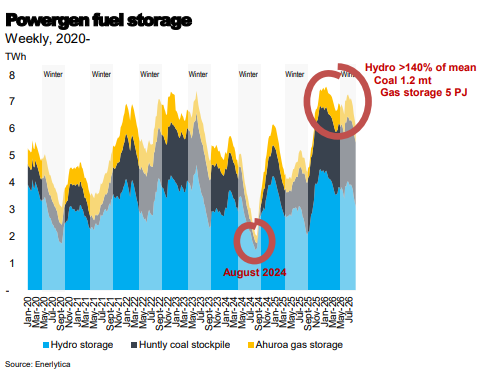
When we look at the latest gas storage outlook this indicates more gas could be available in 2027 than is assumed in the Electricity Authority’s severe dry period analysis of the long duration firm energy gap.
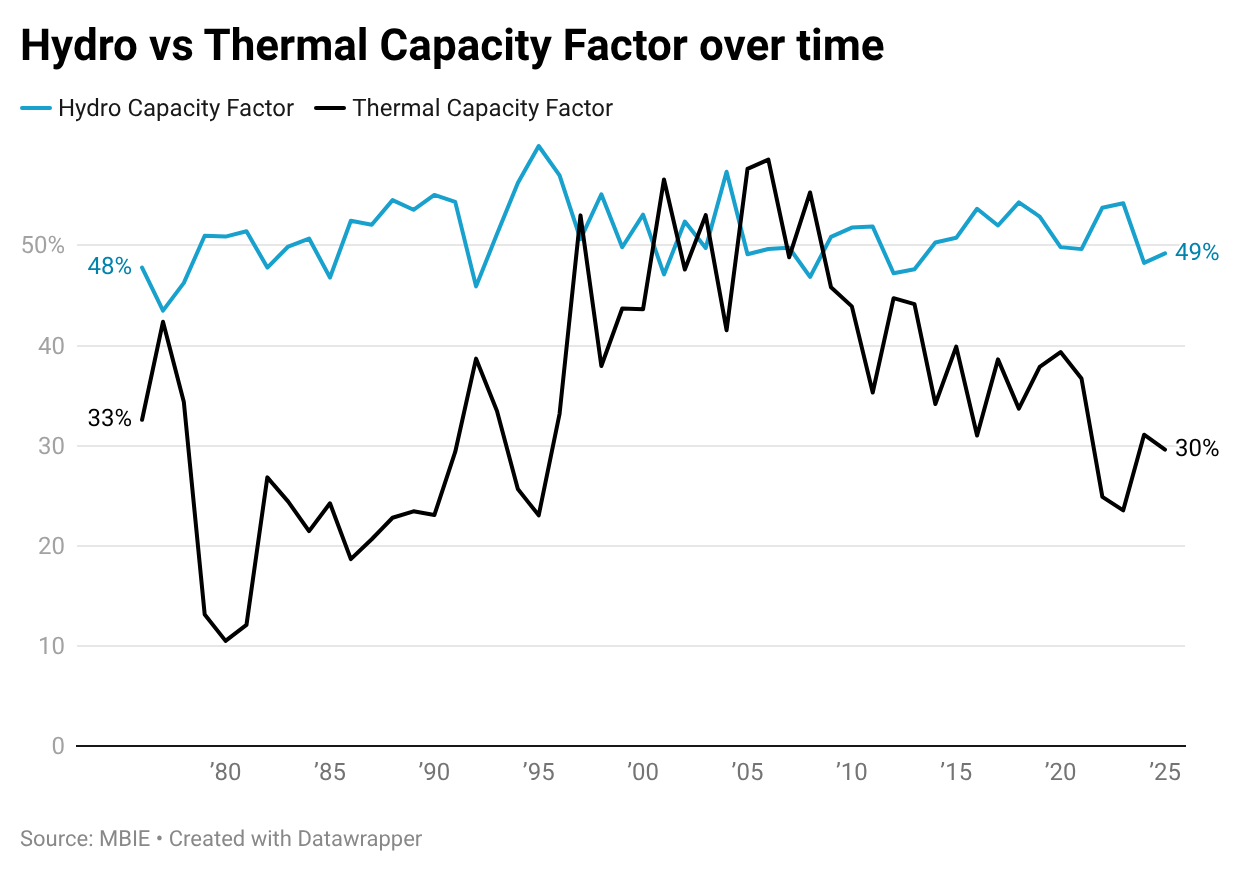
The lowest contribution of hydro generation since the Clyde dam was completed was in 2001 at 21.5TWh and the highest in 2004 at 27TWh, a difference of 5.5TWhs while the capacity factor of the thermal fleet has declined substantially since the mid 2000s.
Genesis Energy has been fined just over $300,000 for failing to generate power when told to. The facts of the decision say Genesis wasn't able to ramp up its gas unit within safe temperature conditions so wasn't able to meet an agreed target output. The fine for the failure is the highest pecuniary penalty order made by the ruling panel. Mike Casey, chief executive of electricity think-tank Rewiring Aotearoa spoke to John Campbell.
The EStroke Electrification boat was one of the most popular attractions at the Electrify Christchurch Expo - and for good reason. As Michael and Jeff Smit told Mike Casey, retrofitting an old petrol boat with a Nissan Leaf motor and battery pack means you can have fun without the fumes on the water - and lower your leisure costs by running on electrons.
Read moreDownload"The mechanism to address the dry year challenge should be technology neutral and the Government's proposed Winter Energy Reliability Obligation risks biasing thermal fuel solutions, when as the Authority rightly notes renewable dry year solutions could be lower cost. We are concerned about the process undertaken by the Government and MBIE to deliver the wider dry year solution and encourage the Electricity Authority to weigh in on policy matters, and advocate for a transparent expert to undertake this market design exercise."
Read moreDownload
