Don't listen to Old Man Gas. Ditch LNG. Support New Zealand-made energy!

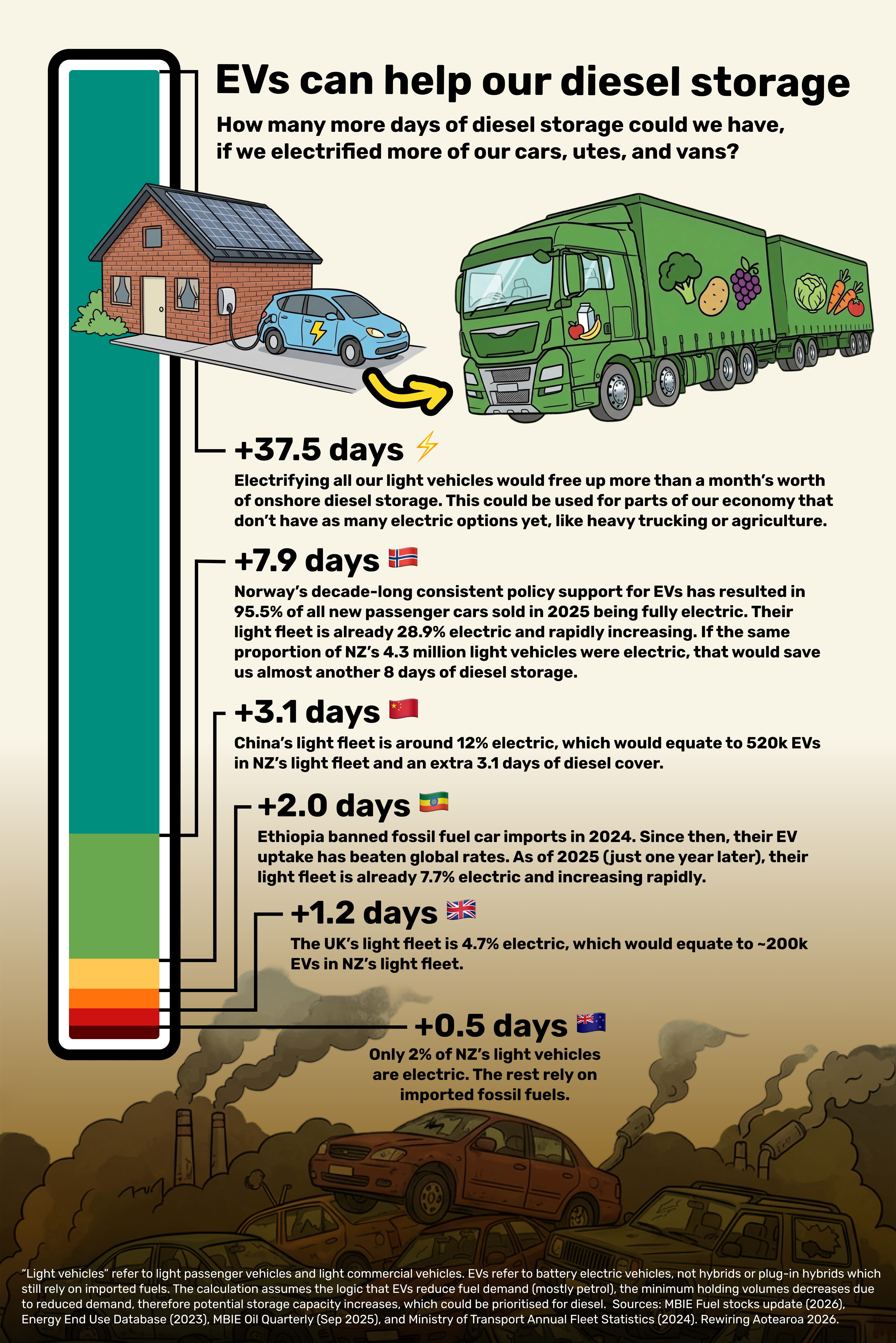

Ensuring more electric vehicles can run on New Zealand-made energy needs to be seen as an issue of national security and dual fuel peakers that can run on gas or diesel can help solve the dry year issue while also improving diesel storage, unlike the LNG import terminal.
Right now, diesel prices are ramping up and some are worried we won't have enough supply to keep the economy going. We have a set amount of fuel storage in New Zealand, but if we had more EVs in the fleet we would need less of that for petrol and could devote more of it to diesel. While the majority of light vehicle fuel consumption is petrol, 1/3 is still diesel from most of our utes and vans, so electrifying these light commercial vehicles would also significantly reduce our current diesel demand. Taking both together - the reduced diesel demand from easier-to-electrify light vehicles, and the increased storage capacity from reduced petrol demand - we'd increase our diesel storage capacity significantly for our harder-to-electrify sectors.
If all our light transport fleet was electrified, it would equate to 37.5 days of diesel storage.
If one third of our fleet was electric, as it is in Norway following a decade's worth of policy support, that would give us an additional eight days of storage.
At our current rate of EV adoption, with just 2% of the fleet electric, we have just 0.5 days.
Fuel security is also relevant when it comes to the decision to build an LNG import terminal. The primary reason it has been suggested is to solve the dry year issue - although it is also clearly about keeping gas users hooked and letting the gas industry play for time. But our portfolio approach can kill two birds with one stone.
Along with rapid build out of large-scale renewables, mass adoption of rooftop solar and batteries on homes, farms and businesses to keep our hydro lakes full, and assistance for gas users to electrify, we also believe we should invest in dual fuel peakers that can run on gas or diesel and offer added diesel storage.
.png)
Rather than an investment of $1-$2.7 billion into LNG for no added fuel security, an investment of around $400-$800 million could add 120 million litres of additional fuel storage (11-12 days). This would come at a much lower fixed cost than the LNG terminal but at a higher fuel cost and it would still push electricity prices down in the same way by removing the cost of dry year risk in electricity bills. And if we build those renewables quickly enough, we may not need to use it.
Political Power has gone local! Dr Nick Smith, mayor of Nelson and ex-National Party minister, is an early adopter when it comes to electric machines but, through his efforts with the council and his close involvement with the Ratepayer Assistance Scheme, he's also embracing one of Rewiring's core mantras: once you've electrified your own life, electrify someone else's life, too.
Read moreDownloadWhether it's the growing number of electric buses, new electric trains for the lower North Island and City Rail Link, or new electric ferries, we love seeing more electric transport options in our big cities. It's also good to see some of our smaller cities like Palmerston North, Timaru and Nelson going electric and, as is almost always the case, the drivers reckon it's better on electrons. At the Electrify Nelson expo, we spoke with one driver Lee about the city's electric buses. And he definitely wouldn't go back to diesel.
Read moreDownload