Don't listen to Old Man Gas. Ditch LNG. Support New Zealand-made energy!

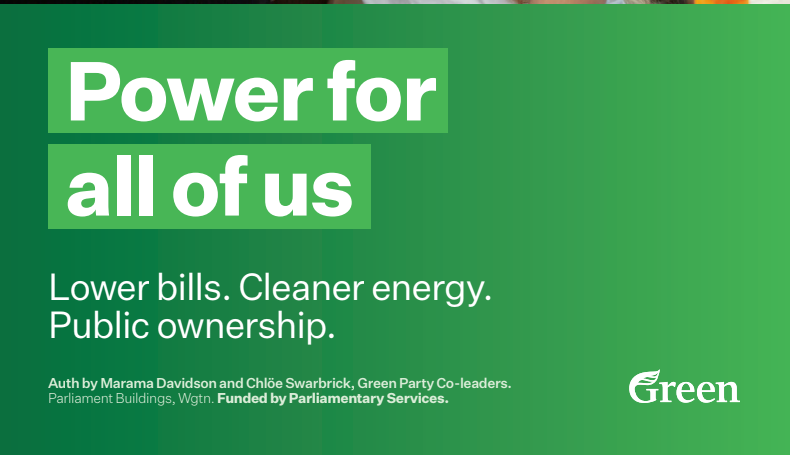

The Green Party has today launched its election energy policy, a plan to cut household power bills and establish Kiwipower, a publicly owned company to deliver the affordable, secure, renewable power the market has failed to build.
“The Greens will lower bills, cut emissions and put power back in the hands of New Zealanders. That means Warmer Kiwi Homes, community-owned power, solar on rooftops and a new generation company, designed to solve our dry-year problem, owned by New Zealanders: Kiwipower," says Green Party Co-leader Chlöe Swarbrick.
The full plan includes:
Establishing Kiwipower, a publicly owned entity to ensure affordable power and energy security, fill the gaps the market has failed to fill, and speed up the renewable energy transition.
Zero-interest clean energy loans to install solar and batteries.
A renters' right to solar, and legalising plug-in solar.
Expanding Warmer Kiwi Homes to cover more upgrades, including gas transitions, so more low-income people live in homes that are warm and dry.
$200 million for community-owned renewable energy, to build resilience, make local power more affordable, and share the benefits of ownership.
Solar on more than half of all public homes within four years, and $80 million for renewable energy for Māori housing.
“200,000 households are unable to afford to heat their homes while four big power companies control over 85 per cent of the market and rake in massive profits. New Zealanders need a Government willing to fix the real basics, and that’s what the Greens are here to do.”
“Kiwipower will invest directly in new renewable generation and sort out our dry-year problem sensibly, without a billion-dollar LNG facility, and support new, independent players coming into the market.”
“Generations of New Zealanders built our energy infrastructure, and two National Governments have sold it off for parts, driving up bills and reducing New Zealanders' power and control. The Greens will fix that by investing in putting power directly in the hands of our communities.”
“Nearly 20 years ago, the Greens established Warmer Kiwi Homes, insulating hundreds of thousands of households. We will expand this incredibly successful programme, supporting the transition from gas.”
"Hope is not a plan. Successive Governments, including and especially this one, have failed to plan for a renewable energy transition to give certainty, stability and resilience to households and industry. Today, the Greens are proud to launch the plan our country needs, for abundant, affordable renewable energy, for all of us."
Green Party Co-leader Marama Davidson says the plan puts ownership back in the hands of communities.
"We will invest $200 million in community-owned renewable energy, solar on your local school, marae, papakāinga or library, with the benefits flowing back to your community,” says Davidson.
“Our plan will put solar on more than half of all public homes within four years, and invest $80 million in renewable energy for Māori housing, because tangata whenua are two to three times more likely to face energy hardship."
"This is about rangatiratanga over energy, and it is part of our enduring commitment to Te Tiriti o Waitangi."
The Green Party launched the plan at the Dunedin Gasworks Museum, the first and last place in Aotearoa where coal gas was manufactured.
Swarbrick says "Gas belongs in a museum. But Luxon's Government wants to lock us into 15 more years of imported fossil fuels and higher prices with their expensive LNG terminal. That is a choice, and it is the wrong one.”
"When the market won't deliver affordable, secure, renewable power, a responsible Government should step in. We can pay for all of this by making corporations and the super-rich pay their fair share."
"A warm, dry home powered by clean energy should be within everyone's reach. That is the country we can build, and this is how we do it," says Swarbrick.
Political Power has gone local! Dr Nick Smith, mayor of Nelson and ex-National Party minister, is an early adopter when it comes to electric machines but, through his efforts with the council and his close involvement with the Ratepayer Assistance Scheme, he's also embracing one of Rewiring's core mantras: once you've electrified your own life, electrify someone else's life, too.
Read moreDownloadWhether it's the growing number of electric buses, new electric trains for the lower North Island and City Rail Link, or new electric ferries, we love seeing more electric transport options in our big cities. It's also good to see some of our smaller cities like Palmerston North, Timaru and Nelson going electric and, as is almost always the case, the drivers reckon it's better on electrons. At the Electrify Nelson expo, we spoke with one driver Lee about the city's electric buses. And he definitely wouldn't go back to diesel.
Read moreDownload