Don't listen to Old Man Gas. Ditch LNG. Support New Zealand-made energy!

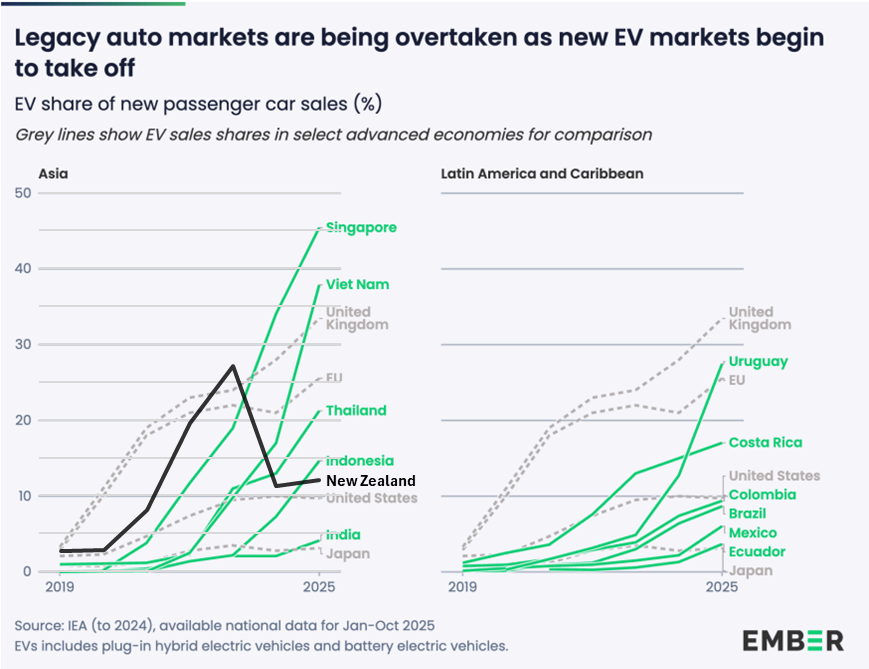

Rewiring Aotearoa CEO Mike Casey says more public EV chargers going in the ground is positive but, as our vulnerability to high petrol and diesel prices has been exposed, the Government’s lack of support for EV adoption is simply not good enough.
Casey says the Government deserves some credit for investing in EV charging infrastructure alongside industry, but it’s a lot less than what was originally promised.
At the time of the 2023 election, National promised to invest $257 million over four years to deliver 10,000 public EV chargers - nearly 10 times more than the number of public chargers at the time.
The explicit target was that there would be one charger for every 40 EVs. New Zealand currently has the worst ratio of chargers-to-EVs in the OECD - at 1:80/85. Norway has 1:25, UK and Germany have 1:15/20, while Mexico has 1:41.
“What actually got set aside was less than one quarter of the promised funding. Rather than grants, $50 million will be used as concessionary loans to private operators to co-invest in 2,500+ more public EV chargers. This will still leave us at languishing at the bottom of the OECD table. Time has also been lost in allocating funding: it’s been 11 months since the scheme was announced.”
Casey says it’s good to see there will be a mix of fast chargers and slower chargers at places where people stay for longer, but given it is loans rather than grants as originally planned, we should really be applauding ChargeNet and Meridian for their investment.
“The Government is playing a cameo role, and it also needs to be held to account for turning New Zealand from a leader in EV adoption to a laggard. It dropped the Clean Car Discount, added RUCs to EVs ahead of petrol vehicles, loosened standards for polluting cars through the Clean Car Standard and has proposed to remove it completely, and it is unlikely to reach its goal of 10,000 public chargers. They slammed on the brakes when other countries started accelerating and more New Zealanders are suffering as a result.”
As reported in RNZ, “EVs accounted for around 27 percent of new vehicle sales in 2023, or at least one in four cars sold. Only one in nine cars sold are electric now.”
Casey says it has become abundantly clear since the Iranian conflict kicked off that we need a strategy to reduce our reliance on imported energy. That was also clear the last time petrol prices spiked in 2022 after Russia invaded Ukraine.
“It’s not just wealthy countries like Norway doing this, either. Places like Thailand, Uruguay, Nepal, Ethiopia and Vietnam are reducing their reliance on imported fuel with pro-EV legislation and EV sales are increasing rapidly. We went in the opposite direction and now we are dealing with the repercussions of that. We need a lot more ambition because we are now a long way behind. We are good at producing renewable electricity in New Zealand and we should be putting it into our vehicles. Running on New Zealand-made energy makes for more stability, lower costs and lower emissions.”
He says it’s been good to see so many New Zealanders investing in EVs since the war in Iran started and it shows they are not waiting for the public charging infrastructure to arrive before making that call.
“These public chargers could take years to be installed, but pretty much every plug in the country is an EV charger and there are plenty of specific home chargers available at good prices. It pays to remember that over 80% of charging happens at home.”
Recent research from Consumer showed that 96% of current EV owners would buy another one. That is a powerful endorsement and seems to show that public charging is not a major issue for them once you have invested.
“But it is definitely a barrier stopping others from going electric because they may be thinking about the one or two longer road trips they do every year."
According to research from EECA conducted in 2024, 39% of non-EV owners perceive "there are not enough public chargers available" and 41% think EVs "have a driving range that is not suitable for long distance travelling" - although modern EVs have much bigger ranges.
"This announcement will hopefully give them more confidence to invest."
Casey says some dealers have reported a 40% increase in EV sales since the war started, with some EV brands having sold more in March than in January and February combined.
So, what's needed?
He says the government should be doing a lot more to remove barriers to EV uptake. That includes both accelerated depreciation (like a Supercharged Investment Boost that takes the current policy but pushes it further for EVs) and Fringe Benefit Tax relief for EVs (for the first two years only).
“This would incentivise businesses to add more EVs to their fleets and turn them over faster. That would help protect businesses from oil price shocks and act as a circuit breaker to the inflationary pressure that comes with them.”
Businesses also tend to turn over their vehicles every three to four years, meaning those vehicles soon enter the second-hand market that most households rely on. Around 60% of the 150,000 new cars sold each year are purchased by businesses and if those purchases shift to electric now, they will flow into the used market within five years.
“Most private cars are bought second-hand, so incentivising businesses to go electric now will help lower income households to benefit from the savings EVs offer in the coming years.”
In the meantime, we also encourage the Government to consider longer-term policies that can facilitate access to EVs and reduce exposure to oil price shocks. For example, Australia allows EVs to be purchased through employer salary-sacrifice schemes (paired with corresponding Fringe Benefit Tax relief). This helps workers with their everyday commuting costs, by having predictable finance payments rather than volatile fuel costs. The Government could also provide zero or low interest loans for households - giving a long term solution for families rather than short term relief for spiraling fuel prices.
Political Power has gone local! Dr Nick Smith, mayor of Nelson and ex-National Party minister, is an early adopter when it comes to electric machines but, through his efforts with the council and his close involvement with the Ratepayer Assistance Scheme, he's also embracing one of Rewiring's core mantras: once you've electrified your own life, electrify someone else's life, too.
Read moreDownloadWhether it's the growing number of electric buses, new electric trains for the lower North Island and City Rail Link, or new electric ferries, we love seeing more electric transport options in our big cities. It's also good to see some of our smaller cities like Palmerston North, Timaru and Nelson going electric and, as is almost always the case, the drivers reckon it's better on electrons. At the Electrify Nelson expo, we spoke with one driver Lee about the city's electric buses. And he definitely wouldn't go back to diesel.
Read moreDownload