Operation Laser Kiwi: help us take New Zealand-made energy on the road


Rural solar already made sense in most cases, but ASB has made it even more appealing with the launch of what could be seen as the farm equivalent of a green loan: 0% interest for five years for farm installs worth up to $150,000. Aidan Gent, general manager of ASB Rural, talked to Kerre Woodham on Newstalk ZB and explained the thinking behind the offer.
As the ASB media release explains:
As farmers brace for another season of high electricity prices, ASB is helping them save money, improve energy security and cut emissions with its new ASB SMART Solar Loan.
With a sunny 5 years interest-free on up to $150,000 for solar and battery systems, the market-leading product will help rural customers self-generate energy to power their farm.
ASB has engaged Prism Earth to develop online interactive tools to help farmers assess the benefits of solar for their business, including pioneering capability for farmers to map good locations for solar on their farm. Available shortly, the tools will also enable farmers to calculate their potential energy and emissions savings from solar and expected payback time from investment.
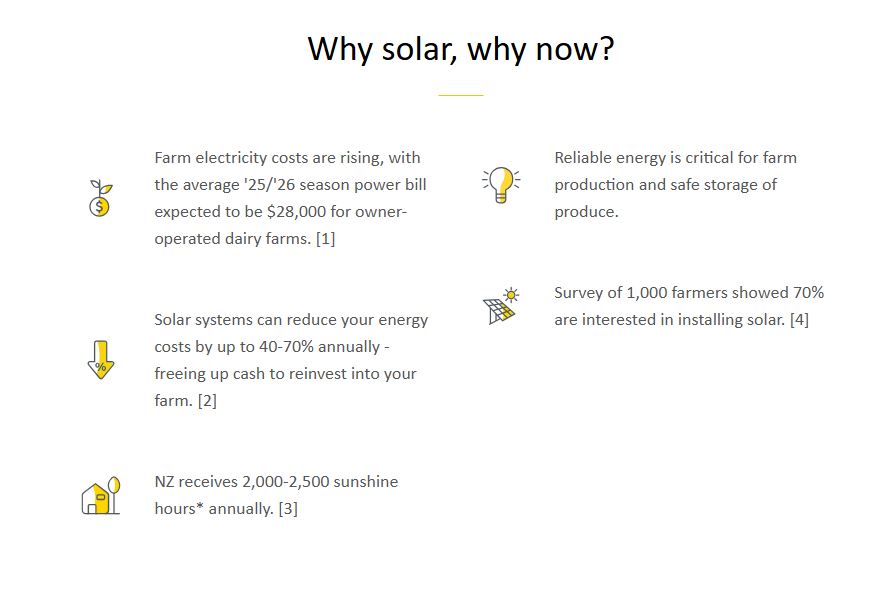
ASB SMART Solar draws on insights from research ASB conducted with energy transition charity Rewiring Aotearoa, which found 66% latent demand for electrification among farmers, compared to 48% among residential survey respondents.3 The key barrier to adopting solar was the high upfront cost. Most farms had rooftop space available for solar, and 60% of farmers said they had land which could be used for solar without reducing production.
This research found a 250m² ground solar system could save farmers up to $598,200 over the lifetime of the panels from avoided grid costs, at a median installation cost of $110,600. While every farm is different, in this scenario, an ASB SMART Solar customer could expect to pay back their solar set up from as early as their 6th year of generation.
With rural areas at the end of the electricity network, ASB General Manager Rural Aidan Gent says unlocking the potential of farm solar is an important way ASB can help strengthen energy security for farmers, and regional communities.
"We're stepping up with this strong offer for our rural customers, as we're committed to investing in a more resilient future for regional New Zealand," says Aidan. "From high-tech milking sheds to irrigation, farmers need affordable, reliable energy. Solar generation will help farmers work smoothly through power outages and extreme weather events, when rural communities are often the last to be reconnected.
"With cheaper energy from the day solar is up and running, and five years interest-free to get started, ASB SMART Solar will be the right call for many farmers.

"Rising power bills and a drive to be more self-sufficient motivated North Otago dairy farmer Otto Dogterom to install solar panels on farm in 2021. "Power prices were going up faster than inflation and I wanted to insulate against further increases." He says his 240 kWh ground system is perfect for powering irrigation across the 300-hectare farm, as sunny days are when irrigation is needed most.
Otto says as well as being a good business investment, solar is positive for rural communities: "It's a way farmers can do our bit for the environment and make New Zealand as a whole more resilient."
For farmers with larger solar initiatives, ASB SMART Solar lending can be combined with ASB's Business Sustainability Loan, which offers special variable rates on eligible projects.
The ASB SMART Solar Loan launches at National Fieldays on 11 June, with the new solar tools and energy calculator available shortly after on the ASB website. The offer is available for existing and new ASB rural customers until 15 December 2025, at ASB's discretion.
1 DairyNZ Econ Tracker, Farm Economics, 25/26 dairy season budget forecasts, based on 456 peak cows milked, as at 09 June 2025.
2 Rewiring Aotearoa/ Federated Farmers survey, 1000 respondents, March 2025.
3 Rewiring Aotearoa, Residential and Rural Electrification, March 2025.
"The sentiment around making the electricity market fairer and cheaper for customers is great, but there's still something missing." That's Rewiring Aotearoa CEO Mike Casey's summary of Act's energy policy announcement today.
Read moreDownloadACT will open electricity networks to competition, give New Zealanders more freedom to generate and sell power, and make monopoly lines companies prove consumers are getting value before loading more costs onto their power bills, says ACT spokesperson for Energy and Resources Simon Court.
Read moreDownloadACT is pledging to keep the gentailers whole and use market forces to curb the costs of lines management and increase solar repayment rates. Energy spokesperson Simon Court announced the party's electricity policy at Parliament on Friday afternoon.
Read moreDownload