The 'Electric Election': energy policies, side by side

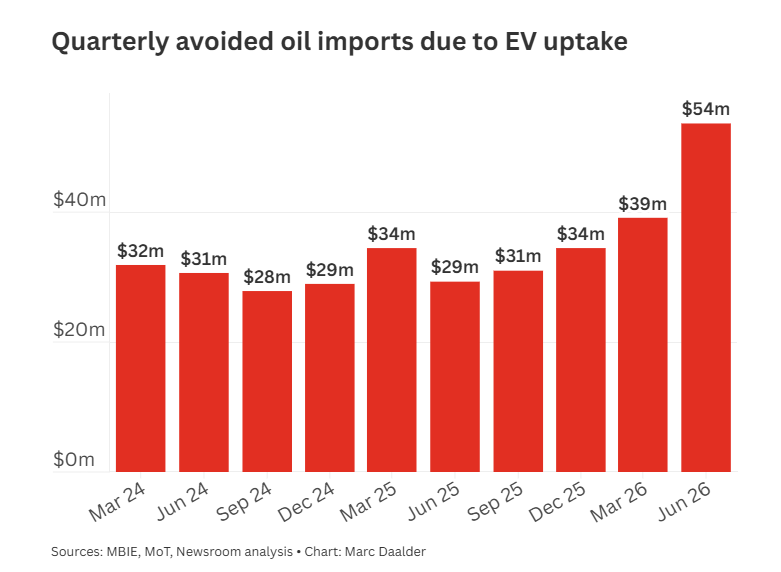

Whether you think subsidies are justified or not often depends on whether the goal is deemed worthy. One man’s subsidy is another man’s tax. And one man’s tax break, low-interest financing scheme or industrial policy intervention is another man’s subsidy. Government support can either keep the old world alive or give an uneconomic new option an unfair advantage. But there's a pretty good argument for subsidising EVs in New Zealand, as Marc Daalder explained in Newsroom.
"Electric cars, trucks and buses are cutting New Zealand’s dependency on imported fossil fuels, saving the country hundreds of millions of dollars since the start of 2024."
Rewiring's Josh Ellison said that "essentially, every litre of fuel that we’re not buying, it’s a lot of money we’re not spending offshore."
And the money we do spend on charging those electric vehicles up with New Zealand-made energy largely stays in the country.
"New Zealand imports $10 billion in oil products each year – about the same amount of money goes overseas to buy fuel as we bring in through selling concentrated milk, our largest physical export product."
Petrol prices were the primary cause of the highest inflation numbers in a few years recently and diesel is up by 70% since the start of the year. And while our politicians like to claim that these inflation issues are imported, they could be addressed by offering more support to get off fuel for good.
New Zealand has some history when it comes to EV subsidies and the Clean Car Discount saw us leading the world on adoption for a while. There were issues with the design of that subsidy, but a better one should not be ruled out because it could pay us back in terms of energy security, economic gain and emissions reductions.
“It would be nice if EV subsidies weren’t as out of vogue as they are. I think there is a very good argument for investing in the economy in that way,” Ellison said.
We're pushing for the EV Salary Boost scheme, where new or second-hand EVs can be leased using pre-tax income. Around 50% of the EVs bought in Australia used a similar scheme. But there's plenty of room for all the parties to be a bit more ambitious on EV policy.
'Twas the night before Chris-mas, and all through the house, all the voters were stirring, the pundits showing their nous … the election will soon be over, but the energy crisis won't, so we'll be there to pester whoever is in power about the need to run more of the economy on New Zealand-made energy; can Ethiopia's aggressive push for EVs work and how does New Zealand compare in terms of adoption rates?; a two-way charging trial from Genesis shows promise in Auckland, but there's still a way to go before it's mainstream; small electric vehicles are often overlooked when it comes to electrifying transport, but it's hard to miss this weird French one; a solar-powered cafe (and some electric coffee); and we endorse the political vandalism of Keith of All Trades.
Read moreDownloadPoliticians are being urged to adopt stronger electric vehicle incentives ahead of the election. Climate and energy advocacy group Rewiring Aotearoa is arguing that EVs are one of the most effective long-term solutions for rising transport and energy costs. They're promoting an EV Salary Boost proposal, which would allow workers to access EVs through pre-tax salary arrangements – similarly to already existing schemes in the UK and Australia. Policy and Government Relations Spokesperson Ngaio Neumegen told Kerre Woodham that even with the rising cost of power, it's still cheaper to run an EV than a car running on imported fuel.
A proposal that would let New Zealanders lease an electric car using their before-tax pay has not won a commitment from either National or Labour, with the 7 November election days away. Under the EV Salary Boost, put forward by Rewiring Aotearoa and Drive Electric, an employee would lease a new or used EV for three to five years. The payments would come out of their pay before tax, lowering the cost of running the car. The idea is based on Australia’s novated leasing system, though the groups say they are not proposing a direct copy.
Read moreDownload
