The 'Electric Election': energy policies, side by side


BloombergNEF says sales of combustion cars peaked in 2017 and there's no coming back, while a new study in New Zealand shows petrol vehicles were losing value more quickly than equivalent models did a decade ago; big batteries aren't just for storing electricity, they can also store heat; the story of the world's biggest electric ferry and the Australian company that made it; electric motorbikes are doing a lot of heavy lifting on emissions reduction, so why don't they get more attention?; and a new show called HallowGreen2 that tackles the energy transition "with music, humour and a hopeful message”.

There’s no coming back
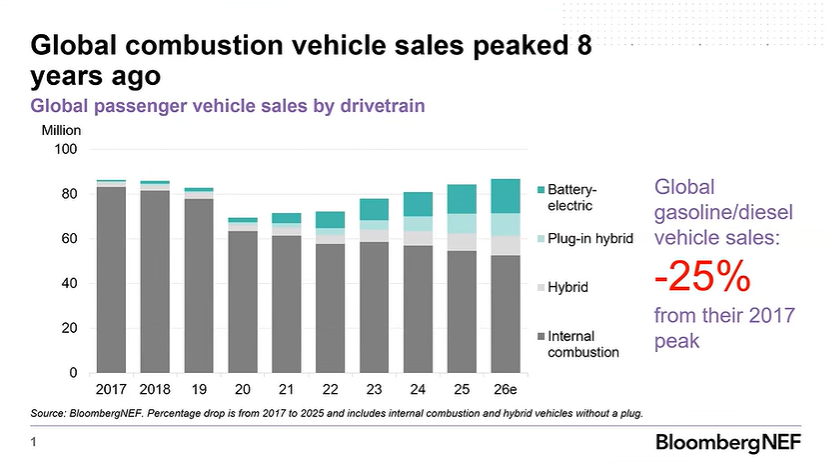
BloombergNEF tracks the auto and energy sectors very closely and, as head of clean transportation Colin McKerracher told Electric Vehicle Society, combustion vehicles passed their peak sales eight years ago.
Sales are down by 25% since 2017 and to get back up to that level today would require a whole new market as big as America that only buys combustion vehicles. As he says, that’s not going to happen.
Depreciation was also a barrier for EVs as the price of new EVs kept coming down, which obviously affected the second-hand market. But depreciation is much less than it was on early EVs and, in some markets like Australia, it’s petrol cars that people are now worried about selling, something that will only increase as young folk see them as the transportation equivalent of the landline.
Closer to home, a recent study by Trade Me compared like-for-like vehicle age cohorts in 2016 and today and found that petrol vehicles were losing value more quickly than equivalent models did a decade ago.
"It is a market-wide trend for petrol, not a specific impact on older vehicles," says the AA’s Terry Collins. " ... I really think the electrification of our fleet will finally start really taking off meaningfully… the running cost savings are just about a no-brainer.”
Can you handle the heat?
Big batteries are coming onstream all around the world to help electricity grids handle peaks and reduce the need for fossil fuels for generation, but The New York Times writes about a new battery that can take excess electricity and turn it into heat.
“Nestled in the cornfields of eastern South Dakota, a new type of battery is running, and some companies are betting the idea could transform the global energy system. Most big batteries store electricity. But this array, built over the past year by a start-up called Antora Energy, stores large amounts of blistering heat.
To charge up, Antora draws surplus electricity from nearby wind farms that would otherwise go to waste, using it to heat carbon blocks to as much as 4,352 degrees Fahrenheit, or about 2,400 Celsius. The blocks stay hot for days, releasing heat on demand to produce steam for a nearby biofuel refinery, replacing the need to burn natural gas and coal. Only a smattering of these large heat batteries exist today. But experts say the technology, also known as thermal storage, has the potential to unlock vast amounts of low-cost clean energy.
Over in Finland, it's using sand batteries to heat an entire town.
“Finland's revolutionary sand battery is transforming renewable energy storage by using low-grade sand to store excess solar and wind power as heat. Developed by Polar Night Energy, the system can retain thermal energy at 500–600°C for months, providing sustainable heating for homes and public buildings. It's low-cost, long-lasting, and cuts emissions significantly, offering a scalable solution to balance green energy supply and demand.”
Ferry godmothers
While there’s dismay in Auckland as the hybrid ferry goes around in circles to charge due to delayed chargers on the docks, the world’s biggest electric boat is on the water and it was made by Australian company Incat.
“Electric cars have gone mainstream in many parts of the world, but shipping has lagged behind. That may be changing thanks to better battery technology and global pressure to reduce greenhouse gas emissions in the maritime sector. However, electrifying big ships comes with its own technological challenges, and it might be the humble passenger ferry that’s most primed to take battery-powered boats to open waters. Bloomberg sets out to visit the biggest one yet.
Aim small
We need to focus on the roads if we want the most emissions reductions (and cost savings, especially in a country like New Zealand), but it’s not just about cars. They get a lot of attention and, as Susan Su writes in The Single Technology Killing Oil Demand, bikes deserve a bit more credit.
According to recent modeling and analysis by BNEF, electric vehicles are now displacing more than 2.3 million barrels of oil per day. In 2025, 1.1 million barrels were avoided by two and three wheelers, while passenger cars contributed to the avoidance of 741K barrels of oil …
Road transport electrification is outpacing emissions reduction efforts in the industrial, marine and aviation sectors. In fact, the impact of road fleet electrification plus efficiency improvements will displace roughly four times more oil demand by 2040 than efforts across aviation, marine and petrochemicals combined.
Despite this, BNEF actually downgraded their EV outlook due to a slowdown in the Chinese and US markets. But this assessment has a big omission: it’s only looking at cars. In fact, despite their own numbers demonstrating the predominant role of electric two and three wheelers, BNEF’s entire report is dedicated to analysis of the electric car segment.
… Instead, the real workhorse of the climate transition is a $1,500 electric scooter zipping around the streets of Jakarta, or a $400 Yadea ebike making deliveries across Shanghai.
A number of places in Asia - from Hanoi to Delhi - have imposed bans on combustion motorbikes in central cities, in part to address air pollution.
Boo!

Climate change is a major issue for a number of voters, but no-one is really talking about emissions this election, something Kate Newton looked into in an excellent story about 'the big climate change rebrand‘. Rewiring and many others have focused on the economic benefits of substitution to try and get away from the negativity of sacrifice and a new show called Hallow Green 2 “explores how our fears and fixed ideas about the world and each other can get in the way of working together on climate solutions that already exist”, says producer Lātū Harper.
“We also explore transition engineering: how we move from our current dependence on fossil fuels towards a more sustainable future, while recognising how deeply that dependence runs even through the fertilisers and other inputs that support our fragile food systems. Making that transition takes more than technology; it takes people coming together. It might sound like a lot to fit into a show, but we tackle it with music, humour and a hopeful message!”
The show runs from 4-7 November in Auckland. Book your tickets here.
BloombergNEF says sales of combustion cars peaked in 2017 and there's no coming back, while a new study in New Zealand shows petrol vehicles were losing value more quickly than equivalent models did a decade ago; big batteries aren't just for storing electricity, they can also store heat; the story of the world's biggest electric ferry and the Australian company that made it; electric motorbikes are doing a lot of heavy lifting on emissions reduction, so why don't they get more attention?; and a new show called HallowGreen2 that tackles the energy transition "with music, humour and a hopeful message”.
Read moreDownloadRNZ's Kate Newton looks at why no-one is really talking about emissions as an election issue. As Mike Casey said: "The climate movement up until this point has been very, very good at creating dartboards, but terrible at providing people with darts to play the game." That's allowed for inaction, and active lobbying against climate change action from fossil fuel companies and others who stand to lose out ... The solution is "flipping it into a strong economic narrative that they can't possibly fight with".
Read moreDownloadHumans are comparative creatures and they're particularly comparative during election season. That's why we've created a rundown of all the energy-related election policies that have been announced by the parties so far.
Read moreDownload
