The 'Electric Election': energy policies, side by side


'Twas the night before Chris-mas, and all through the house, all the voters were stirring, the pundits showing their nous … the election will soon be over, but the energy crisis won't, so we'll be there to pester whoever is in power about the need to run more of the economy on New Zealand-made energy; can Ethiopia's aggressive push for EVs work and how does New Zealand compare in terms of adoption rates?; a two-way charging trial from Genesis shows promise in Auckland, but there's still a way to go before it's mainstream; small electric vehicles are often overlooked when it comes to electrifying transport, but it's hard to miss this weird French one; a solar-powered cafe (and some electric coffee); and we endorse the political vandalism of Keith of All Trades.

It's the final countdown
'Twas the night before Chris-mas, and all through the house, all the voters were stirring, the pundits were showing their nous …
Thank you to everyone who put their name forward as a candidate for what we dubbed the ‘electric election’ (keep in mind that New Zealand is ranked number 2 in terms of functioning democracies, so no matter who wins, we can be proud of that). And well done to all our community groups around the country for engaging with those candidates, getting a whole range of them to come to our electrification expos, and making sure they understood all the benefits of electrification.
While the election will soon be over, the energy crisis won’t. We’re seeing near-record petrol and diesel prices affecting inflation and the economy, a lack of domestic gas (and a lack of a plan to get businesses off it), and rising electricity costs. There’s a lot to fix and we’ll still be in the politicians’ ears, giving them the data they need to make good decisions, proposing policy ideas, and barracking for an economy that runs on more New Zealand-made energy.
Previous energy crises have changed behaviour and Government policies significantly and 2026 will be no different. It has been a watershed year for electrification and many countries have had their reliance on imported energy laid bare. New Zealand’s response has been tepid at best and focused on short-term responses like subsiding fuel, delaying fuel tax rises or increasing fuel storage, rather than on long-term solutions that get us off foreign fuel, like incentivising EV uptake, investing in truck charging infrastructure, or helping businesses get off gas and diesel.
The LNG import terminal, which would tie us to another volatile global fuel, is heading in the opposite direction to most other countries that have recognised this vulnerability and are trying to bring as much of their energy in-house. New Zealand is more exposed than most given we are at the end of the supply chain.
As energy expert Jan Rosenow wrote about Europe's experience:
According to the European Commission, EU countries have already paid more than €100 billion extra for oil and gas since the Strait of Hormuz closed. Not one extra molecule of gas or barrel of oil came with it.
We have been here before. In 2022, Europe spent hundreds of billions of euros shielding households and businesses from fossil fuel prices it could not control. That money bought time, not resilience.
The lesson is the same now. Every boiler, engine and industrial process that burns gas or oil is exposed to whatever happens on global commodity markets. Heat pumps, electric vehicles and electrified industry avoid importing fossil fuels in the first place, and stop billions of euros leaving the European economy.
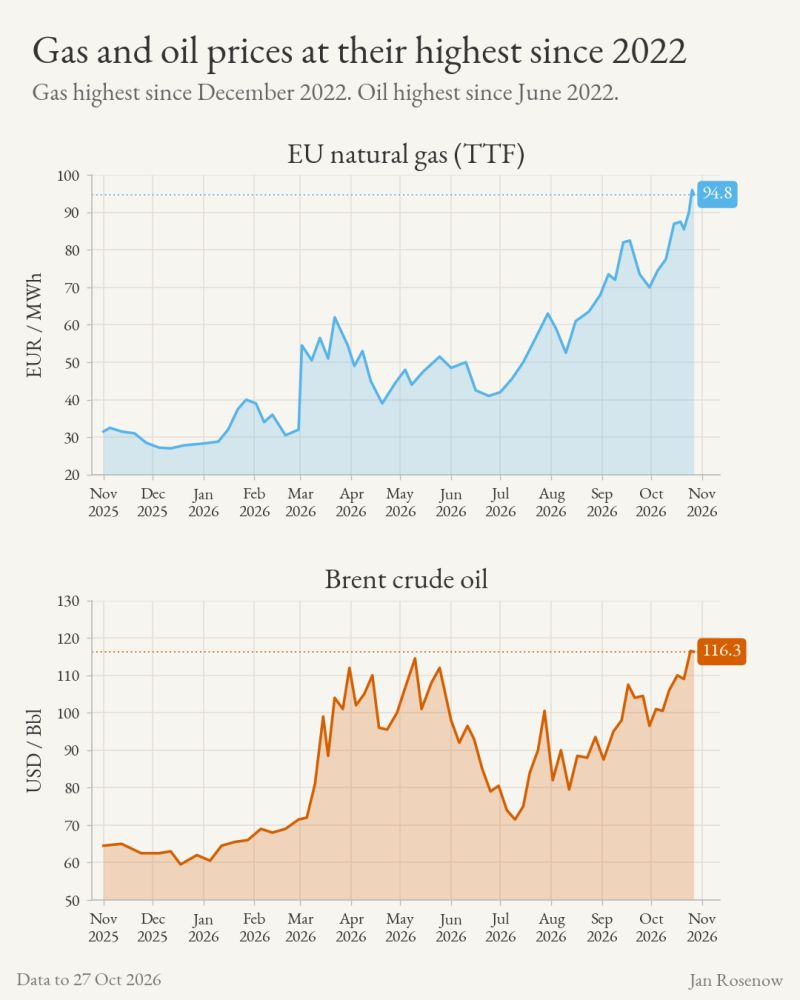
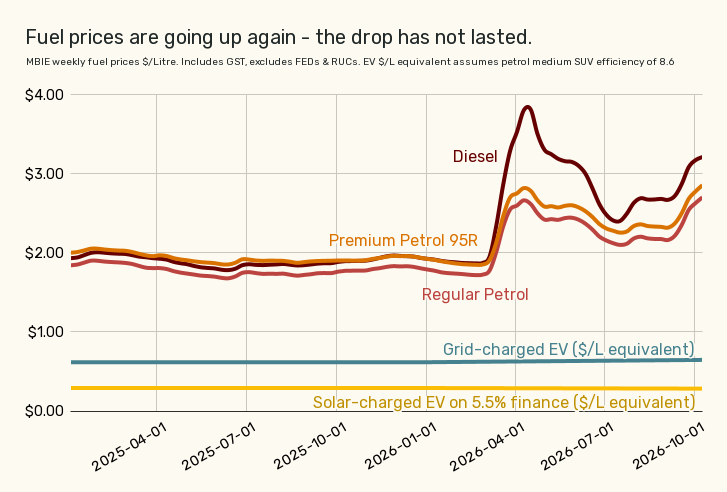
Whoever ends up in power, this is the volatility we need to get away from and locally-made electricity is the stability we need to move towards.
EVthiopia
Ethiopia has one of the most aggressive EV adoption plans in the world and banned new petrol and diesel cars in 2024 - for economic rather than environmental reasons. So how is that working out?
It's a fairly familiar story:
Ethiopia was spending billions of dollars every year on imported fuel it couldn’t afford, and subsequently defaulted on its debt. Cheap hydropower from Africa’s largest dam made electric vehicles a practical alternative, and Chinese-made EVs — some assembled locally — quickly filled dealership lots. Today, Ethiopia’s EV share outpaces the global average. But sticker prices are too high for most, the grid remains patchy and armed conflict is flaring in the country and across the region. Can Ethiopia make its unprecedented bet on EVs pay off?
Norway is well known for its electric vehicle adoption rates, and almost 100% of new cars are now fully electric. Other Scandinavian and European countries are also well above 50% and China, the country with by far the biggest number of EVs, is at around 50% share.
Nepal is another developing country that has embraced EVs and its share is around 70%, while Vietnam is around 40%.
In Australia, around 25% of new cars were fully electric in October and Government policies are helping to drive demand.
While sales in New Zealand are up by around 170% on the same time last year, just 10% of new cars sold were electric in October, down slightly from previous months and well below other developed markets (at a regional level, Nelson took the prize for highest share with 25%, followed by Wellington and Tasman).
It’s great to see growth, but it pays to put it in context: there were ten times more combustion vehicles than BEVs registered last month in New Zealand and every one of those will probably be burning expensive, imported fuel for a couple of decades.
There was a disappointing dearth of EV policy in the election (despite our good-natured peer pressuring of the Chrises), but we'll continue to push for the EV Salary Boost scheme, which would help more New Zealanders who want an EV get into one - and get over the upfront cost barrier.
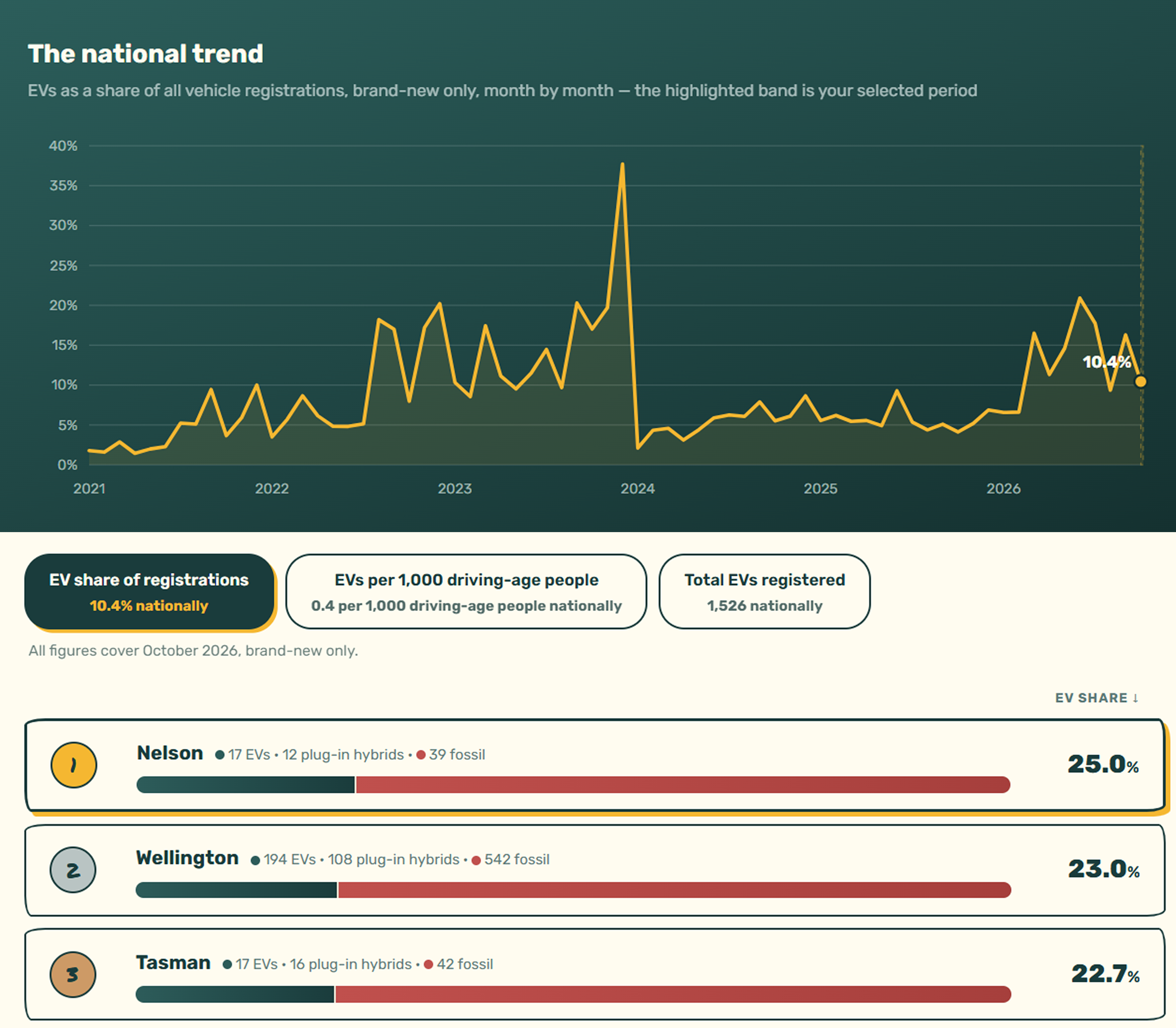
The annual sales graph is still following the typical three-month cycle of one boom month followed by two subdued months, but the overall trend is clear: EV sales have been heading upwards for about eight months now and total sales for the year are above 2023 levels when there was a subsidy in place.
While businesses account for a majority of new car sales, EV sales are stubbornly low with them and they accounted for just 35% of EV purchases.
There were also a lot of people (and businesses) half-assing it with a hybrid when they could instead be covering their asses completely with an EV that can be run on cheaper, more stable New Zealand-made energy.
Ship arrivals can affect registration numbers month-to-month and elections do tend to have a dampening effect on demand for both homes and businesses, especially when it comes to large decisions like vehicles, so it’s not surprising to see a slight dip in October and we expect to see increased EV sales over the next two months.
Plug and play
We covered our head of policy Dave Karl’s two-way charging set-up a couple of weeks ago and there are a number of trials happening around the country, including one we’re involved with in Queenstown. And Genesis has added more fuel to the fire (sorry) with its own trial.
A report from Concept Consulting said there could be $2,000 of savings up for grabs by having your car run your home, but Genesis (which got a special dispensation from BYD to run the trial, something the other triallists have also had to get) says it’s too early to estimate the numbers.
As always, the New Zealand Herald’s Chris Keall provided an excellent rundown on the trial and the broader potential for V2G.
As he wrote, there are three main benefits:
1. Using your EV to run your home during a power cut or natural disaster. With an average-sized EV and average-sized home, the electric vehicle’s battery (typically three or four times the capacity of a home solar battery) should be able to power the home for about nine hours, or more than a day, if you’re careful, Counties Energy chief network and digital officer Moonis Vegdani said.
2. Using your EV to run your home during normal times, or some of them. You can save an estimated $2000 a year by buying power in the middle of the night or day, when it’s cheap, storing it in your car’s battery, then discharging it back to your home during peak times, plus selling excess power back to the grid. StarCharge’s app can be used to manually start charging your EV or discharging power from the vehicle to your home, or to schedule the process to run on autopilot – once you’ve plugged your EV into the charger outside. The $2000 savings figure comes from Concept Consulting research commissioned by ECCA. Genesis says it’s too early to estimate savings, which will depend on your plan and other factors (the retailer currently pays between 12.5c and 15c per kWh for power you send back to the grid).
3. Helping to ease pressure on the grid during the likes of a winter cold snap, preventing brownouts or price spikes. Forsyth Barr said in a note it estimates battery-electric vehicles on New Zealand roads contain about 7000MWh, or 7GWh, of storage capacity – more than 10 times the country’s installed grid-scale battery capacity.
Good buzz
There’s a huge amount of solar being installed in New Zealand right now, and the average system size is growing rapidly. But there’s still room for smaller arrays, like the 3kW installation on the Java Hut in Māpua.
If they want to go even further on the sustainability front, perhaps they should try Ryder, which runs an electric roaster in Queenstown.
And if they want to go even more local, perhaps in the future they could even get their beans from New Zealand.
Small but perfectly formed
There’s often a focus on cars when it comes to electrification of transport, but smaller vehicles are a massive part of the shift, particularly in places like Asia and Africa where motorbikes and rickshaws are more common. French start-up ÆMOTION has brought a new meaning to hybrid by combining "a motorcycle’s agility with a car’s protection”.
As Cheddar reported:
A French startup built a car that leans into turns like a motorcycle. The idea came out of Paris traffic. It pushed co-founder Alexandre Lagrange onto two wheels … It took seven prototypes to reach the version unveiled in December 2024. No customers have one yet. Prototypes are on public roads, type approval is still in progress, and first deliveries are planned for France and the rest of Europe. Several million euros have gone into the project since 2020, with support from Bpifrance, ADEME and France 2030.
Speaking of small vehicles, the story of the US$2,000 electric truck got some attention when it was imported to the US around five years ago. So, how is it performing?
Full of hot air
Obviously we don’t approve of vandalism of political signs - unless it involves the promotion of heat pumps (or googly eyes).
Keith of All Trades, well-known for his unique approach to heat pump installs and his enticing cat door promotions, has gone to great lengths with this political statement. We endorse this message.
'Twas the night before Chris-mas, and all through the house, all the voters were stirring, the pundits showing their nous … the election will soon be over, but the energy crisis won't, so we'll be there to pester whoever is in power about the need to run more of the economy on New Zealand-made energy; can Ethiopia's aggressive push for EVs work and how does New Zealand compare in terms of adoption rates?; a two-way charging trial from Genesis shows promise in Auckland, but there's still a way to go before it's mainstream; small electric vehicles are often overlooked when it comes to electrifying transport, but it's hard to miss this weird French one; a solar-powered cafe (and some electric coffee); and we endorse the political vandalism of Keith of All Trades.
Read moreDownloadPoliticians are being urged to adopt stronger electric vehicle incentives ahead of the election. Climate and energy advocacy group Rewiring Aotearoa is arguing that EVs are one of the most effective long-term solutions for rising transport and energy costs. They're promoting an EV Salary Boost proposal, which would allow workers to access EVs through pre-tax salary arrangements – similarly to already existing schemes in the UK and Australia. Policy and Government Relations Spokesperson Ngaio Neumegen told Kerre Woodham that even with the rising cost of power, it's still cheaper to run an EV than a car running on imported fuel.
A proposal that would let New Zealanders lease an electric car using their before-tax pay has not won a commitment from either National or Labour, with the 7 November election days away. Under the EV Salary Boost, put forward by Rewiring Aotearoa and Drive Electric, an employee would lease a new or used EV for three to five years. The payments would come out of their pay before tax, lowering the cost of running the car. The idea is based on Australia’s novated leasing system, though the groups say they are not proposing a direct copy.
Read moreDownload
