The 'Electric Election': energy policies, side by side


COP31 has an electrification target, which is a good thing, but the delegates need to watch their language; Turkey puts the foot down on EVs and renewables; Rewiring Australia's new report shows electric homes with solar and batteries can save over $4,000 a year; the IEA's renewables report takes aim at the 'energy trilemma' and shows there's scope for an 'energy trifecta'; how petrol and diesel are causing high inflation (and lower emissions) and how EVs can reduce it; Toyota tries some electric initiation with its brand ambassadors; and Mike Casey frolics in a field.

Watch your language
COP31 is underway in Antalya, Turkey and electrification is one of the big focuses. A number of countries have committed to taking electricity as a share of final energy to 35% by 2035, up from 23% today. That’s good to see, but as energy expert Michael Liebreich says, it pays to make sure the language is right because final energy is very different to useful energy.
As the IEA pointed out in its special electrification report, launched before the conference, the world’s share of useful energy (i.e. the stuff that gets consumed, not the stuff that gets sold by energy companies) is already at 37%.
Speaking of Turkey, it’s seeing rapid growth in EV sales - like most others places - and is now one of the biggest markets in the EU.
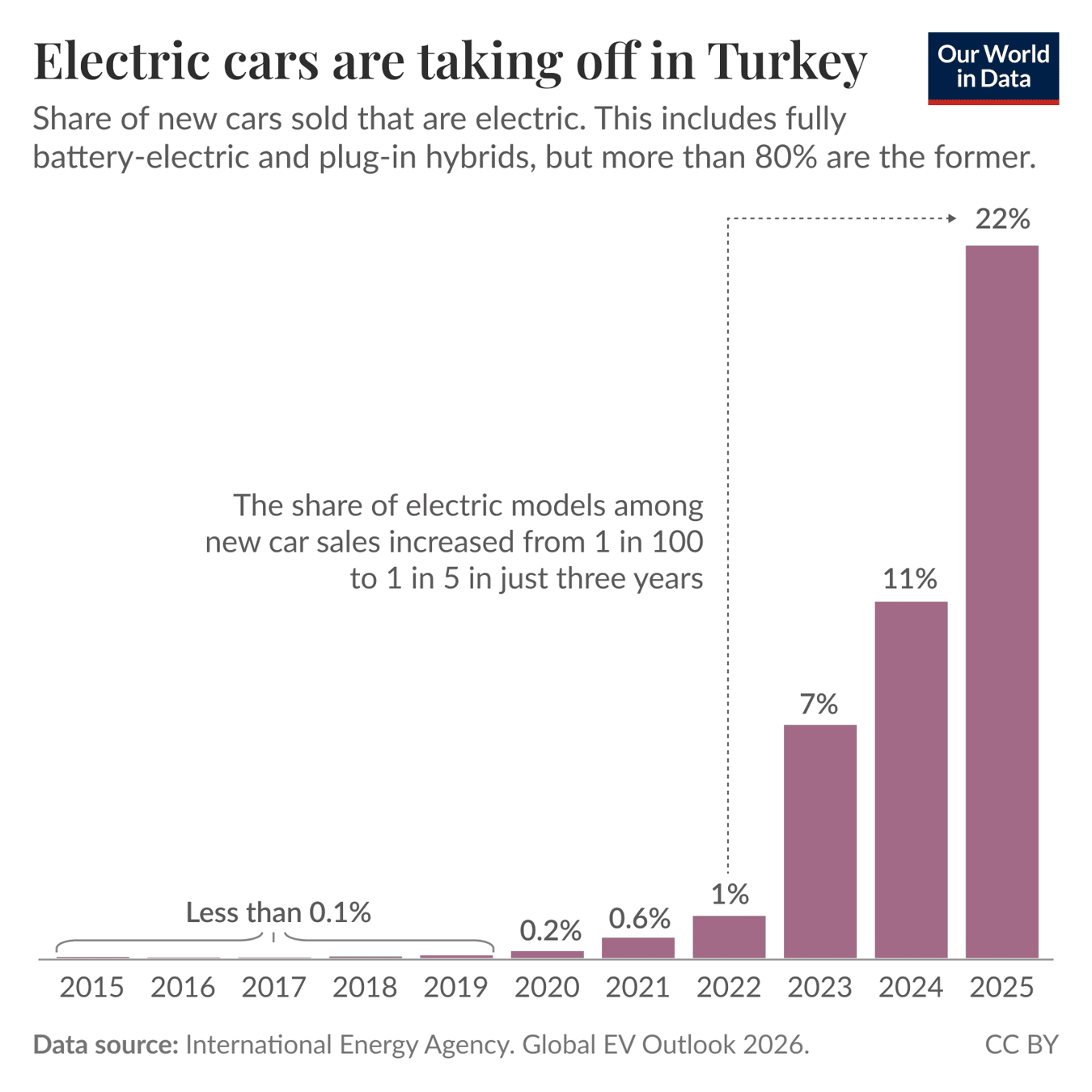
It has big ambitions to electrify the fleet and roll out renewables. According to S&P Global:
Turkey will need to nearly quadruple its wind and solar generating capacity and mobilize $500 billion in investment by 2040 to meet the electrification and carbon reduction targets at the heart of its newly launched energy roadmap, energy minister Alparslan Bayraktar said.
“... Turkey's EV fleet will need to grow from about 500,000 vehicles to 20 million by 2040, a 40-fold increase that will itself generate substantial additional electricity demand even as it displaces oil consumption in the transport sector, Bayraktar said.
From energy trilemma to energy trifecta
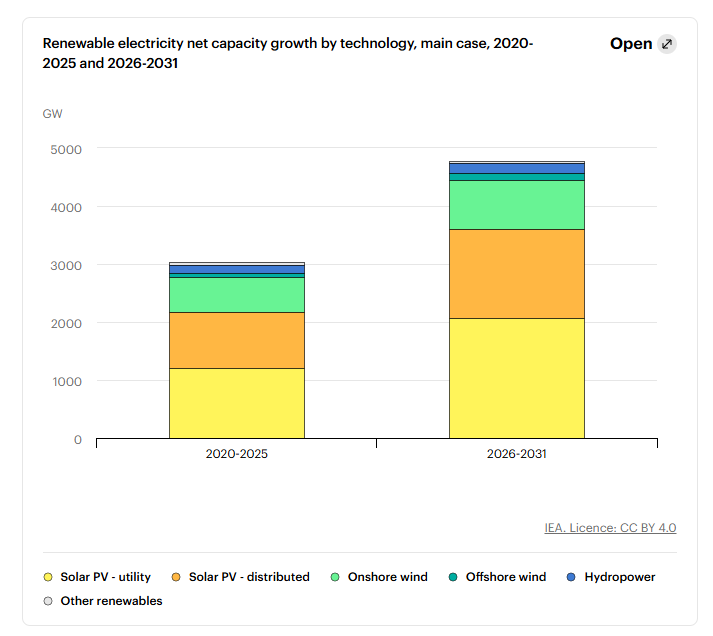
The IEA has also just launched its Renewables 2026 report and it takes aim at the energy trilemma, an argument that was formed in an era where fossil fuels were dominant, in the executive summary:
Because renewable resources are widely distributed, every country has domestic potential that can be developed competitively to strengthen energy security. Yet governments do not have to choose between security, affordability and sustainability. With well-designed policies, renewables can offer countries a way to diversify their energy mix, reduce exposure to imported fuels and high prices, lower overall electricity supply costs and cut emissions.
Renewables are already delivering major energy security benefits. Without their growth since 2010, global annual demand for fossil fuels would have been around 8% higher in 2025, an amount equivalent to India’s total energy consumption. Renewables have also displaced natural gas consumption equivalent to 11% of global demand. This has lowered the influence of gas-fired power plants on wholesale electricity prices and helped limit price increases during the crisis in many countries. In addition, the growth of biofuels and other renewables since 2010 has displaced 2.4 million barrels of oil equivalent per day – comparable to Canada’s total oil demand.
Trans-Tasman savings
Our siblings at Rewiring Australia have just released their Home Energy Savings report and it shows an average home could save $4,300 per year by going electric, including upfront costs, which is slightly more than the $3,000 a year the average home could save in New Zealand.
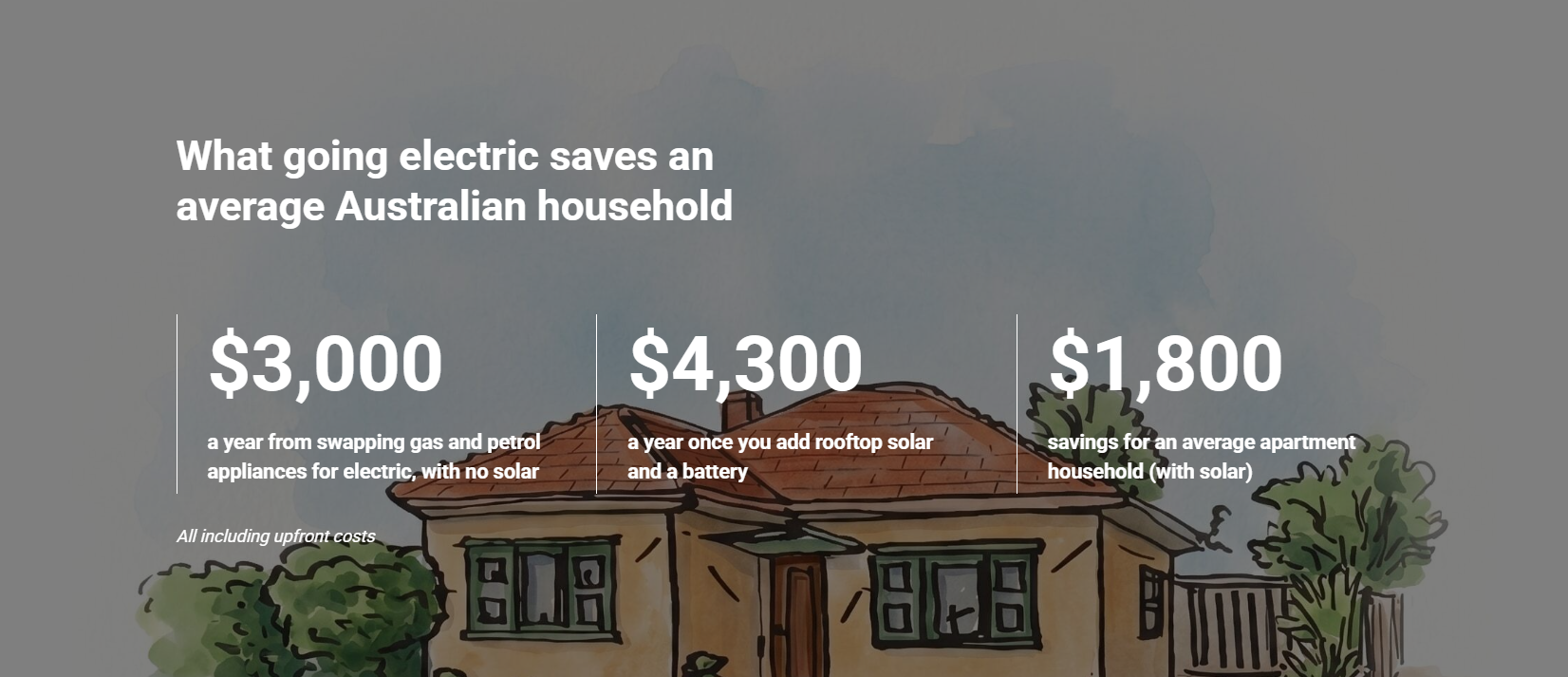
As Chanell 9 reported, there's green to be saved by going green.
Inflation up, emissions down
High petrol and diesel prices have driven inflation all around the world. In New Zealand, Stats NZ reported in September that "petrol (91 and 95/98 octane) was the largest upward contributor to the annual inflation rate, up 19.1 percent (17.5 percent contribution to the 3.7 percent annual inflation rate)".
And that was before the latest rise in prices.
In Australia, it was a similar story, with petrol responsible for around one fifth of the 4.3% inflation rate, and new research by the Electric Vehicle Council has tried to demonstrate the impact an electric fleet would have on reducing it.
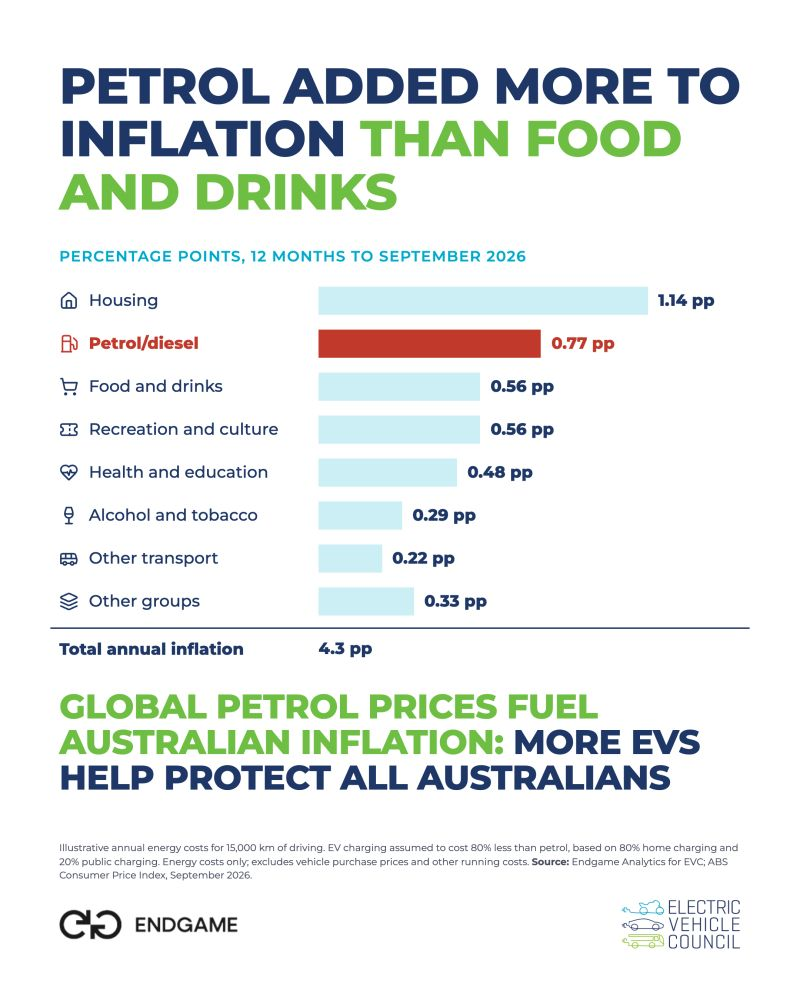
“To illustrate Australia’s exposure to oil price shocks, Endgame Analytics modelled what inflation would have looked like if all household driving had been electric. After allowing for charging costs, annual inflation would have been around 0.6 percentage points lower. This is an illustrative scenario, not a forecast of overnight adoption.
When translated into running costs, rising fuel prices added an estimated $442 to the annual cost of running a small SUV 15,000km per year. By comparison, higher electricity prices added an estimated $48 to the cost of running an EV – around a tenth of the cost.
Nathan Surendran, writing on Substack, explained that the cost-of-living promises being made by politicians can’t be honoured unless we focus on energy.
If that reading is right, a promise to bring down the cost of living without dealing with energy input costs treats the fever, not the infection. Rising energy input costs put a floor under prices that no election promise removes.
On the plus side, just as we saw during Covid, 'The Iran war unexpectedly drove down carbon emissions this year'.
As Carbon News reported:
The latest Global Carbon Budget report finds that the world is projected to emit 32.8bn tonnes of CO2 this year, marking a 0.4% decrease compared to 2025, according to the New York Times. It says: “The dip was driven partly by fighting in the Middle East and the closure of the Strait of Hormuz, as well as by the war between Russia and Ukraine. Both conflicts have caused global prices for crude oil, natural gas, gasoline and diesel to soar, and many nations have responded by using less oil and gas and shifting to domestic alternatives, including coal or renewable energy. Globally, emissions from oil consumption are expected to drop nearly 2% this year, while emissions from natural gas will decline roughly 0.3%. By contrast, CO2 emissions from burning of coal are expected to rise roughly 0.6%.”
Far out
While Toyota has been one of the more sceptical auto brands when it comes to EVs, it’s now being forced to come to the party and it’s taking on some of the misperceptions with a new campaign featuring its brand ambassadors Paddy Gower, Gemma McCaw and Dame Valerie Adams.
In October, according to EVs and Beyond, "Toyota registered 117 new battery electric vehicles, up from five a year earlier, including 71 bZ4X Touring wagons and 43 bZ4Xs".
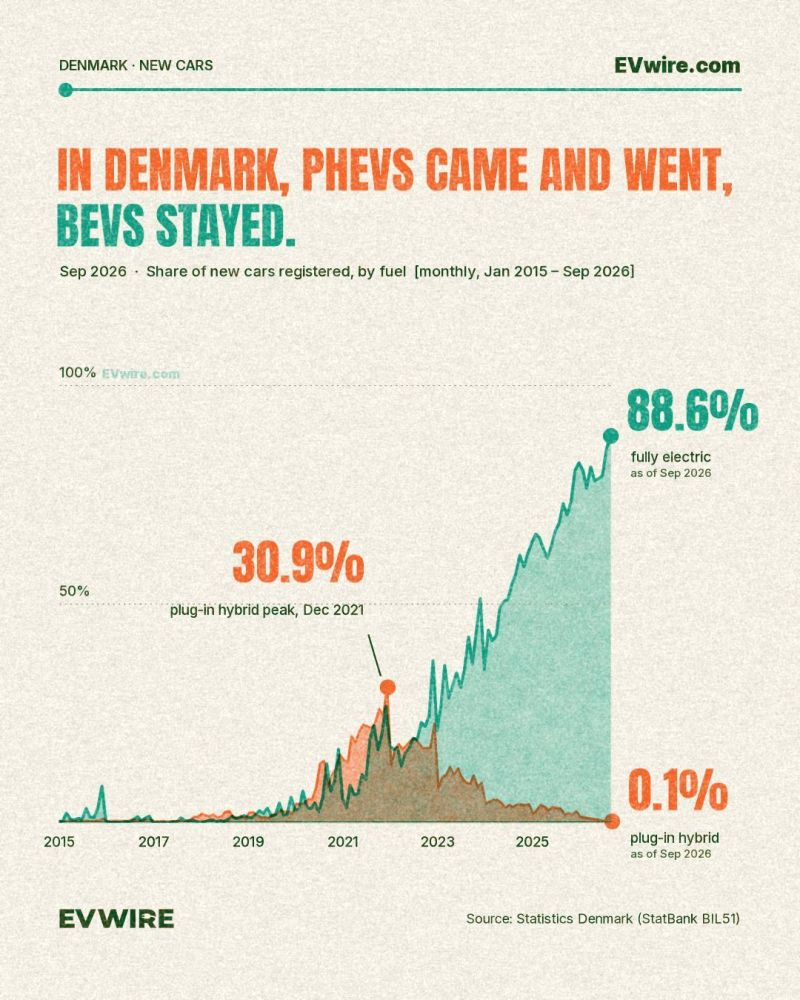
It sells a lot more hybrids and plug-in hybrids than that, but in places where EVs have taken off, they are a dying breed (as we like to say, don’t half-ass it with a hybrid when you can cover your ass completely with an EV).
Toyota is a leading brand in those markets, however, and in Norway, it sits second behind Tesla in terms of total sales in 2026.
It was all yellow
We love seeing the solar installation numbers tick up (you can see them clearly on our Electric Streets map). And that enthusiasm comes from the top.
COP31 has an electrification target, which is a good thing, but the delegates need to watch their language; Turkey puts the foot down on EVs and renewables; Rewiring Australia's new report shows electric homes with solar and batteries can save over $4,000 a year; the IEA's renewables report takes aim at the 'energy trilemma' and shows there's scope for an 'energy trifecta'; how petrol and diesel are causing high inflation (and lower emissions) and how EVs can reduce it; Toyota tries some electric initiation with its brand ambassadors; and Mike Casey frolics in a field.
Read moreDownloadThe installation of a vehicle-to-grid (V2G) charger at the Arrowtown Community Centre has made it one of the most resilient emergency hubs in the country. The bidirectional Starcharge unit, which was fully commissioned last week, can not only charge an electric vehicle (EV) but also draw power from the batteries of compatible EVS to provide backup power for the building in the event of an emergency.
Read moreDownload
