Don't listen to Old Man Gas. Ditch LNG. Support New Zealand-made energy!


The story of Uruguay's renewable push and why it's relevant here; EVs reach a tipping point in the EU, but they're growing in developing nations, too; Tauranga Crossing and Endless Energy go vertical with a new solar install; new research shows panels keep on trucking far past their warranty periods; and if you need a hand getting out on the waves, how about getting your own electric towing machine.

A good model
Uruguay shares a few similarities with New Zealand. As Ken Silverstein writes in Forbes, it is a small yet prosperous nation with a population of 3.5 million and its economy relies on agriculture, livestock, forestry, and a growing services sector rather than heavy industry. It's also a place we should be looking to when it comes to energy.
“By the early 2010s, Uruguay’s government realized that continuing to rely on imported fossil fuels was economically unsustainable. Ramon Méndez Galain, then a particle physicist with no formal experience in the energy sector, proposed a bold plan: to build a system that relied almost entirely on domestic renewable resources—wind, solar, and biomass—and do it in a way that was cheaper than fossil fuels.”
As we often point out, and as the professor says, “the energy transition isn’t just about climate—it’s about economics”.
“Uruguay’s shift to renewables, he argues, demonstrated that clean energy can be cheaper, more stable, and create more jobs than fossil fuels. Once the country adjusted the playing field that had long favored oil and gas, renewables outperformed on every front: halving costs, creating 50,000 jobs, and protecting the economy from price shocks.”
In recent times, New Zealand’s grid has been almost 100% renewable, mostly due to our high hydro lakes. But electricity only makes up a relatively small chunk of our total energy use. We still rely on imported oil for around two-thirds of the total. Uruguay also still imports a lot of oil, but it has proven that it pays to shift the reliance from expensive imported molecules to locally made electrons, something we should keep in mind as we debate the need for an expensive new LNG terminal.
Driving it home
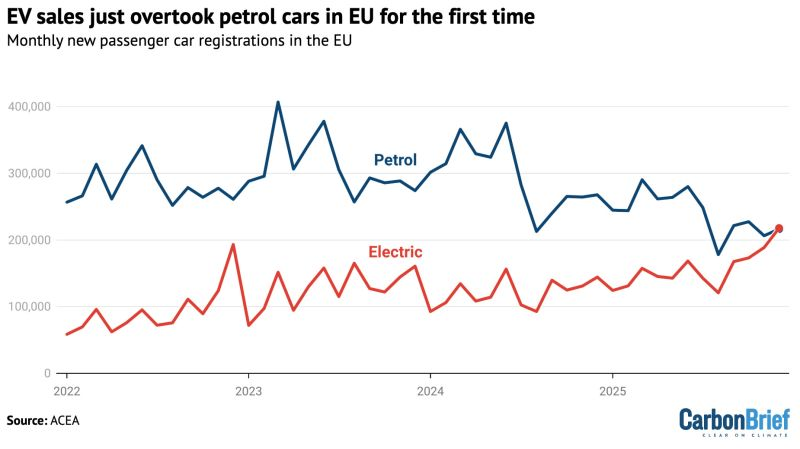
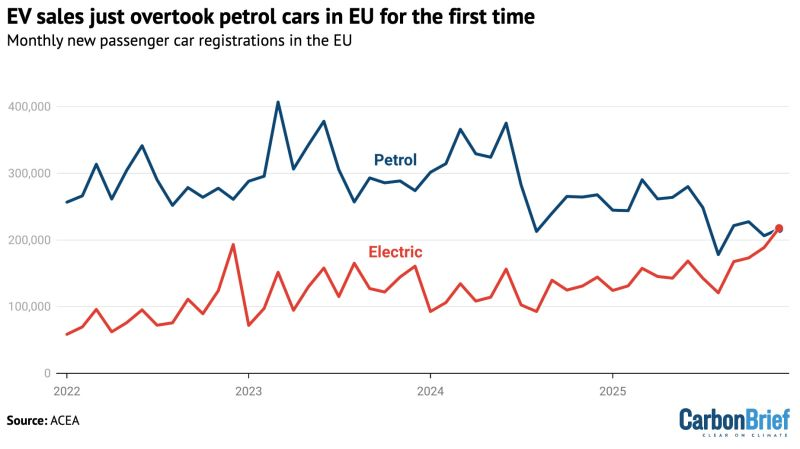
The rise of EVs and the importance of the neighbourhood effect is something we’ve been writing about for a while and we’ve reached a few important tipping points recently. The early adopters are often willing to sacrifice time and money to try new tech, but we are herding creatures and most of us wait until lots of others have jumped on board before we decide to follow suit. And that can be possibly be seen in the EU market as EVs overtook petrol cars for the first time ever in December 2025.
But it’s not just happening in the rich countries. As The Guardian's Down to Earth newsletter wrote:
“Last year, almost every new car sold in Norway, the nature-loving country flush with oil wealth, was fully electric. In prosperous Denmark, which was all-in on petrol and diesel cars until just before Covid, sales of battery electric vehicles (BEVs) reached a share of 68%. In California, the share of zero-emissions vehicles hit 20%. And at least every third new car now bought by the Dutch, Finns, Belgians and Swedes burns no fuel.
These figures, which would have felt fanciful just five years ago, show the rich world leading the shift away from cars that pump out toxic gas and planet-heating pollutants. But a more startling trend is that electric car sales are also racing ahead in many developing countries. While China is known for its embrace of electric vehicles (EVs), demand has also soared in emerging markets from South America to south-east Asia. BEV sales in Turkey have caught up with the EU’s, data published this week shows.
While policy shifts have dampened demand in New Zealand, the same trends are evident here.
And, as tech journalist Ashlee Vance reports, GM is certainly still trying pretty hard, despite some obvious headwinds.
Straight up and down
Solar panels are now so cheap that some are putting them up as fences. They're also going up beside motorways. And now New Zealand has gone vertical, with a building at Tauranga Crossing adding 714 panels on the roof and facade.
“The system is expected to contribute significant clean energy to the centre each year, with a carbon reduction of around 42.4 tonnes of CO₂ annually - equivalent to planting ~1,800 trees or avoiding ~170,000 km of car travel.
This project shows that retail centres don’t just have to rely on conventional energy - with smart design and planning, even complex buildings can turn facades (not just roofs) into renewable-energy assets.
For any business considering a solar transition, now is the time to rethink what “rooftop solar” can really mean.
There’s also a growing number of innovations focused on windows that can generate electricity, so in the future we might be generating electricity off more than just the roof and walls.
Keep on sunnin’
Solar panel waste is a legitimate issue and we covered Australia's solar recycling scheme last week, but it turns out they might not need to be replaced at the end of their 25 or 30 years of performance promises.
“A new analysis led by Ebrar Özkalay at the University of Applied Sciences and Arts of Southern Switzerland suggests the answer can be surprisingly good. Looking at six solar arrays in Switzerland that have been running since the late 1980s and early 1990s, the team found most panels still produced more than 80% of their original power after three decades.”
More tow than a Roman sandal
We've got a few keen water sporters in the Rewiring crew. And this personal electric towing machine is most definitely on the wish list.
Political Power has gone local! Dr Nick Smith, mayor of Nelson and ex-National Party minister, is an early adopter when it comes to electric machines but, through his efforts with the council and his close involvement with the Ratepayer Assistance Scheme, he's also embracing one of Rewiring's core mantras: once you've electrified your own life, electrify someone else's life, too.
Read moreDownloadWhether it's the growing number of electric buses, new electric trains for the lower North Island and City Rail Link, or new electric ferries, we love seeing more electric transport options in our big cities. It's also good to see some of our smaller cities like Palmerston North, Timaru and Nelson going electric and, as is almost always the case, the drivers reckon it's better on electrons. At the Electrify Nelson expo, we spoke with one driver Lee about the city's electric buses. And he definitely wouldn't go back to diesel.
Read moreDownload