Don't listen to Old Man Gas. Ditch LNG. Support New Zealand-made energy!

.png)

Getting the government off our roof and in favour of plug-in solar; new research from ChargeNet shows EV interest rising rapidly and Rewiring modelling shows a potential $75 a week saving with a new EV; OECD lays out the issues for New Zealand's energy system and compares our electricity prices; BYD rolls out its flash charging network outside of China and looks to launch in New Zealand, while Tesla finally launches its semi truck; Nat Bullard's energy analysis; and a video of a world-first in the Rotorua forest.
Regulators, mount up!
It was all about regulations this week at Rewiring. And while it’s not always as exciting as the tech, it’s often just as important and there’s set to be some improvements to the solar process after Minister of Regulation David Seymour announced a review.
Solar already stacks up economically in New Zealand and installations generally go smoothly for customers, but customers don't see the red tape. They just get stung with a higher price at the end. And we want to bring that price down.
Yesterday, Minister of Regulation David Seymour ventured south to the all-electric, mostly solar-powered Electric Cherries orchard near Cromwell to announce a review into (or, as we like to say, a 'red tape rampage' on) the solar installation process alongside Rewiring Aotearoa CEO Mike Casey.
We heard from a few people who said their installs had gone smoothly and some said that bureaucracy wasn't the problem. But, as Casey told The Post: "The industry has to deal with that red tape and the inefficiency in the system is built into the price. If you don't mind paying twice as much as the Australians do for the same thing, it's not a problem, but solar should be cheaper here and this review will help that."
We raised these issues years ago and Wellington sat on it, so we're excited that the Ministry of Regulation is looking to redesign the system from the ground up and we hope that they standardise the rules across our many lines companies and councils.
We're also excited about the potential of plug-in solar coming to the New Zealand market.
“Plug-in solar is going bonkers in places like Germany and Spain, where it can often be seen on apartment balconies, and some US states now allow it, but it's still illegal in New Zealand and that needs to change. Overseas, small systems have been shown to generate 10-20% of an average home's daily energy needs so it would make a meaningful difference to bills. And these systems are easily accessible to renters and apartment owners and can move as they move."
EV does it
New research from ChargeNet proves what we’ve been seeing: EVs are on more Kiwis’ minds and "more than 27% of New Zealanders are now considering buying an EV within the next three years, up from 15% in August 2025."
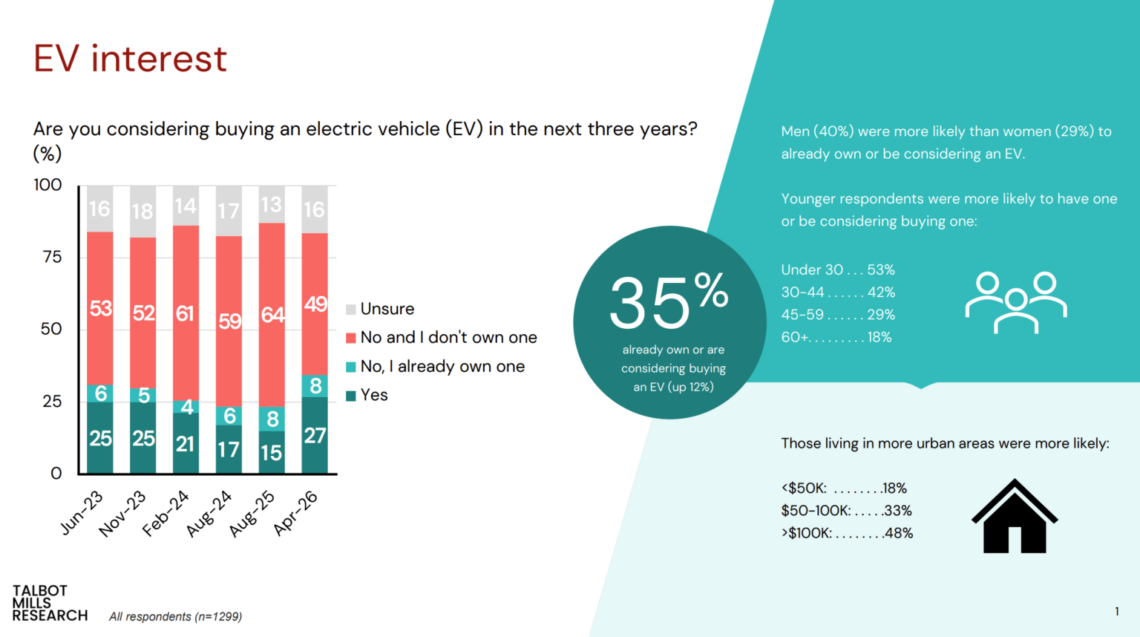
The rise in interest is being matched by activity on the network, with ChargeNet recording seven consecutive weeks of more than 20,000 charging sessions through to the end of April, including four weeks above 22,500 sessions.”
ChargeNet says early modelling work with Rewiring Aotearoa indicates some New Zealand households could be around $75 a week better off leasing a new EV compared with financing an older petrol vehicle, once fuel savings are taken into account.
New Zealand has fallen behind on EV adoption, but we can catch up. And, as Gavin Shoebridge showed, this is what a transition looks like.
Keep it down
We often talk about the need for cheap electricity to get the economic benefits of electrification. And a new OECD report shows that our wholesale prices have increased at one of the highest rates of any country in the group.

Countries with more electric transport have been able to better insulate themselves from high fuel prices and countries where the electricity price was more closely tied to renewables - like Sweden, Finland, Norway, Canada and Iceland - were able to keep electricity prices low.
New Zealand could be one of those countries. We lack an energy strategy, and the Government has proposed building an LNG terminal to deal with our dry year issue, but the report says clearly that it is unlikely to make electricity any more affordable because it ties electricity prices to gas prices, something we have said from the start.
High energy prices in New Zealand have been blamed for multiple business closures in recent years, but cheap renewable electricity should be seen as a solution to the deindustrialisation and productivity issues we are currently witnessing.
Quick as a flash
When you can fill up with electrons faster than fuel, one of the main barriers to EVs on long trips disappears. We’ve shown off BYD’s flash charging before, but it claims to have 5,000 chargers, it’s been successfully tested in the Mongolian desert and it’s now expanding to other markets.
BYD has started rolling out 1.5MW Flash Chargers in Europe and hopes to have 200–300 stations in the next few months.
BYD also plans to introduce three charging stations in Australia by October when it launches its premium Denza brand there.
“In New Zealand, too, the Chinese automaker plans to deploy these high-output chargers first at Denza dealerships, although it has yet to disclose the initial footprint or locations.”
Very few EVs will be able to charge at that rate, but new cars will and it’s thought the new Atto 3 will be able to.
Truck charging will also be needed in New Zealand. And, given the seat’s in the middle of the new Tesla Semi, just like the Windrose, we might see a few on New Zealand roads.
Bull at a gate
Nat Bullard is always a wealth of information on energy. He joined Derek Thompson to discuss the macro changes we’re seeing as a result of war in the Middle East and the potential for economies to electrify.
His decarbonisation presentations are also worth a look and this graph from his 2026 version stood out.

Wood for the trees
If you missed the world-first in last week's rundown, here’s a video that explains an electric world first in the forest, with a 400kW fast charger being installed “to service a fully electric loader and newly introduced electric logging truck bought by Rotorua Forest Haulage”.
Old Man Gas will be featuring in a few newspapers and billboards this week discussing the proposed LNG import terminal. Not surprisingly, he has his justifications, but they don't stack up. It is a multi-billion dollar tax on Kiwis that many experts and sector players think is unnecessary.
Read moreDownload"The sentiment around making the electricity market fairer and cheaper for customers is great, but there's still something missing." That's Rewiring Aotearoa CEO Mike Casey's summary of Act's energy policy announcement today.
Read moreDownload