Don't listen to Old Man Gas. Ditch LNG. Support New Zealand-made energy!


World Energy Council shows cost is now the biggest issue in New Zealand's energy sector; more New Zealanders running on the sun; as reality catches up with gas users, the Google data tells a story in Australia; focus on the benefits for climate comms; electric events FTW; and Tom Sainsbury gets dirty for Uber Electric

Costs keeping us up at night
The World Energy Council has just released its latest Issues Monitor survey, which basically looks at what keeps energy professionals awake at night and busy at work. And New Zealand has some bright spots and blind spots.
The key insight for New Zealand was that the top issue shifted from infrastructure in 2024 to affordability in 2025. There is lots about the gas shortage, and also that New Zealand (more so than other countries) scores low on community engagement.
One of the key blind spots in New Zealand’s energy landscape continues to be community engagement. Societal engagement and energy literacy rank low on the country’s issues map for perceived uncertainty and impact, yet these factors are crucial in ensuring public support for energy initiatives. The World Energy Council (WEC) has highlighted that neglecting local sentiments can stall or derail projects, reinforcing the need to ‘humanize energy’ and better align political will with citizen needs.
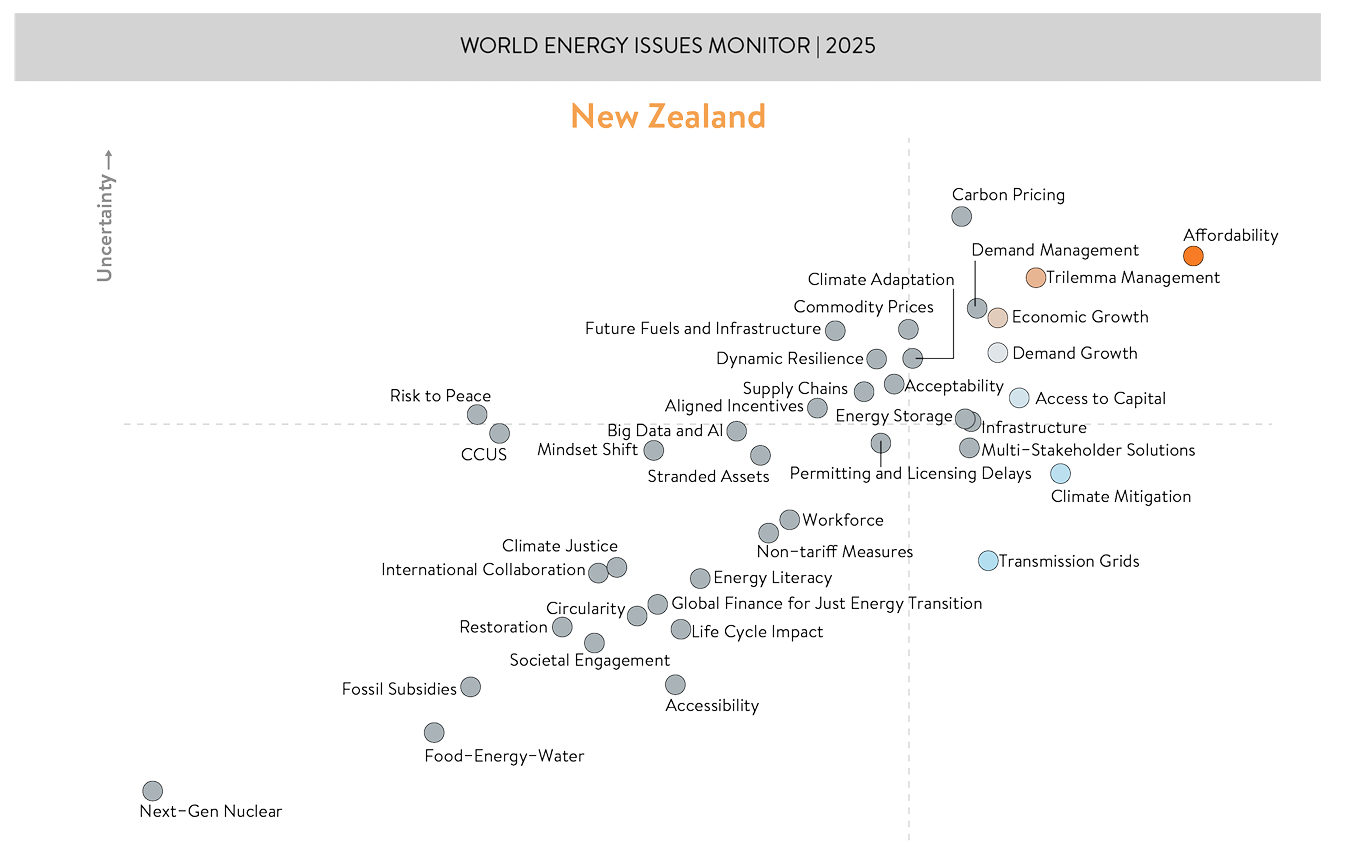
Despite the challenges facing its energy sector, New Zealand continues to be an early mover and innovator. The country’s abundant renewable energy resources position it well for ongoing transition efforts, and the combined efforts of private and public enterprises have helped leverage diverse stakeholders to tackle emerging challenges. While concerns persist regarding gas sector shortfalls, rising peak electricity demand, and blackout risks, demonstrated in 2024, New Zealand remains resilient. It ranks among the top ten countries in balancing the energy trilemma, a testament to its strong regulatory framework and adaptability in the face of evolving energy needs.
We’re trying to do something about prices and low engagement here at Rewiring. That’s why we advocate so strongly for rooftop solar, because it’s the cheapest electricity households can get, and that's why we are focusing on growing our community groups. We can now claim 36 of them, all doing what’s most needed in their communities.
For the recent submissions to the EA, we helped many of those community members submit, and as energy prices continue to rise for households and big and small businesses, the pressure is mounting on politicians to actually do something about it.
Summer sun
There are plenty of solar folks showing off solar generation on their apps at the moment - and that's increasing as solar installs grow. Transpower is celebrating it too.
“Grid-connected solar on average delivers more than 1% of this generation mix - more in summer and less in winter - which is more than what we've seen in previous years. Better yet, in November we're on track for total solar generation in Aotearoa to make up 3.5% of our generation mix, or around 100,000 megawatt hours! This includes both grid-connected solar and the solar panels people install on and around their homes and businesses.
As more grid-scale solar farms are connected to the grid and become operational, solar's percentage will only increase alongside the growth in overall renewable energy generation.
There are several large solar farms in the pipeline, and we're looking forward to seeing the sun on the rise!


We believe there should be a lot more rooftop solar, and the little blue line of batteries needs to grow significantly. Check out our solar streets map to see how much solar is in your neighbourhood. We've just added TOP Energy up north and some of PowerNet's customers down south.
Gaseous play
Rewiring Australia CEO Francis Vierboom writes in Renew Economy that while the debate around climate continues, the “economic fundamentals have shifted for households, and reality is about to start catching up.”
If you want to save money on energy bills in 2025, there’s a straightforward answer. You can unsubscribe from fossil fuels, and switch to all-electric appliances and vehicles.
Rewiring Australia’s latest research found that the average home that switches from gas appliances and petrol cars to all-electric options saves about $4,100 a year, including the upfront and finance costs.

As he points out, twice as many people now search on Google for 'induction cooktops' as 'gas cooktops'? The two search terms were basically even until 2021. The word is getting out!”
And it's a no-brainer given the health impacts of indoor gas use.
Selling the sizzle
Speaking of getting the word out, the culture has shifted on emissions (with New Zealand a pretty clear example of that in action), so how do you get people to care? Writing in industry title Mumbrella, Patrick Leyland, who worked for the Australian Labour Party in the past, says it’s about focusing on the benefits, not the issues.
As he says:
Talk about net zero and people hear rules and costs. Talk about clean industry hubs, local jobs, and Australian-made power, and they hear ambition, opportunities and prosperity. The best marketing always answers a simple question: what’s in it for me? Climate communication too often forgets to.
This is something we try to do at Rewiring. And, as Mike Casey often says, it’s all about telling a better story than the other guys. When the economics are front and centre and the environmental benefits are an added bonus, that’s when things start to change.
The Kiwis in Climate group is also getting the word out and is about to release a book.
Voices for Climate Solutions in Aotearoa New Zealand brings together bold and practical visions for Aotearoa to lead on climate. This inspiring collection from over 30 New Zealanders explains how climate solutions can improve our lives, from cheaper energy to job creation and healthier communities. Ten years on from the Paris Agreement, this book showcases the opportunities for New Zealand in acting now to protect our future. Launching in March 2026.

Pre-order it here.
Electric Santa
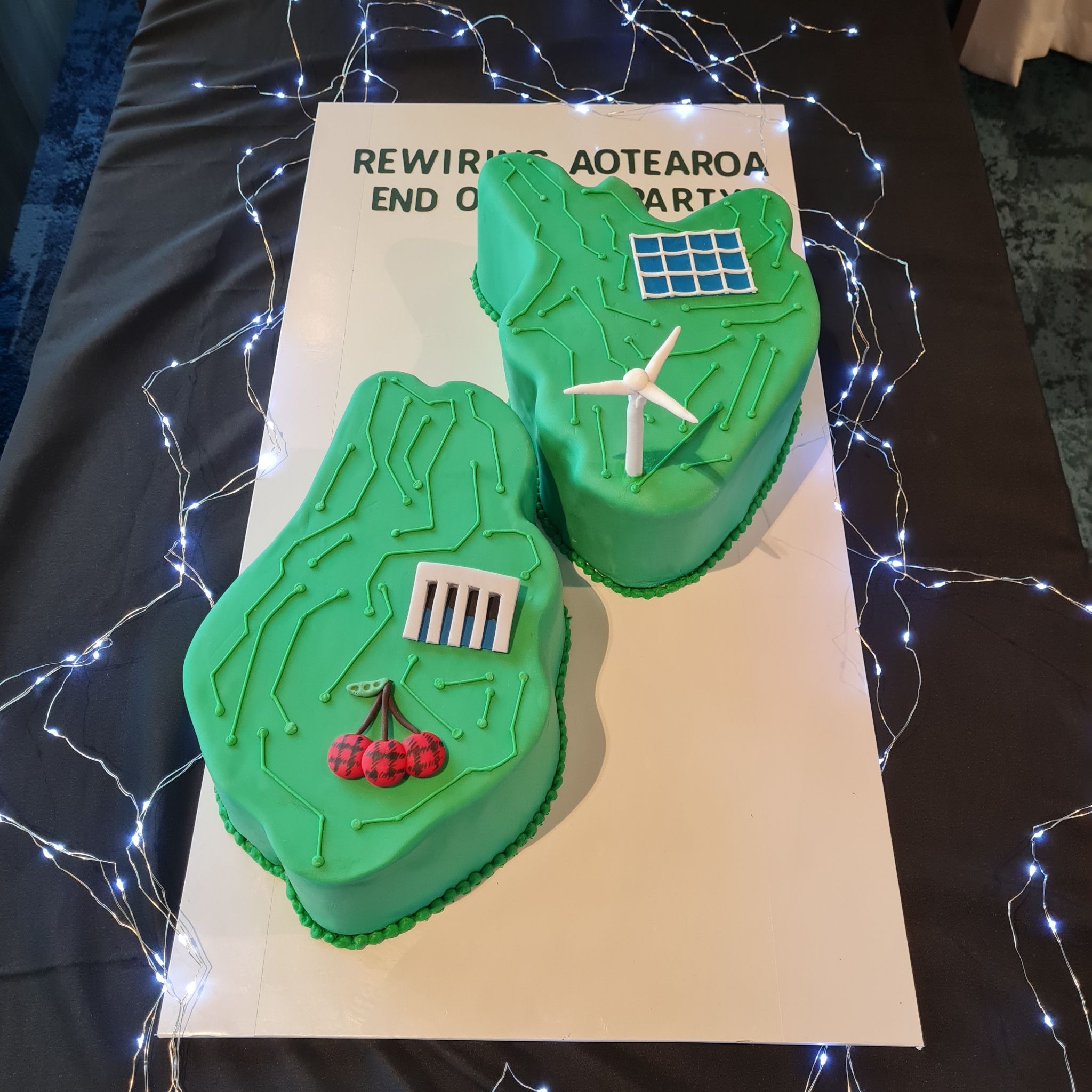
Rewiring’s electric Christmas party took place on Thursday night and it was generously hosted by Ecotricity. Mike Casey presented the vision for 2026 (electrify everything, electrify everyone, electrify New Zealand), and EV expert Gavin Shoebridge talked about the big shifts he’s seen this year (cheap, good quality Chinese EVs are here and big electric trucks are coming). The electric New Zealand cake was also a thing of beauty.
Another event that Rewiring was also heavily involved with, Electrify Queenstown, won the Legacy Award and the Excellence in Environmental Sustainability
awards at the inaugural Bizzies – Aotearoa Business Events Awards 2025.

These awards recognise the significant and growing impact of the event to accelerate electrification.
This achievement reflects:
• the strength of our partnerships across business, community, and government
• the leadership of sustainably run business events
• the momentum building around practical, scalable climate action
• our shared commitment to long-term regional resilience
We loved being involved in this year’s event (and pushing hard to run the first one in 2024) and our team is looking forward to an even bigger event next year.
Tennis, anyone?
We wrote about Uber’s new electric option a few weeks back and it’s great to see more drivers hopping onboard - for their own savings, but also so that more people get to experience what an EV is like.
New Zealand comedian Tom Sainsbury has been called on to promote the electric rides and there are double entendres galore.
“I had my first time last week, and I’m not going back.” We've heard that before.
Political Power has gone local! Dr Nick Smith, mayor of Nelson and ex-National Party minister, is an early adopter when it comes to electric machines but, through his efforts with the council and his close involvement with the Ratepayer Assistance Scheme, he's also embracing one of Rewiring's core mantras: once you've electrified your own life, electrify someone else's life, too.
Read moreDownloadWhether it's the growing number of electric buses, new electric trains for the lower North Island and City Rail Link, or new electric ferries, we love seeing more electric transport options in our big cities. It's also good to see some of our smaller cities like Palmerston North, Timaru and Nelson going electric and, as is almost always the case, the drivers reckon it's better on electrons. At the Electrify Nelson expo, we spoke with one driver Lee about the city's electric buses. And he definitely wouldn't go back to diesel.
Read moreDownload