Don't listen to Old Man Gas. Ditch LNG. Support New Zealand-made energy!



First 32 Solar on Farms demonstration grants handed out by EECA, more farmers running on the sun for bill reductions and resilience gains, BYD flashes everyone with its super fast charging and gets set for V2G, China drops a 10,000 ton electric container ship; why more electricity in more electric machines is the big climate story of 2026, how a coal museum in Kentucky got solar, and a bit of heat pump humour and LNG levity.

Sunny country
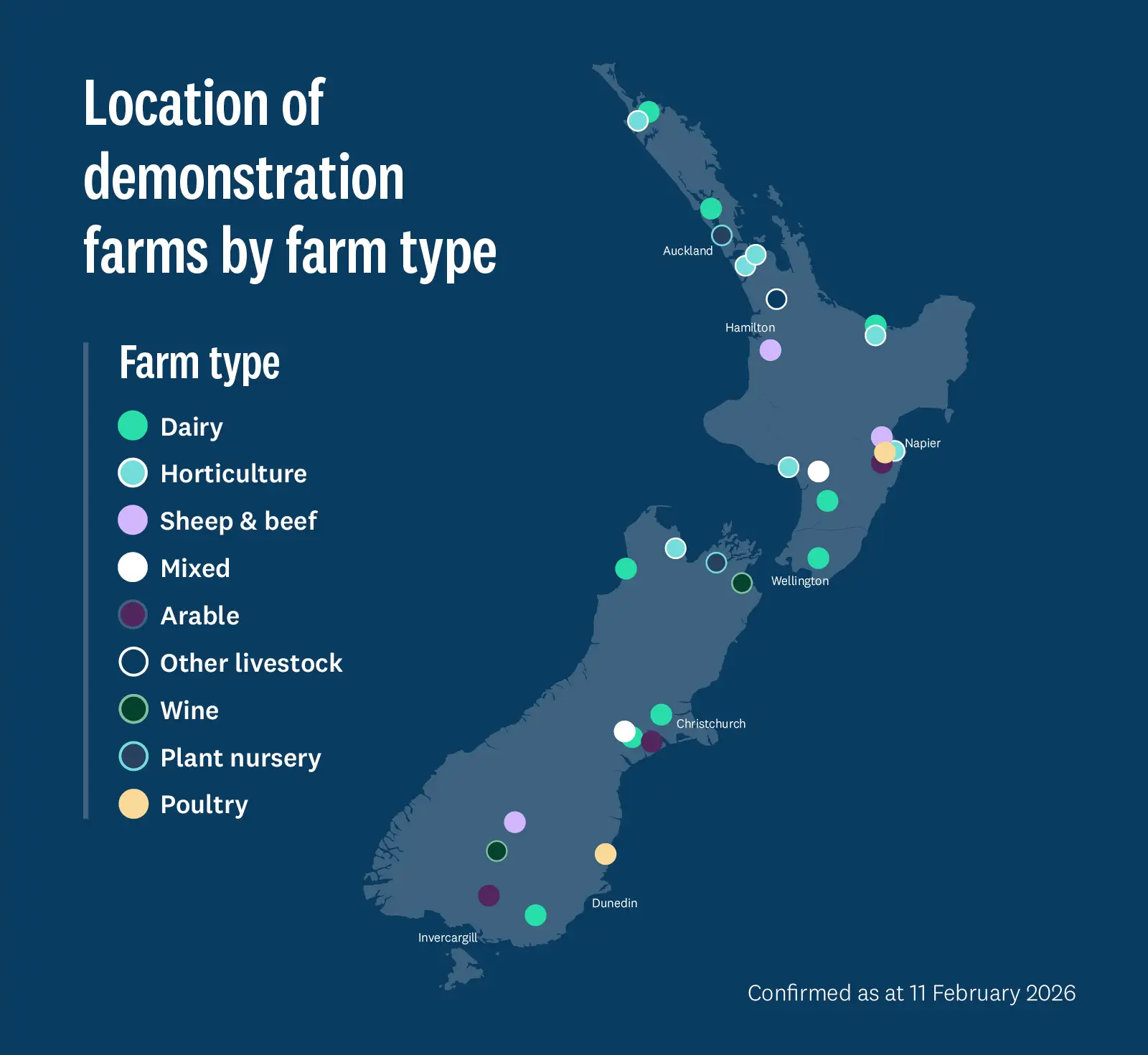
We’re loving the effort EECA is putting into promoting solar, both at the residential and rural level. And it has just announced the first 32 demonstration farms as part of its solar on farms programme.
Early EECA modelling suggests that if 30% of Kiwi farms installed larger systems already used on some properties, they could generate up to 10% of New Zealand’s current electricity demand - a major opportunity for cost reduction, resilience and energy security.
Following significant interest, 40 farms were selected across a range of farm types from dairy and sheep & beef to horticulture, poultry, nurseries and wine. The farms will receive partial funding and share performance data, lessons learned, and host on-farm demonstration events to support wider sector uptake.
The announcement was made at Balle Bros Group Ltd in Pukekohe. It is getting a helping hand to install a 216kW solar system on their packhouse roof, and a 116kWh battery.
"With high daytime energy demand from chillers and rising electricity costs, it’s a strong example of solar aligned with operational load."
Solar makes sense for farmers without a grant, but as Gerhard Uys writes in Farmers Weekly, it's not clear how many have solar.
As Mike Casey told him:
Farmers can contribute to the New Zealand electricity system when it needs it most, during winter, exporting energy when cows are dried off and orchards don’t produce fruit, easing pressure on generators … The cost of commercial solar varies, but could be as low as a third of the price of power from the grid, and as low as a fifth to a 10th the price of diesel, if diesel is used to generate electricity, Casey said. He knows of sawmills, dairy, and pig and chicken farmers using solar. Farmers can help New Zealand move away from importing fossil fuels, he said.
There are also some major resilience benefits for farmers - and particularly dairy farmers. With a large payout to famers from Fonterra’s sale of its consumer brands this year, we hope more of them will decide to invest in resilience that pays for itself every day through lowering electricity bills.
Like these guys:
Southland dairy farmer Chris Stewart and his business partner use solar because it ticks environmental boxes and creates business resilience. They run the entire farm off solar, including fences, pumps and chilling milk. “We charge [batteries] using night rates to start the morning off. When the sun comes up it helps finish off milking and chilling. Solar then generates enough energy to do the afternoon milking and start the battery charging process.”
The farm runs on 137 solar panels generating around 70kW of power, with 200kW of battery storage. During recent Southland wind storms and power cuts they milked twice a day without dumping milk.
Quick as a flash
BYD continues to push the boundaries with its EV innovations and its ‘flash charging’, which promises to take cars from flat to full in around five minutes, is 'hopefully' going to be in New Zealand by the end of the year.
BYD New Zealand says it will have cars capable of charging at up to 1000kW (one megawatt) in the country as early as this year, with the beginnings of a charging infrastructure to follow.
For context, BYD's current Sealion 7 SUV can charge at a maximum rate of 150kW. ChargeNet's fastest Kiwi Hypercharger DC stations can deliver up to 300kW, although there's only a select group of EVs that can accept that speed (some can theoretically do more though, such as the Zeekr 7X).
This means charging would be about as quick as filling up with fuel and while general manager Warren Willmot suggested you wouldn’t need a charger at home with those speeds, it’s important to remember that most charging still happens slowly at home, generally when you’re asleep (if your petrol car is being filled up as you sleep, something’s gone horribly wrong).
Fast charging is also very expensive, to the point where if you only used fast-chargers it would cost more over its lifetime than a fossil fuel vehicle.
V2G is another technology BYD is pushing and, just as the Queenstown Electrification Accelerator team has announced the first two-way charger is up and running for testing at the Remarkables Market, Willmot said it would be a standard feature of its cars by next year.
We like big boats and we cannot lie
Not content with dominating EV, solar panel, heat pump and other electrotech manufacturing, China is also currently conducting trials of the first 10,000-ton electric container ship.
It has 10 containerised batteries and can generate up to 19,000 kWh and reach a top speed of 11.5 knots (about 21kmh).
Fast charging at the port or battery swaps will be possible. There are also solar panels to provide additional power.
We need to get a lot more of those EVs over the New Zealand and on our roads. And it might not be long before they're coning on an electric boat. We just need to get those big boys up on the foils! Let's hope they're talking to Vessev.
The revolution will be electrified
Here is a phrase that Rewiring can get behind: Electrification, not decarbonisation, is the big climate story of 2026.
Ember's Kingsmill Bond (who isn't a spy) joins the Bloomberg Zero podcast to discuss the electrotech revolution (which isn’t a dance craze). Instead, it’s a suite of technologies like solar and wind, electric vehicles, and all the connections between those things, like batteries and smart grids.
As its paper said: “Humanity is graduating from burning fossil commodities to mastering manufactured technologies—from hunting scarce fossils to farming the inexhaustible sun, from consuming Earth’s resources to merely borrowing them. This isn’t a marginal climate substitution. It’s an energy revolution.”
Buried sunlight

It’s pretty clear the writing is on the wall for old fossil tech. They will stick around for a while, and those with vested interests will delay the inevitable, but the smart countries, states and communities - like Harlan County in Kentucky - are embracing renewable tech.
Harlan County used to be a ‘Cadillac coal town’. But the black gold stopped providing and one old miner decided to look into renewable energy to try and get the town's mojo back.
Eleven years ago, a third generation coal miner called Carl Shoupe decided to do something about his area’s economic slump. He started researching renewable energy, still a nascent industry then, and preaching what he learned. To many of his neighbors, his words were heresy.
“They were calling me every kind of turncoat,” Shoupe said. “We took some abuse, man, let me tell you. They cursed us and called us everything in the world, saying we were trying to cut down the coal industry.
He helped a woman fix up her house and halved her electricity bill and then, in what some felt was comical irony and others saw as moving with the times, the coal museum in Kentucky installed about 80 solar panels on its roof in hopes of saving money on energy.
Coal is occasionally called buried sunlight because photosynthesis is required to create the tree that eventually turns into coal. You could argue that solar just cuts out the middleman and shortens the timeframes.
Pump it real good
The energy and climate space can get a bit serious sometimes, but this campaign in the UK for Parents for Future UK brings some hilarity to the heatpump.
Writer Rose Johnson said: “I like a challenge, so when Parents for Future came to me and asked “Can you make heat pumps funny?”. I jumped at the opportunity. Comedy and the climate crisis might not seem like natural bedfellows, but laughter is a great engager, and if this sketch encourages even one person to look up “What actually is a heat pump?”, then I’ll consider it a success.”
And while we're on the topic of comedy, this satire from Greenpeace of the LNG terminal decision was very well done.
Old Man Gas will be featuring in a few newspapers and billboards this week discussing the proposed LNG import terminal. Not surprisingly, he has his justifications, but they don't stack up. It is a multi-billion dollar tax on Kiwis that many experts and sector players think is unnecessary.
Read moreDownload"The sentiment around making the electricity market fairer and cheaper for customers is great, but there's still something missing." That's Rewiring Aotearoa CEO Mike Casey's summary of Act's energy policy announcement today.
Read moreDownload