Don't listen to Old Man Gas. Ditch LNG. Support New Zealand-made energy!

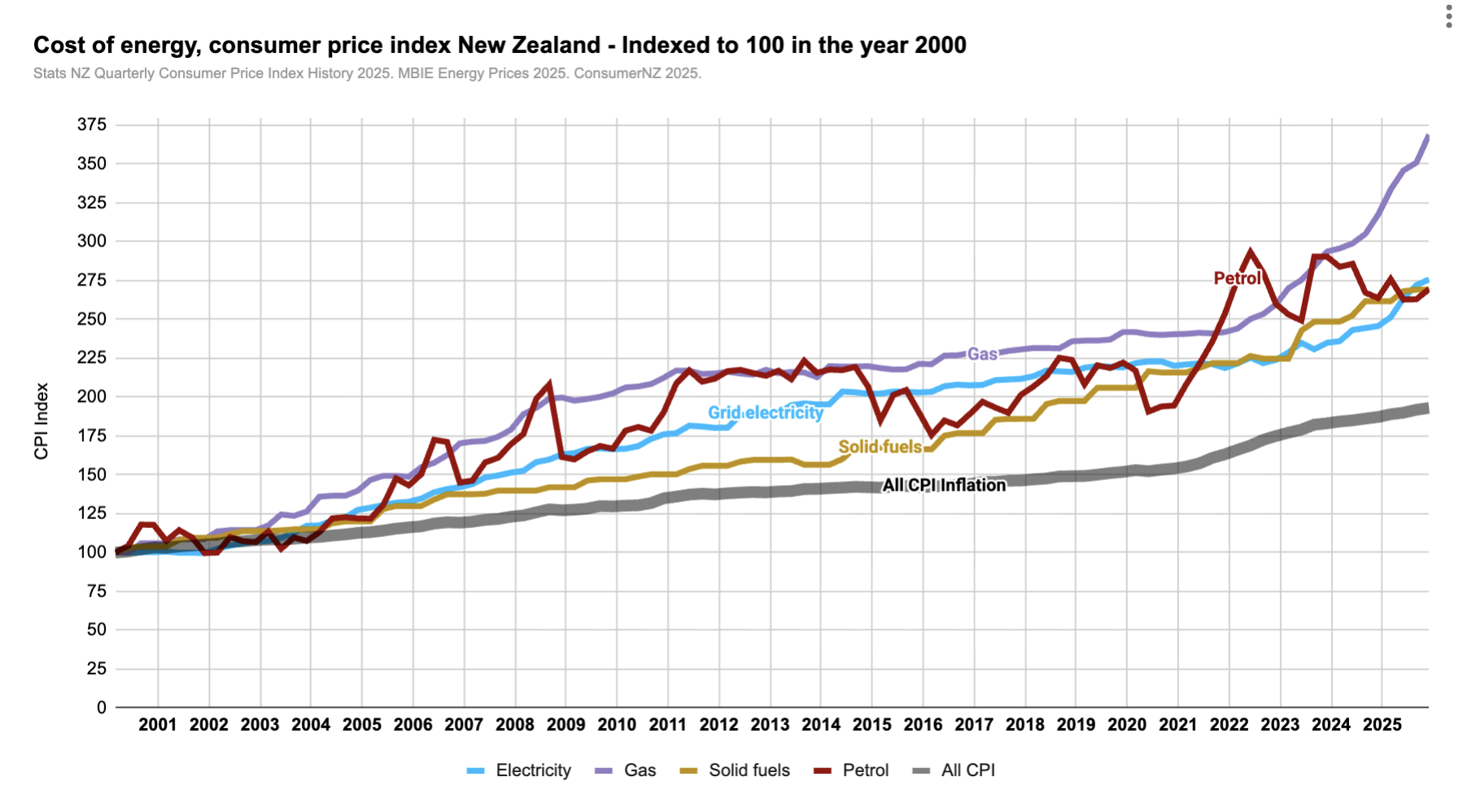

Consumer is calling on 100,000 New Zealanders to sign its petition demanding government action on soaring power prices.
“In just two years, electricity prices have surged 20%, and many households across New Zealand are feeling the strain,” says Jon Duffy, Consumer chief executive.
Consumer research found one in four households struggled to pay their power bills in the past year, and over half of New Zealanders are concerned about the cost of their household’s energy.
“In a country powered mostly by cheap renewable electricity, more than a million households should not be worrying about the cost of energy. But that’s the reality,” says Duffy.
Earlier this year, the major electricity companies reported combined half-year profits of more than half a billion dollars.
“While the big power companies rake in hundreds of millions in profits, more and more people can’t afford to heat their homes properly. Last year alone, more than 30,000 households were disconnected because they couldn’t pay their power bills,” says Duffy.
Consumer’s four-point plan sets out the changes needed to bring power bills down.
• End the dominance of the big four power companies – ensure separation of generation (making power) and retail (selling power) so smaller power companies can compete, which should lead to lower prices and more choice for consumers.
• Make power prices reflect real costs – sort out the market so consumers stop paying high fossil fuel prices for cheaper renewable energy.
• Invest in more homegrown energy – so we have enough power for years with less rainfall and reduce our reliance on expensive coal and gas.
• Set a long-term plan together – develop a cross-party energy strategy to put affordable power ahead of politics and vested interests.
“You can’t untie this knot with one pull,” says Duffy. “Fixing the electricity sector will take action on multiple fronts. Right now, the market is delivering for power companies, not people – and that must change.”
Lower prices and competition that were heralded in the Bradford reforms of the late nineties have not been delivered as promised.
“We have given the current system a fair crack, and more than 25 years later, we can confidently say the market is not delivering for consumers. We need a long-term strategy, with cross-party buy-in, that puts affordable power ahead of politics. It is not feasible to continue down the path we are on. New Zealanders support change. More than half the nation say energy issues will affect how they vote. Our petition is a way people can directly send a message that’s impossible for politicians to ignore – it’s time to act, and power bills must come down,” says Duffy.
The petition is open until mid-August.
Political Power has gone local! Dr Nick Smith, mayor of Nelson and ex-National Party minister, is an early adopter when it comes to electric machines but, through his efforts with the council and his close involvement with the Ratepayer Assistance Scheme, he's also embracing one of Rewiring's core mantras: once you've electrified your own life, electrify someone else's life, too.
Read moreDownloadWhether it's the growing number of electric buses, new electric trains for the lower North Island and City Rail Link, or new electric ferries, we love seeing more electric transport options in our big cities. It's also good to see some of our smaller cities like Palmerston North, Timaru and Nelson going electric and, as is almost always the case, the drivers reckon it's better on electrons. At the Electrify Nelson expo, we spoke with one driver Lee about the city's electric buses. And he definitely wouldn't go back to diesel.
Read moreDownload