Don't listen to Old Man Gas. Ditch LNG. Support New Zealand-made energy!

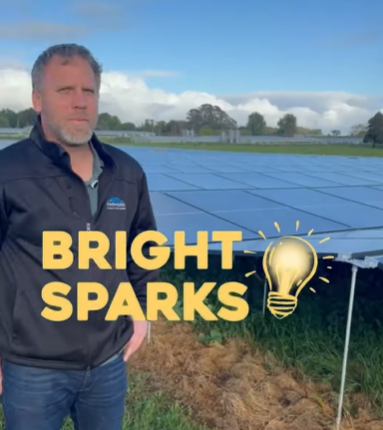

Solar is already cheap and an increasing number of farmers are discovering that, but Mattt Luscombe has found a way to make it even cheaper. The founder of FarmGen says architects like steel, but engineers like efficiency and taking steel out of the build and instead relying on ground anchors means the owners get more generation for less outlay.
His 1.4 megawatt system has 4000 panels set up at lower angles to reduce shade impact. This is about twice the number a typical system in that space would fit.
Because it's modular and has pre-set sizes, his team can install these systems a lot faster than the traditional approach. That saves money as well and it ends up being about half the cost of a domestic rooftop installation.
Farmers often have unused or unproductive chunks of land where these systems can sit. And while Rewiring was pleased to see more support and demonstration grants from EECA for farmers looking to get solar and batteries, plenty of keen farmers missed out. As a way to help them get what they want, Luscombe says he will match those deals.
When farmers go solar, they start to look at other ways of using the cheap, clean energy they're creating. And that's when we'll start to see more electric machines on farm.
Political Power has gone local! Dr Nick Smith, mayor of Nelson and ex-National Party minister, is an early adopter when it comes to electric machines but, through his efforts with the council and his close involvement with the Ratepayer Assistance Scheme, he's also embracing one of Rewiring's core mantras: once you've electrified your own life, electrify someone else's life, too.
Read moreDownloadWhether it's the growing number of electric buses, new electric trains for the lower North Island and City Rail Link, or new electric ferries, we love seeing more electric transport options in our big cities. It's also good to see some of our smaller cities like Palmerston North, Timaru and Nelson going electric and, as is almost always the case, the drivers reckon it's better on electrons. At the Electrify Nelson expo, we spoke with one driver Lee about the city's electric buses. And he definitely wouldn't go back to diesel.
Read moreDownload