Don't listen to Old Man Gas. Ditch LNG. Support New Zealand-made energy!

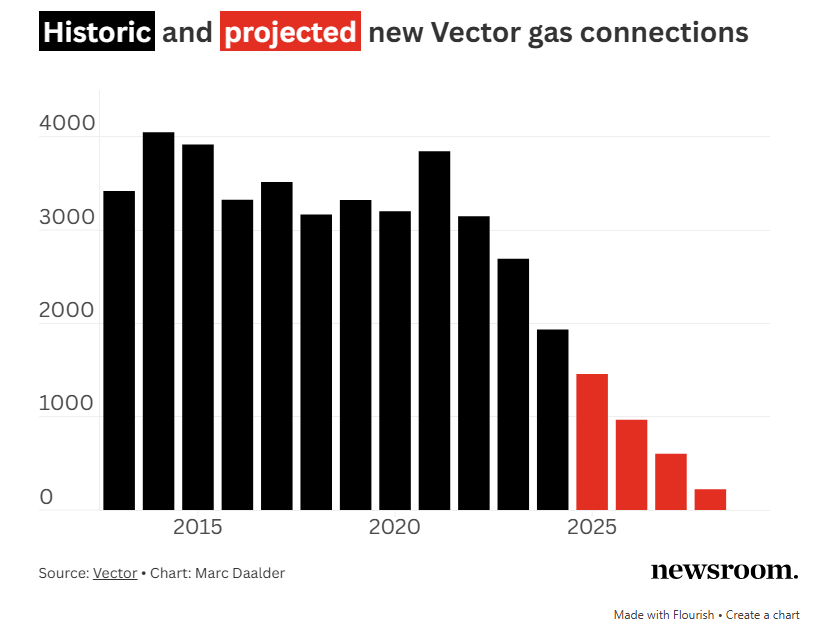

Marc Daalder reports on Vector's declining gas network and how it is responding to falling customer numbers. As he writes: "Gas in Auckland is formally past its peak in the latest forecasts from Vector, the city’s only gas distribution business, with new connections set to fall to zero in three years ... From 2029, there would be no new residential or commercial connections – with new industrial connections projected to have already ceased this year."
"This particular estimate is more important than usual, because it shows Vector believes its gas network has peaked in size. As disconnections outpace new connections, residential and commercial gas use will ultimately decline."
... Every year, 40,000 gas hot water systems are installed in New Zealand homes, with an expected lifetime of 15 years. A new system installed next year, then, could still be trucking along by the time Vector thinks it might be winding down its network.
We need to make sure there is a managed transition to avoid the gas death spiral, where those who are stuck on the network are burdened with the costs of maintaining it. We laid out this scenario in our explainer, a bad case of gas. And if you're building new or considering an upgrade, don't invest in the wrong tech.
Political Power has gone local! Dr Nick Smith, mayor of Nelson and ex-National Party minister, is an early adopter when it comes to electric machines but, through his efforts with the council and his close involvement with the Ratepayer Assistance Scheme, he's also embracing one of Rewiring's core mantras: once you've electrified your own life, electrify someone else's life, too.
Read moreDownloadWhether it's the growing number of electric buses, new electric trains for the lower North Island and City Rail Link, or new electric ferries, we love seeing more electric transport options in our big cities. It's also good to see some of our smaller cities like Palmerston North, Timaru and Nelson going electric and, as is almost always the case, the drivers reckon it's better on electrons. At the Electrify Nelson expo, we spoke with one driver Lee about the city's electric buses. And he definitely wouldn't go back to diesel.
Read moreDownload