Don't listen to Old Man Gas. Ditch LNG. Support New Zealand-made energy!

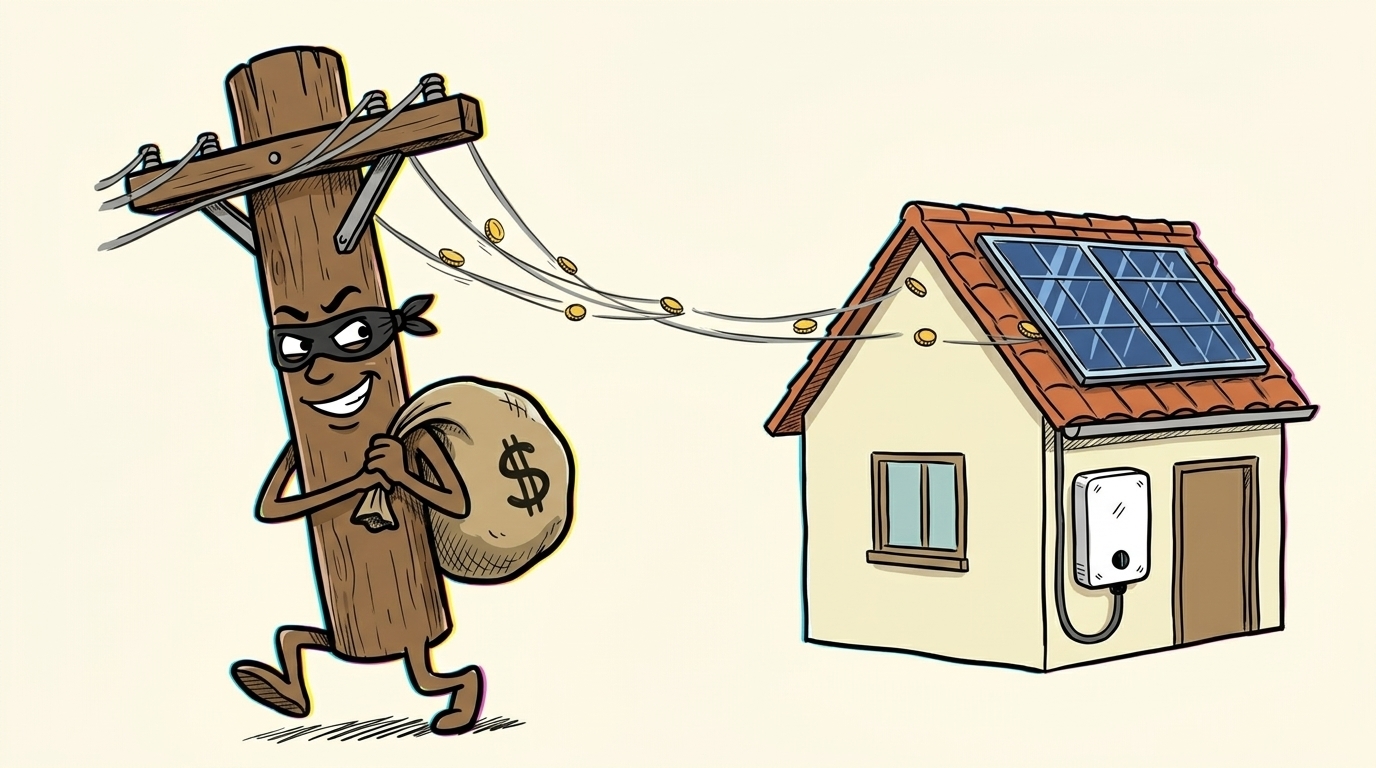

If you've got solar, the best option is to use as much of it as possible to avoid high grid prices, but being paid to export energy is a nice cherry on top. It means many New Zealanders end up getting paid by their power company and shorten the payback period of their systems. Regulatory changes that meant customers would be paid more for exporting at peak times were meant to make batteries more appealing to customers and reduce the need for more investment in expensive poles and wires, but, as Marc Daalder writes in Newsroom, some retailers are not passing on the full value of those exports.
Rewiring CEO Mike Casey said the failure to pass on the full rebates was tantamount to clipping the ticket for no added value.
“We’ve been calling it energy scalping, essentially, which I think is about the best way of describing it."
By not passing on the full rebates, retailers risked being the cause of increasing consumer bills over the coming years through encouraging unnecessary building of poles and wires.
“There is a massive capex bias at the distribution layer to build more poles and wires, which is not necessarily the cheapest pathway forward for the customers of New Zealand. And if you’re not passing on the pricing, you’re not influencing consumer behaviour and if you’re not influencing consumer behaviour, then ultimately poles and wires becomes the default option.”
Further upstream, there appears to be a bit more 'energy scalping' going on.
The Electricity Authority told the lines companies to calculate how much batteries are worth to them for lowering future investment in lines. And then it allowed them to place an invented “adjustment factor” - with very little evidence or hard data required - that meant they could reduce the amount they pay customers.
Many of them reduced the value by 80%. One by 95%. And the average was a devaluation of around 50%. The regulator that is paid to protect energy consumers encouraged energy companies to create a devaluation factor for consumer energy and treat it as less valuable than they know it is.
There has long been a supply side bias that unnecessarily increases consumer bills, but having the regulator actually encourage this bias is quite shocking when they are meant to represent the interests of everyday New Zealanders.
It's good to see the EA mandate a 10kW export limit, but it often feels like one step forward, two steps back.
At a time when we should be making it more appealing for New Zealanders to produce their own energy, the incumbents find a way to protect their interests and the regulators don't fight hard enough to make customers a bigger part of the energy system and, at times, actively discourage actions towards this.
We believe you should be paid fairly for your contribution based on what it’s worth, not treated differently because you are a home or business rather than an energy company.
We could be unlocking mass investment by consumers in the energy system just by having a level playing field on energy, but we are slowing this down by having a bias that ultimately results in higher energy bills.
Political Power has gone local! Dr Nick Smith, mayor of Nelson and ex-National Party minister, is an early adopter when it comes to electric machines but, through his efforts with the council and his close involvement with the Ratepayer Assistance Scheme, he's also embracing one of Rewiring's core mantras: once you've electrified your own life, electrify someone else's life, too.
Read moreDownloadWhether it's the growing number of electric buses, new electric trains for the lower North Island and City Rail Link, or new electric ferries, we love seeing more electric transport options in our big cities. It's also good to see some of our smaller cities like Palmerston North, Timaru and Nelson going electric and, as is almost always the case, the drivers reckon it's better on electrons. At the Electrify Nelson expo, we spoke with one driver Lee about the city's electric buses. And he definitely wouldn't go back to diesel.
Read moreDownload