Don't listen to Old Man Gas. Ditch LNG. Support New Zealand-made energy!


Following the announcement of some major electrification and energy security-themed policies at the Greens’ State of the Planet address over the weekend, Rewiring Aotearoa CEO Mike Casey is asking all politicians to pause and think about what their own parties have been saying over the last few weeks, because much of what Marama Davidson and Chlöe Swarbrick discussed is agreed across parties.
The Prime Minister, just four days ago, said the fuel crisis is “an opportunity for New Zealand frankly, an opportunity for us to build greater security, energy security, economic security, here at home, and build a better New Zealand over this time".
Labour leader Chris Hipkins said “now is the time to invest in homegrown renewable energy that protects us from global price shocks”.
And Winston Peters in his State of the Nation speech last month stated: “New Zealand First believes energy security is national security. It underpins everything - our households, our jobs, our industries, and our resilience as a nation… It’s hitting Kiwi families. It’s hurting our industries. And it’s costing New Zealand jobs. It’s time to secure our electricity system for all New Zealanders.”
Recently, Casey spent a couple of hours with ACT Leader and Deputy Prime Minister David Seymour, who studied electrical engineering and clearly understands the efficiency of electric machines in comparison to machines that burn fuel.
As Casey says: “He used a line I have since started using: ‘it’s not woke if it works’ and he committed to cutting red tape to reduce energy costs for New Zealanders."
Te Pati Māori has spoken compellingly in the House around energy security, getting off imported fuels and easing the cost of living. And the Opportunity's Party’s energy manifesto has electrification and New Zealand-made energy for the benefit of New Zealanders at its heart.
“From all our discussions with parties over the last few months, I know there is a shared commitment to a more resilient and secure energy future for New Zealand, anchored around affordable and abundant New Zealand-made Energy. Political parties will differ on the details of how we get there, but what New Zealanders need now is a clear direction. Whether you call it the National Electrification Plan, the New Zealand Made Energy Strategy, the energy sovereignty framework, or the Energy and Economic Productivity Pathway, I don’t care. What I do care about is meaningful action in the interest of New Zealanders."
Casey says electrification made economic sense before the fuel crisis, and it will make sense after, but the Middle East situation is a live demonstration of our vulnerability to imported fuel.
“This reliance costs New Zealand families and businesses dearly. Before prices started to rise, we were spending around $40m a day at the pump. That’s now risen to $65m per day. That’s a huge amount of money to be sending offshore. And this affects everyone, regardless of their politics.”
There is more geopolitical uncertainty than ever and the added risks of transporting oil products will now be priced into the system.
“That is not a partisan question. It is a practical one. It’s not about left or right, it's about right or wrong. It's about old, inefficient technology vs new, more efficient technology. It’s about the relative stability of relying on New Zealand-made energy vs the volatility of relying on imported energy. It’s about vested interests from companies, industries and countries with a lot to lose vs New Zealanders with a lot to gain.”
Casey says it was great to see the Greens pick up what Rewiring has been putting down, suggest a national electrification plan and back the idea of low-interest, long-term loans for electric upgrades through the Ratepayer Assistance Scheme, and that’s something most parties should be able to agree on.
“Cheaper home energy and lower transport costs are outcomes every New Zealander wants, and every party has campaigned on delivering that. But they haven’t delivered. Politicians of all stripes claiming they are putting ‘downward pressure on prices’ have not helped, so we need to help New Zealanders help themselves. Electrification is one of the most direct ways to do that and the Ratepayers Assistance Scheme is an excellent example of how the Government can step in to remove barriers and help Kiwis from a range of different demographics to access low cost finance for their homes and businesses.”
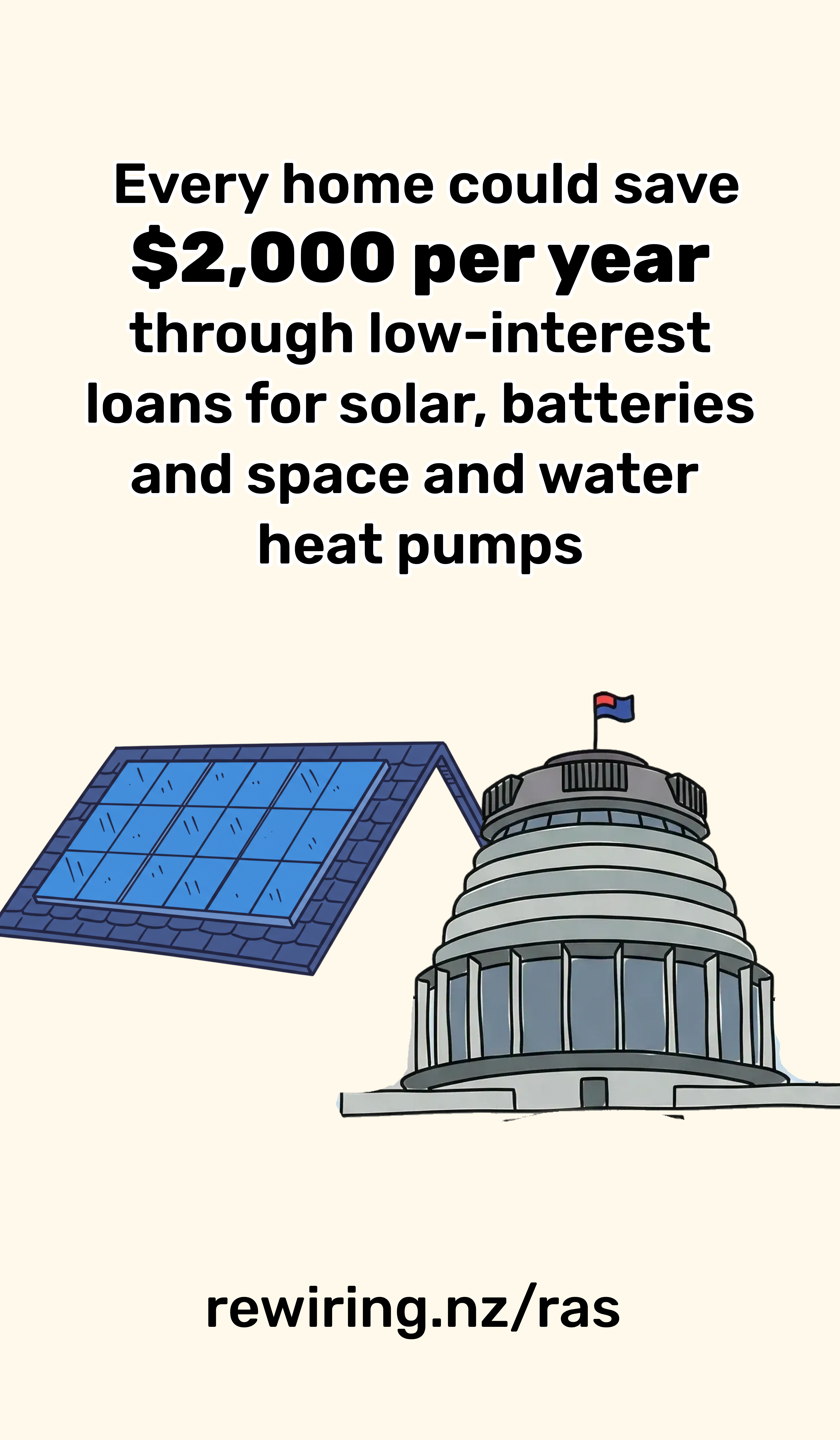
For households and pensioners - many of whom are unable to access bank finance - the RAS could save more than $1,000 a year with solar, including payments on a loan.
“And it could be twice that if you upgrade from gas to electric. Landlords could also use it to lower tenants’ bills while paying back their solar investment and increasing the value of the property.”
“We've been working with councils and the Government on exactly this - because it removes the upfront cost barrier without requiring direct Crown spending and a range of parties are interested in it. It’s a big idea and it could be the energy equivalent of the student loan scheme.”
While I absolutely want an 'Electric Election', with all parties competing to put forward the most ambitious electrification and NZ Made energy plans, New Zealand can't afford to wait. The current Government has time to do things like legislate to enable the Ratepayer Assistance Scheme and could speed up the adoption of electric vehicles with Fringe Benefit Tax Relief for businesses, novated leasing and accelerated depreciation.
Casey says we don't need subsidies to make solar economic, but where subsidies would help is if the Government wanted to speed things up, like they've done in Australia.
“Subsidies will encourage people with money or access to finance to go out and buy solar and batteries, but long-term, low-interest finance is more important because it means more New Zealand households, especially lower-income homes, will be able to access those technologies and save money from day one."
The opportunity to electrify goes well beyond the household, however.
“If we can extend that clean, affordable energy to businesses and industries, we can fundamentally improve their productivity and potentially reverse the deindustrialisation we’re seeing due to high energy costs.
“Lower cost New Zealand-made energy running through electric machines means more competitive exports, more resilient businesses, and more money staying in New Zealand rather than flowing offshore to fuel markets we cannot control.”
Political Power has gone local! Dr Nick Smith, mayor of Nelson and ex-National Party minister, is an early adopter when it comes to electric machines but, through his efforts with the council and his close involvement with the Ratepayer Assistance Scheme, he's also embracing one of Rewiring's core mantras: once you've electrified your own life, electrify someone else's life, too.
Read moreDownloadWhether it's the growing number of electric buses, new electric trains for the lower North Island and City Rail Link, or new electric ferries, we love seeing more electric transport options in our big cities. It's also good to see some of our smaller cities like Palmerston North, Timaru and Nelson going electric and, as is almost always the case, the drivers reckon it's better on electrons. At the Electrify Nelson expo, we spoke with one driver Lee about the city's electric buses. And he definitely wouldn't go back to diesel.
Read moreDownload